Kent Hovind and the Flat Earth, part 3

Kent Hovind Critises Flat Earth Believers

Continuing and concluding Kent Hovind’s remarks on the flat earth.

Click here to see the video.

Kent starts off by saying that he thinks that the resurgence of the flat earth theory is to criticize what Christians think or to justify what the Catholic church did years 500 years ago. This, of course, is wrong conclusion on his part. The flat earth has emerged because people are waking up and realising that what we have been told is not logical, it’s not what we see in reality, and it’s not biblical.

With the internet, people are exposed to more, they can do better research even than if they lived in the Library of Congress; and communication is much faster and wide spread. The same thing applies to other subjects that are not related at all to the flat earth, such as people waking up to the conspiracies and lies the government has been doing. So, Kent, the flat earth information is the not the result of a certain group of people who want to discredit Christians but true Christians finding out the truth of God’s Creation.

Kent says he appreciates the zeal of the flat earthers and he says, “They think they are defending the Bible but they aren’t.” Well, Kent, it is you and your friend who made this video who are not defending the Bible – when it comes to the flat earth; when it comes to your talk on Creation and Evolution, yes, but not here!

Many times Hovind said that the earth is a globe and that’s it. But it’s OK for Edrique to say (about 1:25 into part 3 video) to say, “If you are going to write and say, ‘The earth is flat, get over it,’ I will not respond.” So, it shows a double standard that these two people have!

4:00 Edrique goes into the example of traveling in a semi-truck going at 70mph and throwing a ball to the back of the truck. Now, we know, as flat earth believers that the speed of the ball is different relative to those who are on the ground watching the truck go by. WE have no problem with that, but the globe earth believers think we do and they think that this example explains the fact that we don’t feel anything on a spinning AND shooting forward earth. But this is not a correct analogy with us supposedly being on earth spinning at 1,000mph AND going around the sun at 67,000mph. All of this was explained in a previous Post here; it’s too long to going into it again.

6:10 “The atmosphere is traveling with it (earth),” so Hovind said. How can the atmosphere travel with any solid thing no matter what the speed? It can’t! If the earth were moving under our feet at 1,000mph, it would cause a tremendous amount of wind. Since humans are not attached to the earth but can move, walk, jump around, it would be impossible to be in one place. We would immediately be knocked to our feet, fall and ram into the next object still standing – IF there was anything standing. All of this is crazy talk when you stop and think of the physics of the whole thing. Yet, these two people talk as if everything was normal and their eyes are blind to the whole thing. It’s not just Kent and Edrique, as they represent the average person who believes in the heliocentric model of the universe.

With the above in mind, it shows that with propaganda given from all sources and hearing this from birth to the grave, it shows that humans can be fooled into believing the most outlandish thing. Remember when we believed in the globe earth, too? But I think that for us, when we think of the mechanics of the whole thing, we were able to wake up and realise our foolish belief; with others, they just can’t escape the impossibility of a spinning and traveling earth.

6:30 – 6:54 Kent was explaining about shooting a missile out of the atmosphere and you would miss your target by 200 miles. With this statement, what he is saying is, that there is something at this altitude that is not dragging the atmosphere along. Well, what is it Kent? After all, “we went to the moon,” and the Apollo space capsule did not go through anything. Of course, there is a Dome, or the Firmament, as the Bible calls it. But it’s purpose is something else: to keep the atmosphere contained in a stationary earth. For even a stationary earth will lose its atmosphere and gases if there is other space beyond it.

Again, how can gravity connect to some area outside the atmosphere and make even gases ‘stick’ to the earth and keep it in sync? It can’t. If you want to keep an object on the surface in the same place, it would have to be physically attached to it. Once this object, human or animal leaves contact with the spinning earth, it will fly away.

Note: This is not part of the video but it is a part of what Kent said in the past and what he is saying now. In the past, in one of his videos on evolution, he talked about the Law of Conservation of Angular Motion. He used this to demonstrable what the evolutionist believe in is wrong. Evolutionists believe – whom ALL are believers in the the heliocentric universe – that there are some galaxies along with planets that rotate in the opposite direction then the majority of planets and galaxies. Kent said that if the Big Bang is real, when the explosion occurred everything would have the same spin but it doesn’t. He said it violates the Law of Conservation of Angular Motion – which is true.

If you were to go to a school playground, and go on one of those small merry-go-rounds, where kids sit on it. If it was going in a clockwise direction, for example, and it was going faster and faster until the children couldn’t hold on any longer, they would fly off. They will also be spinning in the same direction as the merry-go-round – until the energy imputed stopped or until they hit a tree! So, why don’t all the people fly off the earth? They would as this law is an observable and repeatable one, but Kent forgot all about what he said years ago. Anyhow, he would say that ‘gravity’ keeps us all in place. But how can it be gravity, IF it exists, keep enormous amount of pressure on everything – which it would have to – but yet, a person can walk, play and jump around and not feel this pressure at all. How can a delicate butterfly fly in any direction and not get crushed? All of this is strange thinking. As for me, when I believed in the globe earth, as soon as a flat earther pointed out to me, I saw how illogical my long held false belief was. So, I dropped in for the flat earth model.

Kent said that gravity keeps us on a spinning ball. If that is so, why doesn’t it keep the children on a merry-go-round going 1,000mph? After all, if a lager mass attracts smaller ones, why doesn’t the earth keep the small merry-go-round and children from falling off? After all, the mass of a merry-go-round is much less compared to a smaller planet.

7:10 Kent talks about sun spots and shows a picture in an earth book put out by Bob Jones University, he said, “a Christian university,” to emphasize the point. In all do respect, just because it comes from a Christian source doesn’t mean that it contains the truth. We have all seen these clowns on TV, known as televangelists, preaching un-Godly things and calling themselves Christians.

Earlier, Kent said that sometimes a planet like Mercury that gets between the earth and the sun, and this can only be in a revolving solar system (can’t think of the exact words, but that was his meaning). When heliocentric believers use this, it’s nothing but a lie. People who would like you to believe in the Big Bang, evolution and the rest of it would think nothing about lying about sun spots and where they come from. Kent knows about the deliberate lying by evolutions so, why does he take as gospel what they say about the universe now?

What could these sun spots be? Whatever it is, it’s NOT planets flying through space; it’s something on the surface of the sun, as it (sun) goes along its circuit above the flat earth.

11:50 Here they are talking about a comet that was going to Jupiter and how it broke up. Kent interjected and said, “It’s more complicated than that. You have greater exertion on the front of the comet than you have on the back half. What was happening was causing internal stresses in the comet which made it break apart.” (Not his exact words but pretty close to it.) IF this was true, Kent, then why hasn’t the earth broken apart? (Because of the greater gravity on the sun side verse the far side of earth.) Why hasn’t it happened to the moon? Look how close that is the the earth, and it has not broken up. What about Mercury (the closest planet to the sun)? What about the mass of a NASA space capsule as it approaches the moon? What about a satellite as it flies by these huge planets? After all, a satellite would be the size of many comets and flying past Jupiter or Saturn would break it apart. We know the answer: that there are neither satellites in space nor gravity anywhere in space or on earth.

Heliocentric believes don’t realise the contradictions they carry in their mind!

kent-sun-rays

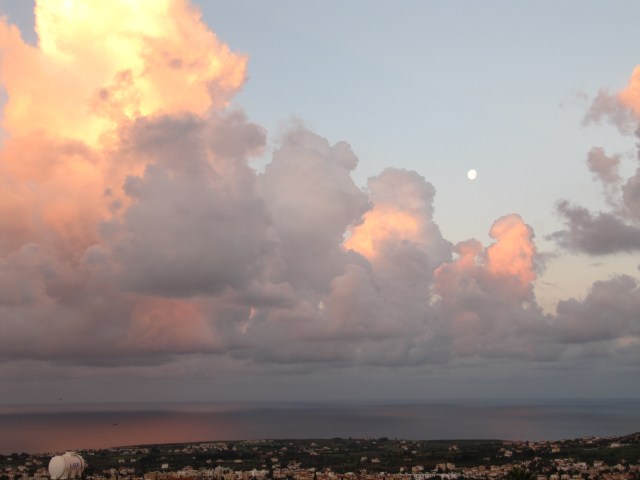
13:50 Edrique was showing the sun light going through spaces in the clouds and shinning down on the sea; known as the ‘crepuscular rays’. He said that the reason why these rays (as he pointed to them) are on an angle and the reason why this ray is pointing straight down, is because it’s noon over there (where the sun rays were going straight down).

Ha, ha, ha. What a joke! I can’t believe what a stupid statement he made! The fact that Kent Hovind didn’t call him out on it, means he must believe it, too. Let’s examine this more closely.

Here, we are present with a photo of, what looks like late afternoon sun. we have all seen similar rays of the sun going out on different angles. Perhaps you have seen this on the seashore. Now, I don’t know where this photo was taken (and, probably Edrique doesn’t either) but it doesn’t really matter. First and foremost, you can’t see across a couple of time zones – period! When you look out at sea, the horizon is about 12 miles out. If you are up higher you can see further out. The only time you can see across a time zone is if you are near the dividing line – that’s it. You can’t see across a whole time zone as they are a couple of hundreds miles apart to nearly 1,000 miles away – depending on latitude.

With the photo that Edrique used, it looks like where the observer is it’s 4pm. In any case, noon would be several times zones away – a distance too far to see. What a ludicrous statements he made!

If the photo was taken on the shores of Georgia, for example, and you are in the late afternoon, further eastward can’t be12 noon – as noon time already passed! You are looking towards Europe, which is later in the day. If it was the morning hours, you still can’t see the length of one time zone.

If you happened to be right near another time zone, the time will be an hour difference BUT the sun in the sky would be the same. Example, if you are five miles away from crossing a time zone, the sun and the angle would be identical. The sun would be no different than if you drove to a town 5 miles away and there was no time zone crossing.

When I was in Cyprus I lived within view of the sea. It was common during certain times of the year to see the rays come through different areas of the sky – just like this. Where the sun was over the Mediterranean Sea, it was in the late afternoon and the view was south-west. I saw rays coming down on an angle and ones coming down straight. No way was this looking across several time zones! No way was it even looking across one time zone. Noon had come and gone, so that was not it. Finally, looking south from Cyprus, you are not even looking across time zones even if you could see that far. Too ‘see across’ time zones you would basically be looking East or West; you have to look across latitude lines not longitude lines. Looking towards the South or the North, you would not be looking across time zones, as they don’t run in that direction.

Another thing that the two guys didn’t think of and that is, IF the sun is 93 million miles away, the sun would be too far away to to show at different angles; there would not be one section of the earth where the sun is directly over head and another one, say, 10% off, and other angle seen at another angle still. The sun would appear at the same degree in the sky for all people. But, with the angle of the rays being different and so close proves that the earth is flat and that the sun is near the surface.

Kent and Edrique science is really lacking; their common-sense is lacking, too. In a way I’m glad that they made such a stupid remark, as people can wake up and see through this as nothing but a LIE.

Just think back of the times and location that you had seen such sunrise or sunset. Where was it? What direction were you facing and where were you in relation to the time zones?

No, Kent and Edrique, the rays are not like that because of a sun 93 million miles away, but because it’s close – perhaps 3,000 miles at the most. The sun’s rays are on an angle because it’s close. His picture proves that it’s close, as something 93 million miles way cannot cast angles like that, and it cannot create a hotspot, either (as seen in some high altitude pictures).

15:30 Kent said, “If the earth is flat, I should be able to see Tokyo.” Another stupid statement. Edrique said that we are told that if we had a military grade telescope we should see Tokyo. Then Kent said, that if you are 6 feet tall, you times that by 1.3 and that number in miles should be how far you can see at sea.

OK, let’s analysis this. First, did they ever get a good telescope to look out at sea? Probably not. If they did, I will assure them that when a boat ‘disappears over the horizon,’ it did not go over the curve, as their telescope will bring it back in view. If they had a ‘military grade’ telescope it would not be strong enough to see Tokyo in the first place. A military grade telescope is not as strong as an observatory telescope. So, why didn’t they use that as an example? I don’t know.

As for seeing Tokyo, what these two guys didn’t take into consideration is: air density, pollution, fog and mist along the way. Each one of these cuts down the view. The strange things is, or maybe not so strange is, why hasn’t Edrique brought up these objections? He brought up other statements from the flat earthers but not these. I guess there would be no way to get around this and they would have to agree that flat earthers are right. Also, it might be clear on shore, but 500 miles out it could be foggy, which would block their view.

I notice the technique that globe believers do in order to justify their belief. They take some huge distance from one location on earth to another, and ask, “Why can’t see it?” I heard another man, a good Christian, but just wrong on this issue say, “Why can’t you go to the Florida beach and see South America?” again, a great distance. You don’t have to use distance like this to PROVE that the earth is flat. All you need to do is, watch a ship disappear from your eyes – which could be 10 miles away. It would be ‘over the curve’ we are told. Then take a telescope out and look at the ship again. This will prove a flat earth, and you can do it all without getting an expensive telescope. If you prove you CAN see beyond the so-called curvature at 10 miles, you proved your point. You don’t need to do it for 100 or 1,000 miles. Again, the problem with seeing something on earth at sea level at 1,000 miles is the air density, fog, mist, and pollution – all of which blocks vision. Telescopes will always work better and see further pointing up – not parallel at ground level!

kent-video-3b

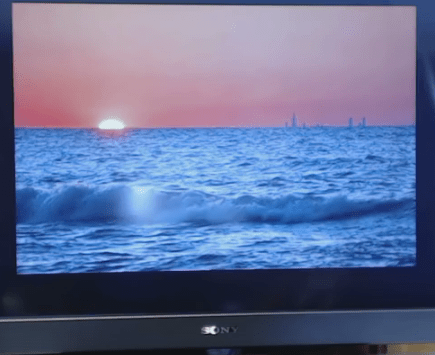
16:45 Edrique shows a picture of what was on Chicago TV of a view of Chicago skyline taken across Lake Michigan – distance I think of 60 miles. He said, take a look at the water, you can’t see the waves, it was taken high up. And the higher up you are the further you can see. Well, this part is true – the higher you are the further you can see – flat earthers will tell you that, you don’t have to go to globe earth believers. Anyhow, this is part of the reason why he says you can see Chicago.

Again, they ignore the facts. The guy who took this was on the ground not high up. Even if the distance was only 6 miles, in order to see the skyline ACCORDING to globe earth believers, he would have to be 24 feet up. Do the math to figure how far up in the air the photographer would have to be to see 60 miles away. That formula is: 8 inches times 60 squared, divide by 12 to get the feet. If you find that the distance is greater, then use that figure.
kent-video-3-skyline2

No, the photographer was on the ground, maybe not exactly at sea level but he was not even on a high hill. He would have to be in an airplane at see that much further. Another thing that should make Edrique blush and that is, the Chicago weatherman, himself a heliocentric believer, said the photo was taken on the shores of Lake Michigan. But if Edrique said that, he would not be able to use the story that it was taken very high up.

Photo Skyline

Edrique goes on to say that if you were at sea level, you would not see the 2, 3, or 4 floor. Taking what he said, IF it was true, how can you see the rest of the building? These buildings are skyscrapers of various heights. By what heliocentric believers tell us, we should not be able to see anything. Yet, what this heliocentric believer tells us – by implication – we should see floors above the 4th. The fact is, if you do the math on 25,000 circumference, the top of the skyscrapers would still be behind the curve. But since we CAN see them, it’s PROOF that the earth is flat. At this distance, the skyline would be 2,000 feet below the curve, and that it taking 400 feet off the 2,400 figure you’d come up with on 8 inches square the distance.

Side note: You can see how people who would be watching this video and bobbing their collective heads along, say, “Yea, yea, yea,” that they would agree with the globe earth model. But analysing this, we see that what they say is not true.

19:00 It’s easy for someone to see a video, agree with everything they say and go on with their life. It’s only when you take the time to analysis it – which might require you seeing it again – that you see the many lies and distortions. Most people don’t take the time, so if their belief is one way, and they watch something that supports their belief and they’ll continue their life as normal.

Continuing, Edrique shows another photo, which was taken a shore level (compared to the other which was about 20 feet up). Here, he witnessed AGAINST himself, in that you still see the skyline of Chicago. The reason why you can’t see the very bottom is simple, and that is because of the small waves. Don’t forget, small waves up close will BLOCK big objects and even whole buildings in the background. A child can tell them that!

20:09 Kent said, “With their model, why would it (sun) go behind the horizon ever?” He was holding up a paperback book (using that as the earth) and with his finger, started over the book and went over the edge of it. This tells us that he thinks the sun is going under the flat earth. No flat earthers believe the earth travels under the earth. All they have to do is watch a flat earth video and they wouldn’t bring up this argument.

20:30 Edrique was pointing to a video on the screen about a very long hallway that went smaller and smaller (because of perspective). He said, “Imagine each of these lights (in the hallway) is like the sun, each one is getting smaller and smaller (implying why the sun doesn’t get smaller and smaller). Kent then said, “That hall can go on for ever and ever – to infinity.” Edirque said yes and he added, “Even if the hallway is 5 miles away or 10 miles away, you should still the the light.” (Meaning that last light in this long hallway is on.) He continued, “Even though it would be very small, you should still see the light.” This, of course, is implying that we should see the sun but it would be very small.

Again, these guys just don’t know science, they are not using their real life experience. They admit that things get smaller and smaller (referring to the sun). Well, when things get smaller and smaller, what happens? They get smaller and smaller UNTIL you can’t see it at all! So, what makes them think that you can see forever? We can’t see other objects forever; with light it is a longer distance but it’s not forever. I guess they believe this because we see stars “trillions of miles away.”

When the foundation is wrong, everything built on it is wrong.

They admit the point gets smaller and smaller, so that tells us that light does not go on forever.

One reason why the sun doesn’t do what the “lights in an infinity hallway does” is that the sun gets further and further away TO A POINT, but goes on a circuit above the earth and loops back.

22:00 Kent ask do they know what makes the sun go around, and Edrique said no. Kent answered that he knows (on heliocentric model). Now, just because someone doesn’t know ALL the answers, does not make the flat earth model false.

Edrique said that the flat earth people don’t believe in gravity and Kent asked, what do they believe in? His response was something like electromagnetism. What Edrique should know if he studied what we believe is, that it’s density that keeps things on the earth. Kent should know about the characteristics of density being a science teacher and offer that in place of the lack of knowledge that Edrique had.

Kent said, “Don’t include me in your flat earth model.” He repeated this a couple of times. No one included him, so why did he make this up? Why would any flat earth believer include a person who does not believe as they do? Why would they include someone who is a strong advocate against the flat earth? Sorry, Kent but you have to be invited and you turned down the invitation (accepting the flat earth) so you are then not invited.

So ends video 3.

Summary

As you can see, these two – Kent Hovind and Edrique Visser – did a hatchet job on discussing the flat earth. What I would like to see is Kent Hovind taking debate a flat earther – just like he has done with evolutionists. But will he do it? Since he says that he doesn’t want to see any more Posts or comments about the flat earth, I don’t think we would want to debate geocentric believers. How would he like it if he was turned down by universities and professors who don’t want to accept his offer to debate. He wouldn’t but he can’t see his hypocrisy – that he is reacting just like his opponents the evolution believers.


Posted in flat earth discussion | Tagged | 2 Comments

My Flat Earth Experience

Continuing from the Post of Happy Birthday One Year Flat Earth Awakening, I’d like to add a bit more to this.

doctor-sick-dying

As previously mentioned, I had come to the flat earth through another alternative news website. This one is on the medical racket and how the Establishment keeps us sick. For you flat earthers that don’t know about this, I highly recommend that you go to: http://www.whale.to They have a ton of article on the subject as well as videos.

What I’m saying is, that if you are not into alternative news, conspiracies and such, you probably would not be on this flat earth site. That is why most people who do know about the flat earth are already aware of other government cover ups. For a few readers, the flat earth happened to come first THEN they learn about about the other cover ups such as: 9-11, money racket by international banks, lies to get us into wars, etc. So, if the flat earth is the first subject that is in the alternative news category, do not stop there, the lying and corruption goes deep; there are many ‘rabbit holes’ to go down.

The average Joe who only watches CNN, BBC News or watches trivial programs on TV, will more than likely not come across the flat earth information. IF they do, they probably don’t want to really listen and read what it’s all about. But for people who are into what the anti-Christs are doing will more than likely listen to what you have to say.

Back to the medical racket. If you think that the treatments that are given to us and the advice on how to stay well from the doctors is correct, kindly go to the above website to learn more. This cover up is as large as the flat earth, as it, too, is world-wide. Just watch a couple of these videos or read a dozen articles from whale.to and see if this makes sense to you. There are others alternative health sites that also have a lot of information on the medical racket. Another one is: http://www.naturalnews.com Check it out; learn how to be healthy and stay healthy.

doctor-sick-dying2

If you go to any health food shop or go to a natural health convention, tell the people about the flat earth! They would be a better audience than the average person on the street.

In short, when you are on a learning path and discovering the lies that have been told us, a whole new world opens up. You’ll learn about other truths about: Bible, health, history, banking, wars, flat earth and more.

If you are new to this and want to know how you find this information, one way to do is is by doing searches such as:

The truth about x (whatever your topic is)

x cover up

You can use the words: lie, cover up, fraud and conspiracy with your topic word. If you are on a major alternative news site, many times they will have many topics all in one place. Then, you may find even more by following their links. Alternative news sites often have a link to the original article, where that site could have someone on a topic that is not covered from the site you came from. Also, look for a Page tab that is named Links or References. What many website owners do is, they put other website addresses to go to. Site A might have just a little on the bioengineering, while Site B would have many more articles. When you read other cover ups and the like, you’ll see how all of this is connected and you’ll get the bigger picture. Normally, when you are on a major alternative news website, there are enough links to follow to keep you busy for a long time. These links will have links of their own where you can go. In time, you’ll be down every ‘rabbit hole’ there is!

Posted in Conspiracies, flat earth discussion | Tagged , | Leave a comment

Happy Birthday One Year Flat Earth Awakening

One Year Ago: My Flat Earth Learning

It was 30 April, 2015

It has been exactly one year ago (30 April, 2015) that I woke up to the flat earth truth! I remember the day well. I shared it later in the day with my wife and she accepted it, too.

It was about 5.30 in the evening that I came across a site that had flat earth facts. My wife and I were in Cyprus at the time, I was in the dinning room on my computer and she was on the balcony (right outside the dinning room) talking to the neighbours who were on their balcony. I waited until she came in, which was about 6pm.

The flat earth news made sense to me, so I was able to accept it right away.

I was actually on another site that talks about the medical racket and how the medical establishment keeps us sick and do not give us effective treatments. But this website had other news as well. The website name address is: http://www.whale.to There was an article about the Challenger astronauts who were killed on the landing pad in 1986 saying they were still alive and they had a link to another site for the full article.

I knew about conspiracies and government lying but I had never heard of this – that these astronauts were still alive. So, I clicked on the link and this sent me to a flat earth site. When reading the article, I notice the Page names at the top of the website had: flat earth videos, flat earth gallery, flat earth library. I wonder, ‘What in the heck is this nonsense?’ Since a number of their Pages had the name ‘flat earth’ in it, I finally click on one. I saw a video by Eric Dubay, which had good pictures along with the audio.

IMG_2213 Two days later two friends of ours came over and I shared the flat earth news with them, too. When they came over, we were sitting on the balcony having our morning tea/coffee and looking at the Mediterranean Sea. I had told them I wanted to share some important news before they came over. I said to Bob and Else. Stand up and look at the sea; look at the horizon from left to right and tell me if everything looks normal to you. They looked and saw nothing unusual. I said, “Everything is flat, right?” And they agreed. Meanwhile, my wife, Jayne was smiling at them – knowing what I was up to.
They agreed that everything looked normal. I then added, “That’s the problem – it’s not suppose to be flat if we are on a globe; there should be a curve or a drop-off to the right and left of your view but there isn’t.”

Where we lived in Cyprus, we had a beautiful view of the hill going down, the homes below, and the Mediterranean Sea. A perfect place to point out the horizon. Since we were about 500 feet above sea level, it gave a view further out than if you were standing on the shore.

A couple of years before, from the same balcony, I had photographed a cruise ship at sea. I had it on one setting, took a picture than zoomed in and took another picture. I was able to zoom in more on my computer and I could see details of the ship and the water level that I could not see with my eyes. Of course, at this time I had no idea that this would play into proving a flat earth. Now, several years later, I looked out and see the world differently.

For the first week or two, and especially when I was with my friends on the balcony; I had literally a different view of the world. I’m sure you can relate to this and I’m sure you have your own unique story. Do you remember the day and the circumstances when you first learned about the flat earth? You might want to right it down someone where for reference.

After doing some talking, they had questions. I answered some of them but I couldn’t answer others, as I was just learning, too. I did show them part of one video while they were there. Then Bob, who did not believe in God as we do, said, “Then that means there is a God of the Bible.” I said, “Yes, there is.”

They were open minded and listened to what I had to say, which not everyone is like that. I said, “Do your own research, watch the videos and see if it makes sense to you; then make your own decision.”

Jayne and I had to fly back to England but we kept in touch with our friends. As the days went by, for the first couple of weeks, there was almost daily contact, via email, about what we learned on the flat earth. I answered more of their questions and told them what I had learned, too. That’s all we did in the beginning weeks of learning about the flat earth – and that was more research.

In fact, my zeal for the flat earth news and what this means prompted me to start a website – which you are on now. As you can see, this Christian Flat Earth Ministry was started back in May of last year – shortly after I learned about the flat earth myself. I took me a couple of weeks more of learning and organizing this information for me to get to the point of putting up this website. And, as you can see, I’m still going at it.

To this day they are flat earth believers. I hope you have a nice story of sharing this news with your wife or husband and with friends. Not everyone takes kindly to the flat earth news but those that do, it’s a pleasure to share in their joy.

Posted in flat earth discussion | Tagged | Leave a comment

The Cause of Solar and Lunar Eclipses

The Cause of Solar and Lunar Eclipses

Zetetic Astronomy, by ‘Parallax’ (pseud. Samuel Birley Rowbotham), [1881]

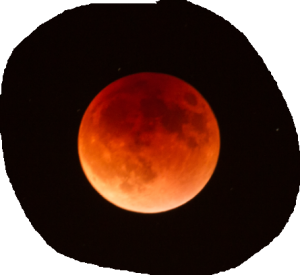
eclipse-solar1  A SOLAR eclipse is the result simply of the moon passing between the sun and the observer on earth. But that an eclipse of the moon arises from a shadow of the earth, is a statement in every respect, because unproved, unsatisfactory. The earth has been proved to be without orbital or axial motion; and, therefore, it could never come between the sun and the moon. The earth is also proved to be a plane, always underneath the sun and moon; and, therefore, to speak of its intercepting the light of the sun, and thus casting its own shadow on the moon, is to say that which is physically impossible.
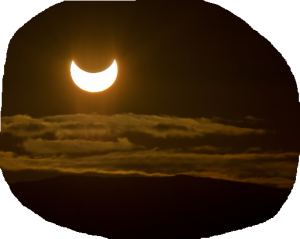
Besides the above difficulties or incompatibilities, many cases are on record of the sun and moon being eclipsed when both were above the horizon. The sun, the earth, and the moon, not in a straight line, but the earth below the sun and moon–out of the reach or direction of both–and yet a lunar eclipse has occurred! Is it possible that a “shadow” of the earth could be thrown upon the moon, when sun, earth, and moon, were not in the same line? The difficulty has been met by assuming the influence of refraction, as in the following quotations:–

eclipse-lunar1“On some occasions the horizontal refraction amounts to 36 or 37 minutes, and generally to about 33 minutes, which is equal to the diameter of the sun or moon; and, therefore, the whole disc of the sun or moon will appear above the horizon, both at rising and setting, although actually below. This is the reason that the full moon has sometimes been seen above the horizon before the sun was set. A remarkable instance of this kind was observed at Paris, on the 19th of July, 1750, when the moon appeared visibly eclipsed, while the sun was distinctly to be seen above the horizon.” 1

“On the 20th of April, 1837, the moon appeared to rise eclipsed before the sun had set. The same phenomenon was observed on the 20th of September, 1717.” 2

“In the lunar eclipses of July 17th, 1590; November 3rd, 1648; June 16th, 1666; and May 26th, 1668; the moon rose eclipsed whilst the sun was still apparently above the horizon. Those horizontal eclipses were noticed as early as the time of Pliny.” 3

On the 17th of January, 1870, a similar phenomenon occurred; .and again in July of the same year. 4

The only explanation which has been given of this phenomenon is the refraction caused by the earth’s atmosphere. This, at first sight, is a plausible and fairly satisfactory solution; but on carefully examining the subject, it is found to be utterly inadequate; and those who have recourse to it cannot be aware that the refraction of an object and that of a shadow are in opposite directions. An object by refraction is bent upwards; but the shadow of any object is bent downwards, as will be seen by the following very simple experiment. Take a plain white shallow basin, and place it ten or twelve inches from a light in such a position that the shadow of the edge of the basin touches the centre of the bottom. Hold a rod vertically over and on the edge of the shadow, to denote its true position. Now let water be gradually poured into the basin, and the shadow will be seen to recede or shorten inwards and downwards; but if a rod or a spoon is allowed to rest, with its upper end towards the light, and the lower end in the bottom of the vessel, it will be seen, as the water is poured in, to bend upwards–thus proving that if refraction operated at all, it would do so by elevating the moon above its true position, and throwing the earth’s shadow downwards, or directly away from the moon’s surface. Hence it is clear that a lunar eclipse by a shadow of the earth is an utter impossibility.

The moon’s entire surface, or that portion of it which is presented to the earth, has also been distinctly seen during the whole time of a total lunar eclipse. This also is entirely incompatible with the doctrine that an eclipse of the moon is the result of a shadow of the earth passing over its surface.

Mr. Walker, who observed the lunar eclipse of March 19th, 1848, near Collumpton, says:–

“The appearances were as usual till twenty minutes past nine; at that period, and for the space of the next hour, instead of an eclipse, or the shadow (umbra) of the earth being the cause of the total obscurity of the moon, the whole phase of that body became very quickly and most beautifully illuminated, and assumed the appearance of the glowing heat of fire from the furnace, rather tinged with a deep red. . . . The whole disc of the moon being as perfect with light as if there had been no eclipse whatever! . . . . The moon positively gave good light from its disc during the total eclipse.” 1

The following case, although not exactly similar to the last, is worth recording here, as showing that some other cause existed than the earth’s shadow to produce a lunar eclipse:–

“EXTRAORDINARY PHENOMENA ATTENDING THE ECLIPSE.–On Saturday evening, February 27th, 1858, at Brussels, the eclipse was seen by several English philosophers who happened to be present. It was attended by a very remarkable appearance, which Dr. Forster said was wholly inexplicable on any laws of natural philosophy with which he was acquainted. The moment before contact a small dusky spot appeared on the moon’s surface, and during the whole of the eclipse, a reddish-brown fringe, or penumbra, projected above the shadow of the earth. Another thing still more remarkable was the apparent irregularity of the edge of the shadow. Three persons, one of them an astronomer, were witnesses of these curious phenomena, which no law of refraction can in any way explain.” 2

“LUNAR ECLIPSE OF FEBRUARY 6TH, 1860.–The only remarkable feature in this eclipse was the visibility–it might almost be termed the brilliancy of Aristarchus. Kepler, and other spots, were comparatively lost, or at most, barely discernible, as soon as they became enveloped in the shadow; but not so Aristarchus, which evidently shone either by intrinsic or retained illumination.” 3

“The moon has sometimes shone during a total eclipse with an almost unaccountable distinctness. On December 22nd, 1703, the moon, when totally immersed in the earth’s shadow, was visible at Avignon by a ruddy light of such brilliancy that one might have imagined her body to be transparent, and to be enlightened from behind; and on March 19th, 1848, it is stated that so bright was the moon’s surface during its total immersion,, that many persons could not be persuaded that it was eclipsed. Mr. Forster, of Bruges, states, in an account of that eclipse, that the light and dark places on the moon’s surface could be almost as well made out as in an ordinary dull moonlight night.

“Sometimes, in a total lunar eclipse, the moon will appear quite obscure in some parts of its surface, and in other parts will exhibit a high degree of illumination. . . . To a certain extent I witnessed some of these phenomena, during the merely partial eclipse of February 7th, 1860. . . . I prepared, during the afternoon of February 6th, for witnessing the. eclipse, without any distinct expectation of seeing much worthy of note. I knew, however, that upwards of eight-tenths of the. disc would be covered, and I was anxious to observe with what degree of distinctness the eclipsed portion could be viewed, partly as an interesting fact, and partly with a view of verifying or discovering the weak points of an engraving (in which I am concerned) of a lunar eclipse. After seeing the increasing darkness of the penumbra softly merging into the true shadow, at the commencement of the eclipse (about 1 o’clock a.m., Greenwich time), I proceeded with pencil and paper, dimly lighted by a distant lamp, to note by name the different lunar mountains and plains (the so-called seas), over which the shadow passed. . . . During the first hour and ten minutes I had seen nothing unexpected. . . . I had repeatedly written down my observations of the remarkable clearness with which the moon’s eclipsed outline could be seen, both with the naked eye and with the telescope. At 1 hour 58 minutes, however, I suddenly noted the ruddy colour of a portion of the moon. I may as well give my notes in the original words, as copied next day in a more connected form:

“‘1 hour 58 minutes, Greenwich time.–I am suddenly struck by the fact that the whole of the western seas of the moon are showing through the shadow with singular sharpness, and that the whole region where they lie has assumed a decidedly reddish tinge, attaining its greatest brightness at a sort of temporary polar region, having ‘Endymion’ about the position of its imaginary pole. I particularly notice that the ‘Lake of Sleep’ has disappeared in this brightness, instead of standing out in a darker shade. And I notice that this so-called polar region is not parallel with the rim of the shadow, but rather west of it.

“‘2 hours 15 minutes.–Some clouds, though very thin and transparent, now intervene.

“‘2 hours 20 minutes.–The sky is now clear. How extra-ordinary is the appearance of the moon! Reddish is not the word to express it; it is red–red hot! I endeavour to think of various red objects with which to compare it, and nothing seems so like as a red-hot penny–a red-hot penny, with a little white-hot piece at its lower edge, standing out against a dark blue background; only it is evidently not a mere disc, but beautifully rounded by shading. Such is its appearance with the naked eye; with the telescope, its surface varies more in tint than with the naked eye, and is not of quite so bright a red as when thus viewed. The redness continues to be most perceptible at a distance from the shadow’s southern edge, and to be greatest about the region of ‘Endymion.’ The ‘Hercynian Mountains’ (north of ‘Grimaldus’) are, however, of rather a bright red, and ‘Grimaldus’ shows well. ‘Mare Crisium’ and the western seas, are wonderfully distinct. Not a trace to be seen of ‘Aristarchus’ or ‘Plato.’

“‘2 hours 27 minutes.–It is now nearly the middle of the eclipse. The red colour is very brilliant to the naked eye. . . . After this, I noticed a progressive change of tint in the moon.

“‘2 hours 50 minutes.–The moon does not seem to the naked eye of so bright a red as before; and again I am reminded by its tint, of red-hot copper, which has begun to cool. The whole of ‘Grimaldi’ is now uncovered. Through the telescope I notice a decided grey shade, at the lower part of the eclipsed portion, and the various small craters give it a stippled effect, like the old aqua-tint engravings. The upper part is reddish; but two graceful blueish curves, like horns, mark the form of the ‘Hercynian Mountains,’ and the bright region on the other limb of the moon. These are visible also to the naked eye.

“‘At 3 hours 5 minutes the redness had almost disappeared; a very few minutes afterwards no trace of it remained; and ere long clouds came on. I watched the moon, however, occasionally gaining a glimpse of its disc, till a quarter to 4 o’clock, when, for the last time on that occasion, I saw it faintly appearing through the clouds, nearly a full moon again; and then I took leave of it, feeling amply repaid for my vigil by the beautiful spectacle which I had seen.'” 1

At the time of totality (the lunar eclipse of June 1st, 1863), the moon presented a soft, woolly appearance, apparently more globular in form than when fully illuminated. Traces of the larger and brighter mountains were visible at the time of totality, and particularly the bright rays proceeding from ‘Tycho,’ ‘Kepler,’ and ‘Aristarchus.’ . . . . At first, when the obscured part was of small dimensions, it was of an iron grey tint, but as it approached totality, the reddish light became so apparent that it was remarked that the moon ‘seemed to be on fire;’ and when the totality had commenced, it certainly looked like a fire smouldering in its ashes, and almost going out.” 1

In ordinary cases the disc appears, during a total eclipse, of a reddish hue, the colour being, indeed, of the most various degrees of intensity, passing, even when the moon is far removed from the earth into a fiery glowing red. Whilst I was lying at anchor (29th of March, 1801), off the Island of Baru, not far from Cartagena de Indias, and observing a total lunar eclipse, I was exceedingly struck by seeing how much brighter the reddened disc of the moon appears in the sky of the tropics than in my northern native land.” 2

“The fiery, coal-glowing colour of the darkened (eclipsed) moon. . . . The change is from black to red, and blueish.” 3

“Great was the confusion created in the camp of Vitellius by the eclipse which took place that night; yet it was not so much the eclipse itself–although to minds already disturbed this might appear ominous of misfortune–as it was the circumstance of the moon’s varying colours–blood-red, black, and other mournful hues–which filled their souls with uneasy apprehensions.” 4

The several cases above advanced are logically destructive of the notion that an eclipse of the moon arises from a shadow of the earth. As before stated, the earth is proved to be a plane, without motion, and always several hundred miles below the sun and moon, and cannot, by any known possibility come between them. It cannot therefore intercept the light of the sun, and throw its own shadow upon the moon. If such a thing were a natural possibility, how could the moon continue to shine during the whole or any considerable part of the period of its passage through the dark shadow of the earth? Refraction, or what has been called “Earth light,” will not aid in the explanation; because the light of the moon is at such times “like the glowing heat of firer tinged with deep red.” “Reddish is not the word to express it, it was red–red hot.” “The reddish light made it, seem to be on fire.” “It looked like a fire smouldering in its ashes.” “Its tint was that of red-hot copper.” The sun light is of an entirely different colour to that of the eclipsed moon; and it is contrary to known optical principles to say that light when refracted or reflected, or both simultaneously, is thereby changed in colour. If a light of a given colour is seen through a great depth of a comparatively dense medium, as the sun is often seen in winter through the fog and vapour of the atmosphere, it appears of a different colour, and generally of such as that which the moon so often gives during a total eclipse; but a shadow cannot produce any such effect, as it is, in fact, not an entity at all, but simply the absence of light.

From the facts and phenomena already advanced, we cannot draw any other conclusion than that the moon is obscured by some kind of semi-transparent body passing before it; and through which the luminous surface is visible: the luminosity changed in colour by the density of the intervening object. This conclusion is forced upon, us by the evidence; but it involves the admission that the moon shines with light of its own–that it is not a reflector of the sun’s light, but absolutely self-luminous. Although this admission is logically compulsory, it will be useful and strictly Zetetic to collect all the evidence possible which bears upon it.

1st. A reflector is a plane or concave surface, which gives off or returns what it receives:–

If a piece of red hot metal or any other heated object is placed before a plane or concave surface, heat is reflected.

If snow or ice, or any artificial freezing mixture is similarly placed, cold will be reflected.

If light of any given colour is placed in the same way, the same colour of light will be reflected.

If a given sound is produced, the same tone or pitch will be reflected.

A reflector will not throw off cold when heat is placed before it; nor heat when cold is presented. If a red light is received, red light will be returned, not blue or yellow. If the note C is sounded upon any musical instrument, a reflector will not return the note D or G, but precisely the same note, altered only in degree or intensity.

If the moon is a reflector of the sun’s light, she could not radiate or throw down upon the earth any other light than such as she first receives from the sun. No difference could exist in the quality or character of the light; and it could not possibly differ in any other respect than that of intensity or quantity. It has been asserted in opposition to the above, that the moon might absorb some of the rays of light from the sun and reflect only the remaining rays. To this it is replied that absorption means speedy saturation: a piece of blotting paper, or a lump of hard sugar, or a sponge when brought into contact with any fluid or gaseous substance, would only absorb for a short time; it would quickly become saturated, filled to repletion, and from that moment would cease to absorb, and ever afterwards could only reflect or throw back whatever was projected upon it. So the moon, if an object without light of her own, might at the beginning of her existence absorb the sun’s ray’s, and, fixing some, might return the others; but as already shown, she could only absorb to saturation, which would occur in a very short time; and from this point of saturation to the present moment she could not have been other than a reflector–a reflector, too, of all which she receives.

We have then, in order to know whether the moon is a reflector, merely to ascertain whether the light which we receive from her is, or is not the same, in .character as that received from the sun.

1st. The sun’s light is generally, and in an ordinary state of the atmosphere, of an oppressive, fierce, semi-golden, pyro-phosphorescent character; while that of the moon is pale, silvery and gentle; and when shining most brightly is mild and non-pyrotic.

2nd. The sun’s light is warm, drying, and preservative, or antiseptic; animal and vegetable substances exposed to it soon dry, coagulate, shrink, and lose their tendency to decompose and become putrid. Hence grapes and other fruits by long exposure to sunlight become solid, and partially candied and preserved; as instanced in raisins, prunes, dates, and ordinary grocers’ currants. Hence, too, fish and flesh by similar exposure lose their gaseous and other volatile constituents and by coagulation of their albuminous and other compounds become firm and dry, and less liable to decay; in this way various kinds of fish and flesh well known to travellers are preserved for use.

The light of the moon is damp, cold, and powerfully septic; and animal and nitrogenous vegetable substances. exposed to it soon show symptoms of putrefaction. Even living creatures by long exposure to the moon’s rays, become morbidly affected. It is a common thing on board vessels going through tropical regions, for written or printed notices to be issued, prohibiting persons from sleeping on deck exposed to full moonlight, experience having proved that such exposure is often followed by injurious consequences.

“It is said that the moon has a pernicious effect upon those who, in the East, sleep in its beams; and that fish having been exposed to them for only one night, becomes most injurious to those who eat it.” 1

“At Peckham Rye, a boy named Lowry has entirely lost his sight by sleeping in a field in the bright moonlight.” 2

“If we place in an exposed position two pieces of meat, and one of them be subjected to the moon’s rays, while the other is protected from them by a screen or a cover, the former will be tainted with putrefaction much sooner than the other.” 1

Professor Tyndall describing his journey to the summit of the Alpine Mountain, Weisshorn, August 21st, 1861, says:–

“I lay with my face towards the moon (which was nearly full), and gazed until my face and eyes became so chilled that I was fain to protect them with a handkerchief.” 2

3rd. It is a well known fact, that if the sun is allowed to shine strongly upon a common coal, coke, wood, or charcoal fire, the combustion is greatly diminished; and often the fire is extinguished. It is not an uncommon thing for cooks, housewives, and others to draw down the blinds in summer time to prevent their fires being put out by the continued stream of sun-light pouring through the windows. Many philosophers have recently attempted to deny and ridicule this fact, but they are met, not only by the common sense and every-day experience of very practical people, but by the results of specially instituted experiments.

It is not so well known perhaps, but it is an equally decided fact, that when the light of the moon is allowed to play upon a common carbonaceous fire, the action is increased, the fire burns more vividly, and the fuel is more rapidly consumed.

4th. In sun-light a thermometer stands higher than a similar thermometer placed in the shade. In the full moon-light, a thermometer stands lower than a similar instrument in the shade.

5th. In winter when ice and snow are on the ground, it is patent to every boy seeking amusement by skating or snow-balling, that in the sun light both ice and snow are softer and sooner thaw than that behind a wall, or in the shade. It is equally well known that when, in frosty weather, the night is far advanced, and the full moon has been shining for some hours, the snow and ice exposed to the moon-light are hard and crisp, while in the shade, or behind any object which intercepts the moon’s rays it is warmer, and the ice and snow are softer and less compact. Snow will melt sooner in sun-light than in the shade; but sooner in the shade than when exposed to the light of the moon.

6th. The light of the sun reflected from the surface of a pool of water, or from the surface of ice, may be collected in a large lens, and thrown to a point or focus, when the heat will be found to be considerable; but neither from the light of the moon reflected in a similar way, nor direct from the moon itself, can a heat-giving focus be obtained.

7th. The sun’s light, when concentrated by a number of plane or concave mirrors throwing the light to the same point; or by a large burning lens, produces a black or non-luminous focus, in which the heat is so intense that metallic and alkaline substances are quickly fused; earthy and mineral compounds almost immediately vitrified; and all animal and vegetable structures in a few seconds decomposed, burned up and destroyed.

The moon’s light concentrated in the above manner produces a focus so brilliant and luminous that it is difficult to look upon it; yet there is no increase of temperature. In the focus of sun-light there is great heat but no light. In that of the moon’s light there is great light but no heat. That the light of the moon is without heat, is fully verified by the following quotations:—

“If the most delicate thermometer be exposed to the full light of the moon, shining with its greatest lustre, the mercury is not elevated a hair’s breadth; neither would it be if exposed to the focus of her rays concentrated by the most powerful lenses. This has been proved by actual experiment.” 1

“This question has been submitted to the test of direct experiment. . . . The bulb of a thermometer sufficiently sensitive to render apparent a change of temperature amounting to the thousandth part of a degree, was placed in the focus of a concave reflector of vast dimensions, which, being directed to the moon, the lunar rays were collected with great power upon it. Not the slightest change, however, was produced in the thermometric column; proving that a concentration of rays sufficient to fuse gold if they proceeded from the sun, does not produce a change of temperature so great as the thousandth part of a degree when they proceed from the moon.” 2

“The most delicate experiments have failed in detecting in the light of the moon either calorific or chemical properties. Though concentrated in the focus of the largest mirrors, it produces no sensible heating effect. To make this experiment, recourse has been had to a bent tube, the extremities of which terminate in two hollow globes filled with air, the one trans-parent, the other blackened, the middle space being occupied by a coloured fluid. In this instrument, when caloric is absorbed by it, the black ball takes up more than the other, and the air it encloses increasing in elasticity, the liquid is driven out. This instrument is so delicate that it indicates even the millionth part of a degree; and yet, in the experiment alluded to, it gave no result.” 1

“The light of the moon, though concentrated by the most powerful burning-glass, is incapable of raising the temperature of the most delicate thermometer. M. De la Hire collected the rays of the full moon when on the meridian, by means of a burning-glass 35 inches in diameter, and made them fall on the bulb of a delicate air-thermometer. No effect was produced though the lunar rays by this glass were concentrated 300 times. Professor Forbes concentrated the moon’s light by a lens 30 inches in diameter, its focal distance being about 41 inches, and having a power of concentration exceeding 6000 times. The image of the moon, which was only 18 hours past full, and less than two hours from the meridian, was brilliantly thrown by this lens on the extremity of a commodious thermopile. Although the observations were made in the most unexceptional manner, and (supposing that half the rays were reflected, dispersed and absorbed), though the light of the moon was concentrated 3000 times, not the slightest thermo effect was produced.” 2

In the “Lancet” (Medical Journal), for March 14th, 1856, particulars are given of several experiments which proved that the moon’s rays when concentrated, actually reduced the temperature upon a thermometer more than eight degrees.

It is the common experience of the world that the light of the sun heats and invigorates all things, and that moon light is cold and depressive. Among the Hindoos, the sun is called “Nidâghakara,” which means in Sanscrit “Creator of Heat;” and the moon is called “Sitala Hima,” “The Cold,” and “Himân’su,” “Cold-darting,” or “Cold-radiating.”

Poets, who but utter in measured words the universal knowledge of mankind, always speak of the “Pale cold moon,” and the expression is not only poetically beautiful, but also true philosophically.

“The cold chaste moon, the queen of Heaven’s bright Isles;

Who makes all beautiful on which she smiles:

That wandering shrine of soft yet icy flame

Which ever is transformed, yet still the same;

And warms not but illumes.”

The facts now placed in contrast make it impossible to conclude otherwise than that the moon does not shine by reflection, but by a light peculiar to herself–that she is in short self-luminous. This conclusion is confirmed by the following consideration. The moon is said by the Newtonian philosophers to be a sphere. If so, its surface could not possibly reflect; a reflector must be concave or plane, so that the rays of light may have an “angle of incidence.” If the surface is convex, every ray of light falls upon it in a line direct with radius, or perpendicular to the surface. Hence there cannot be an angle of incidence and therefore none of reflection. If the moon’s surface were a mass of highly polished silver, it could not reflect from more than a mere point. Let a silvered glass ball of considerable size be held before a lamp or fire of any magnitude, and it will be seen that instead of the whole surface reflecting light there will only be a very small portion illuminated. But during full moon the whole disc shines intensely, an effect which from a spherical surface is impossible. If the surface of the moon were opaque and earthy instead of polished like a mirror, it might be seen simply illuminated like a dead wall, or the face of a distant sandstone rock, or chalky cliff, but it could not shine intensely from every part, radiating brilliant light and brightly illuminating the objects around it, as the moon does so beautifully when full and in a clear firmament. If the earth were admitted to be globular, and to move, and to be capable of throwing a shadow by intercepting the sun’s light, it would be impossible for a lunar eclipse to occur thereby, unless, at the same time, the moon is proved to be non-luminous, and to shine only by reflection. But this is not proved; it is only assumed as an essential part of a theory. The contrary is capable of proof. That the moon is self-luminous, or shines with her own light, independently. The very name and the nature of a reflector demand certain well-defined conditions. The moon does not manifest these necessary conditions, and therefore it must be concluded, of necessity, that she is not a reflector, but a self-luminous body. That she shines with her own light independently of the sun, thus admits of direct demonstration.

As the moon is self-luminous, her surface could not be darkened or “eclipsed” by a shadow of the earth—supposing such a shadow could be thrown upon it. In such a case, the luminosity instead of being diminished, would increase, and would be greater in proportion to the greater density or darkness of the shadow. As the light in a bull’s-eye lantern looks brightest in the darkest places, so would the self-shining surface of the moon be most intense in the umbra or deepest part of the earth’s shadow.

The moon shining brightly during the whole time of eclipse, and with a light of different hue to that of the sun; and the light of the moon having, as previously shown, a different character to that of the sun; the earth not a globe, and not in motion round the sun, but sun and moon always over the earth’s plane surface, render the proposition unavoidable as it is clearly undeniable that a lunar eclipse does not and could not in the nature of things arise from a shadow of the earth, but must of sheer logical necessity be referred to some other cause.

We have seen that, during a lunar eclipse, the moon’s self-luminous surface is covered by a semi-transparent something; that this “something” is a definite mass, because it has a distinct and circular outline, as seen during its first and last contact with the moon. As a solar eclipse occurs from the moon passing before the sun, so, from the evidence above collected, it is evident that a lunar eclipse arises from a similar cause–a body semi-transparent and well-defined passing before the moon; or between the moon’s surface and the observer on the surface of the earth.

That many such bodies exist in the firmament is almost a matter of certainty; and that one such as that which eclipses the moon exists at no great distance above the earth’s surface, is a matter admitted by many of the leading astronomers of the day. In the report of the council of the Royal Astronomical Society, for June 1850, it is said:–

“We may well doubt whether that body which we call the moon is the only satellite of the earth.”

In the report of the Academy of Sciences for October 12th, 1846, and again for August, 1847, the director of one of the French observatories gives a number of observations and calculations which have led him to conclude that,–

“There is at least one non-luminous body of considerable magnitude which is attached as a satellite to this earth.”

Sir John Herschel admits that:–

“Invisible moons exist in the firmament.” 1

Sir John Lubbock is of the same opinion, and gives rules and formulæ for calculating their distances, periods, &c. 2

At the meeting of the British Association for the Advancement of Science, in 1850, the president stated that,—

“The opinion was gaining ground, that many of the fixed stars were accompanied by companions emitting no light.”

“The ‘changeable stars’ which disappear for a time, or are eclipsed, have been supposed to have very large opaque bodies revolving about or near to them, so as to obscure them when they come in conjunction with us.” 3

“Bessel, the greatest astronomer of our time, in a letter to myself, in July 1844, said, ‘I do indeed continue in the belief that Procyon and Sirius are both true double stars, each consisting of one visible, and one invisible star.’ . . A laborious inquiry just completed by Peters at Königsberg; and a similar one by Schubert, the calculator employed on the North American Nautical Almanack, support Bessel.” 1

“The belief in the existence of non-luminous stars was prevalent in Grecian antiquity, and especially in the early times of Christianity. It was assumed that ‘among the fiery stars which are nourished by vapours, there move other earthy bodies, which remain invisible to us!’ Origenes.” 2

“Stars that are invisible and consequently have no name move in space together with those that are visible.” Diogenes of Appollonica. 3

Lambert in his cosmological letters admits the existence of “dark cosmical bodies of great size.” 4

We have now seen that the existence of dark bodies revolving about the luminous objects in the firmament has been admitted by practical observers from the earliest ages; and that in our own day such a mass of evidence has accumulated on the subject, that astronomers are compelled to admit that not only dark bodies which occasionally obscure the luminous stars when in conjunction, but that cosmical bodies of large size exist, and that “one at least is attached as a satellite to this earth.” It is this dark or “non-luminous satellite,” which when in conjunction, or in a line with the moon and an observer on earth, IS THE IMMEDIATE CAUSE OF A LUNAR ECLIPSE.

Those who are unacquainted with the methods of calculating eclipses and other phenomena, are prone to look upon the correctness of such calculations as powerful arguments in favour of the doctrine of the earth’s rotundity and the Newtonian philosophy, generally. One of the most pitiful manifestations of ignorance of the true nature of theoretical astronomy is the ardent inquiry so often made, “How is it possible for that system to be false, which enables its professors to calculate to a second of time both solar and lunar eclipses for hundreds of years to come?” The supposition that such calculations are an essential part of the Newtonian or any other theory is entirely gratuitous, and exceedingly fallacious and misleading. Whatever theory is adopted, or if all theories are discarded, the same calculations can be made. The tables of the moon’s relative positions for any fraction of time are purely practical–the result of long-continued observations, and may or may not be connected with hypothesis. The necessary data being tabulated, may be mixed up with any, even the most opposite doctrines, or kept distinct from every theory or system, just as the operator may determine.

“The considered defects of the system of Ptolemy (who lived in the second century of the Christian era), did not prevent him from calculating all the eclipses that were to happen for 600 years to come.” 1

“The most ancient observations of which we are in possession, that are sufficiently accurate to be employed in astronomical calculations, are those made at Babylon about 719 years before the Christian era, of three eclipses of the moon. Ptolemy, who has transmitted them to us, employed them for determining the period of the moon’s mean motion; and therefore had probably none more ancient on which he could depend. The Chaldeans, however, must have made a long series of observations before they could discover their ‘Saros,’ or lunar period of 6585⅓ days, or about 18 years; at which time, as they had learnt, the place of the moon, her node and apogee return nearly to the same situation with respect to the earth and the sun, and, of course, a series of nearly similar eclipses occur.” 1

“Thales (B.C. 600) predicted the eclipse which terminated the war between the Medes and the Lydians. Anaxagoras (B.C. 530) predicted an eclipse which happened in the fifth year of the Peloponnesian War.” 2

“Hipparchus (140 B.C.) constructed tables of the motions of the sun and moon; collected accounts of such eclipses as had been made by the Egyptians and Chaldeans, and calculated all that were to happen for 600 years to come.” 3

“The precision of astronomy arises, not from theories, but from prolonged observations, and the regularity of the motions, or the ascertained uniformity of their irregularities.” 4

“No particular theory is required to calculate eclipses; and the calculations may be made with equal accuracy independent of every theory.” 5

“It is not difficult to form some general notion of the process of calculating eclipses. It may be readily conceived that by long-continued observations on the sun and moon, the laws of their revolution may be so well understood that the exact places which they will occupy in the heavens at any future times may be foreseen, and laid down in tables of the sun and moon’s motions; that we may thus ascertain by inspecting the tables the instant when these bodies will be together in the heavens, or be in conjunction.” 1

The simplest method of ascertaining any future eclipse is to take the tables which have been formed during hundreds of years of careful observation; or each observer may form his own tables by collecting a number of old almanacks one for each of the last forty years: separate the times of the eclipses in each year, and arrange them in a tabular form. On looking over the various items he will soon discover parallel cases, or “cycles” of eclipses; that is, taking the eclipses in the first year of his table, and examining those of each succeeding year, he will notice peculiarities in each year’s phenomena; but on arriving to the items of the nineteenth and twentieth years, he will perceive that some of the eclipses in the earlier part of the table will have been now repeated–that is to say, the times and characters will be alike. If the time which has elapsed between these two parallel or similar eclipses be carefully noted, and called a “cycle,” it will then be a very simple and easy matter to predict any future similar eclipse, because, at the end of the “cycle,” such similar eclipse will be certain to occur; or, at least, because such repetitions of similar phenomena have occurred in every cycle of between eighteen and nineteen years during the last several thousand years, it may be reasonably expected that if the natural world continues to have the same general structure and character, such repetitions may be predicted for all future time. The whole process is neither more nor less–except a little more complicated–than that because an express train had been observed for many years to pass a given point at a given second–say of every eighteenth day, so at a similar moment of every cycle or eighteenth day, for a hundred or more years to. come, the same might be predicted and expected. To tell the actual day and second, it is only necessary to ascertain on what day of the week the eighteenth or “cycle day” falls.

Tables of the places of the sun and moon, of eclipses, and of kindred phenomena, have existed for thousands of years, and were formed independently of each other, by the Chaldean, Babylonian, Egyptian, Hindoo, Chinese, and other ancient astronomers. Modern science has had nothing to do with these; farther than rendering them a little more exact, by averaging and reducing the fractional errors which a longer period of observation has detected.

Footnotes

131:1 “Astronomy and Astronomical Instruments,” p. 105. By George G. Carey.

131:2 McCulloch’s Geography, p. 85.

131:3 “Illustrated London Almanack for 1864,” the astronomical articles in which are by James Glaisher, Esq., of the Greenwich Royal Observatory.

131:4 See “Daily Telegraph,” July 16th, 1870.

133:1 “Philosophical Magazine,” No. 220, for August, 1848.

133:2 “Morning Star,” of Wednesday, March 3rd, 1858.

133:3 Norman Pogson, Esq., Director of the Hartwell Observatory, in “Monthly Notices of the Royal Astronomical Society,” March 9th, 1860.

136:1 The Hon. Mrs. Ward, Trimleston House, near Dublin, in “Recreative Science,” p. 281.

137:1 “Illustrated London Almanack for 1864,” by Mr. Glaisher, of Royal Observatory, Greenwich. A beautiful tinted engraving is given, representing the moon, with all the light and dark places, the so-called mountains, seas, &c., plainly visible, during the totality of the eclipse.

137:2 “Physical Description of the Heavens,” p. 356. By Humboldt.

137:3 Plutarch (“De Facia in Orbe Luna”), T. iv., pp. 780-783.

137:4 Dion Cassius (lxv., 11; T., iv.; p. 185. Sturz.)

141:1 “Wanderings in the East,” p. 367. (Edit. 1854). By Rev. J. Gadsby.

141:2 Newspaper Paragraph.

142:1 “Lectures on Astronomy,” p. 67. By M. Arago.

142:2 “Illustrated London News,” of September, 7th, 1861.

144:1 “All the Year Round,” by Dickens.

144:2 “Museum of Science,” p. 115. By Dr. Lardner.

145:1 “Lectures on Astronomy,” p. 66. By M. Arago.

145:2 “Lectures on Chemistry,” p. 334. By Dr. Noad.

149:1 “Herschel’s Astronomy,” pp. 521 and 616.

149:2 “Philosophical Magazine” for 1848, p. 80.

149:3 “Encyclopædia Londinensis.” Art., “Fixed Stars.”

150:1 “Physical Description of the Heavens.” By Humboldt, p. 183, 1867.

150:2 Ibid., p. 184.

150:3 “Comos,” p. 122. By Humboldt.

150:4 Ibid. Notes, p. 71.

151:1 Smith’s “Rise and Progress of Astronomy.

152:1 “Lectures on Natural Philosophy,” p. 370. By Professor Partington.

152:2 Professor Barlow, in “Encyclopædia Metropolitana,” p. 486.

152:3 “Encyclopædia Londinensis,” vol. if., p. 402.

152:4 “Million of Facts.” By Sir Richard Phillips. Page 358.

152:5 Somerville’s “Physical Sciences,” p. 46.

153:1 “Mechanism of the Heavens,” p. 191. By Professor Olmstead, U.S. Observatory.

157:1 “Elements of Astronomy,” p. 309, by W. Maddy, M.A., Fellow of St. John’s College, Cambridge.

Posted in Sun Moon Stars | Tagged , | Leave a comment

Why A Ship’s Hull Disappears Before The Mast-Head

ship-hull

Why A Ship’s Hull Disappears Before The Mast-Head

Zetetic Astronomy, by ‘Parallax’ (pseud. Samuel Birley Rowbotham), [1881]

IT has already been proved that the astronomers of the Copernican school merely assumed the rotundity of the earth as a doctrine which enabled them to explain certain well-known phenomena. “What other explanation can be imagined except the sphericity of the earth?” is the language of Professor de Morgan, and it expresses the state of mind of all who hold that the earth is a globe. There is on their part an almost amusing innocence of the fact, than in seeking to explain phenomena by the assumption of rotundity, another assumption is necessarily involved, viz., that nothing else will explain the phenomena in question but the foregone and gratuitous conclusion to which they have committed themselves. To argue, for instance, that because the lower part of an outward-bound vessel disappears before the mast-head, the water must be round, is to assume that a round surface only can produce such an effect. But if it can be shown that a simple law of perspective in connection with a plane surface necessarily produces this appearance, the assumption of rotundity is not required, and all the misleading fallacies and confusion involved in or mixed up with it may be avoided.

Before explaining the influence of perspective in causing-the hull of a ship to disappear first when outward bound, it is necessary to remove an error in its application, which artists and teachers have generally committed, and which if persisted in will not only prevent their giving, as it has hitherto done, absolutely correct representations of natural things, but also deprive them of the power to understand the cause of the lower part of any receding object disappearing to the eye before any higher portion–even though the surface on which it moves is admittedly and provably horizontal.

In the first place it is easily demonstrable that, as shown in the following diagrams, fig. 71, lines which are equi-distant

Hull-fig71

FIG. 71

“The range of the eye, or diameter of the field of vision, is

110°; consequently this is the largest angle under which an object can be seen. The range of vision is from 110° to 1°. . . . The smallest angle under which an object can be seen is upon an average, for different sights, the sixtieth part of a degree, or one minute in space; so that when an object is removed from the eye 3000 times its own diameter, it will only just be distinguishable; consequently the greatest distance at which we can behold an object like a shilling of an inch in diameter, is 3000 inches or 250 feet.” 1

The above may be called the law of perspective. It may be given in more formal language, as the following:. when any object or any part thereof is so far removed that its greatest diameter subtends at the eye of the observer, an angle of one minute or less of a degree, it is no longer visible.

From the above it follows:–

1.–That the larger the object the further will it require to go from the observer before it becomes invisible.

2.–The further any two bodies, or any two parts of the same body, are asunder, the further must they recede before they appear to converge to the same point.

3.–Any distinctive part of a receding body will be-come invisible before the whole or any larger part of the same body.

The first and second of the above propositions are self-evident. The third may be illustrated by the following diagram, fig. 73.

Hull-fig73

FIG. 73

Let A represent a disc of wood or card-board, say one foot in diameter, and painted black, except one inch diameter in the centre. On taking this disc to about a hundred feet away from an observer at A, the white centre will appear considerably diminished–as shown at B–and on removing it still further the central white will become invisible, the disc will appear as at C, entirely black. Again, if a similar disc is coloured black, except a segment of say one inch in depth at the lower edge, on moving it forward the lower segment will gradually disappear, as shown at A, B, and C, in diagram fig. 74. If the

Hull-fig74

Fig. 74

disc is allowed to rest on a board D, the effect is still more striking. The disc at C will appear perfectly round–the white segment having disappeared.

The erroneous application of perspective already referred to is the following:–It is well known that on looking along a row of buildings of considerable length, every object below the eye appears to ascend towards the eye-line; and every thing above the eye appears to descend towards the same eye-line; and an artist, wishing to represent such a view on paper, generally adopts the following rule:–draw a line across the paper or canvas at the altitude of the eye. To this line, as a vanishing point, draw all other lines above and below it, irrespective of their distance, as in the diagram 75.

Hull-fig75

Fig. 75

Let A, B, and C, D, represent two lines parallel but not equi-distant from the eye-line E, H. To an observer at E, the vanishing point of C, D, would be at H, because the lines C, D, and E, H, would come together at H, at an angle of one minute of a degree. But it is evident from a single glance at the diagram that H cannot be the vanishing point of A, B, because the distance E, A, being greater than E, C, the angle A, H, E, is also greater than C, H, E–is, in fact, considerably more than one minute of a degree. Therefore the line A, B, cannot possibly have its vanishing point on the line E, H, unless it is carried forward towards W. Hence the line A, W, is the true perspective line of A, B, forming an angle of one minute at W, which is the true vanishing point of A, B, as H is the vanishing point of C, D, and G, H, because these two lines are equidistant from the eye-line.

The error in perspective, which is almost universally committed, consists in causing lines dissimilarly distant from the eye-line to converge to one and the same vanishing point. Whereas it is demonstrable that lines most distant from an eye-line must of necessity converge less rapidly, and must be carried further over the eye-line before they meet it at the angle one minute, which constitutes the vanishing point.

A very good illustration of the difference is given in fig. 76. False or prevailing perspective would bring the lines A, B, and C, D, to the same point H; but the true or natural perspective

Hull-fig76

Fig. 76

brings the line A, B, to the point W, because there and there only does A, W, E, become the same angle as C, H, E. It must be the same angle or it is not the vanishing point.

The law represented in the above diagram is the “law of nature.” It may be seen in every layer of a long wall; in every hedge and bank of the roadside, and indeed in every direction where lines and objects run parallel to each other; but no illustration of the contrary perspective is ever to be seen in nature. In the pictures which abound in our public and private collections, however, it may too often be witnessed, giving a degree of distortion to paintings and drawings–otherwise beautifully executed, which

strikes the observer as very unnatural, but, as he supposes, artistically or theoretically correct.

The theory which affirms that all parallel lines converge to one and the same point on the eye-line, is an error. It is true only of lines equi-distant from the eye-line; lines more or less apart meet the eye-line at different distances, and the point at which they meet is that only where each forms the angle of one minute of a degree, or such other angular measure as may be decided upon as the vanishing point. This is the true law of perspective as shown by nature herself; any idea to the contrary is fallacious, and will deceive whoever may hold and apply it to practice.

In accordance with the above law of natural perspective, the following illustrations are important as representing actually observed phenomena. In a long row of lamps, standing on horizontal ground, the pedestals, if short, gradually diminish until at a distance of a few hundred yards they seem to disappear, and the upper and thinner parts of the lamp posts appear to touch the ground, as shown in the following diagram, fig. 77.

Hull-fig77

Fig. 77

The lines A, B, and C, D, represent the actual depth or length of the whole series of lamps, as from C to A. An observer placing his eye a little to the right or left of the point E, and looking along the row will see that each succeeding pedestal appears shorter than the preceding, and at a certain distance the line C, D, will appear to meet the eye-line at H–the pedestals at that point being no longer visible, the upper portion of each succeeding lamp just appears to stand without pedestal. At the point H where the pedestals disappear the upper portions of the lamps seem to have shortened considerably, as shown by the line A, W, but long after the pedestals have entered the vanishing point, the tops will appear above the line of sight E, H, or until the line A, W, meets the line E, H, at an angle of one minute of a degree. A row of lamps such as that above described may be seen in York Road, which for over 600 yards runs across the south end of Regent’s Park, London.

On the same road the following case may at any time be seen.

Hull-fig78

Fig. 78

Send a young girl, with short garments, from C on towards D; on advancing a hundred yards or more (according to the depth of the limbs exposed) the bottom of the frock or longest garment will seem to touch the ground; and on arriving at H, the vanishing point of the lines C, D, and E, H, the limbs will have disappeared, and the upper part of the body would continue visible, but gradually shortening until the line A, B, came in contact with E, H, at the angle of one minute.

If a receding train be observed on a long, straight, and horizontal portion of railway, the bottom of the last carriage will seem to gradually get nearer to the rails, until at about the distance of two miles the line of rail and the bottom of the carriage will seem to come together, as shown in fig. 79.

Hull-fig79

Fig. 79

The south bank of the Duke of Bridgewater’s canal (which passes between Manchester and Runcorn) in the neighbourhood of Sale and Timperley, in Cheshire, runs parallel to the surface of the water, at an elevation of about eighteen inches, and at this point the canal is a straight line for more than a statute mile. On this bank eight flags, each 6 ft. high, were placed at intervals of 300 yards, and on looking from the towing path on the opposite side, the bank seemed in the distance to gradually diminish in depth, until the grass and the surface of the water converged to a point, and the last flag appeared to stand not on the bank but in the water of the canal, as shown in the diagram fig. 80.

Hull-fig80

Fig. 80

The flags and the bank had throughout the whole length the altitude and the depth represented by the lines respectively A, B, and C, D.

Shooting out into Dublin Bay there is a long wall about three statute miles in length, and at the end next to the sea stands the Poolbeg Lighthouse. On one occasion the author sitting in a boat opposite “Irish Town,” and three miles from the sea end of the wall, noticed that the lighthouse seemed to spring from the water, as shown in the diagram fig. 81.

Hull-fig81

Fig. 81

The top of the wall seemed gradually to decline towards the sea level, as from B to A; but on rowing rapidly towards A the lighthouse was found to be standing on the end of the wall, which was at least four feet vertical depth above the water. as seen in the following diagram, fig. 82.

Hull-fig81

Fig. 82

From the several cases now advanced, which are selected from a great number of instances involving the same law, the third proposition (on page 203) that “any distinctive part of a body will become invisible before the whole or any larger part of the same body,” is sufficiently demonstrated. It will therefore be readily seen that the hull of a receding ship obeying the same law must disappear on a plane surface, before the mast head. If it is put in the form of a syllogism the conclusion is inevitable:–

Any distinctive part of a receding object becomes invisible before the whole or any larger part of the same object.

The hull is a distinctive part of a ship.

Ergo, the hull of a receding or outward bound ship must disappear before the whole, inclusive of the mast head.

To give the argument a more practical and nautical character it may be stated as follows:

That part of any receding body which is nearest to the surface upon which it moves, contracts, and becomes in-visible before the parts which are further away from such surface–as shown in figs. 63, 64, 65, 66, 67, 68, 69, and 70.

The hull of a ship is nearer to the water–the surface on which it moves–than the mast head.

Ergo, the hull of an outward bound ship must be the first to disappear.

This will be seen mathematically in the following diagram, fig. 83.

Hull-fig83

Fig. 83

The line A, B, represents the altitude of the mast head; E, H, of the observer, and C, D, of the horizontal surface of the sea. By the law of perspective the surface of the water appears to ascend towards the eye-line, meeting it at the point H, which is the horizon. The ship appears to ascend the inclined plane C, H, the hull gradually becoming less until on arriving at the horizon H it is apparently so small that its vertical depth subtends an angle, at the eye of the observer, of less than one minute of a degree, and it is therefore invisible; whilst the angle subtended by the space between the mast-head and the surface of the water is considerably more than one minute, and therefore although the hull has disappeared in the horizon as the vanishing point, the mast-head is still visible above the horizon. But the vessel continuing to sail, the mast-head gradually descends in the direction of the line A, W, until at length it forms the same angle of one minute at the eye of the observer, and then becomes invisible.

Those who believe that the earth is a globe have often sought to prove it to be so by quoting the fact that when the ship’s hull has disappeared, if an observer ascends to a higher position the hull again becomes visible. But this, is logically premature; such a result arises simply from the fact that on raising his position the eye-line recedes further over the water before it forms the angle of one minute of a degree, and this includes and brings back the hull within the vanishing point, as shown in fig. 84.

Hull-fig84

Fig. 84

The altitude of the eye-line E, H, being greater, the horizon or vanishing point is formed at fig. 2 instead of at fig. 1, as in the previous illustration.

Hence the phenomenon of the hull of an outward bound vessel being the first to disappear, which has been so universally quoted and relied upon as proving the rotundity of the earth, is fairly, both logically and mathematically, a proof of the very contrary, that the earth is a plane. It has been misunderstood and misapplied in consequence of an erroneous view of the laws of perspective, and the unconquered desire to support a theory. That it is valueless for such a purpose is now completely demonstrated.

Footnotes

203:1 “Wonders of Science,” by Mayhew, p. 357.

Posted in Flat Earth Experiments | Tagged , | Leave a comment

Telling My Step-granddaughter About the Flat Earth

Teaching the flat earth via mathematics

umbrella-1My step-daughter and her daughter came over for a visit. My step-granddaughter is 13 years old and it was 9 years since I had last seen her. Since I like to teach I thought I’d have a little lesson for her. Isabel told me that she likes math, so I thought it would be good to introduce the formula that astronomers use to determine the declination of the earth. You all know the formula – 8 inches times the distance squared.
As I wrote this down and explained it to her, I asked her if she knows how to square the distance. She did. I had her do some multiplication and division. I gave her her first math problem – which she got right. Then I went on to say that we are told that you cannot see anyone that is 6 miles away. Yet, in reality we can see someone 6 miles away – even though you have to use a telescope. I explained that the formula is right and this is what globe earth believers tell us.

I like to stir curiosity into my teaching; as humans we are strongly motivated to learn more when this is done. I told to her, “Isabel, would like to know a math problem that the teacher will not be able to solve?”

“Yes,” was her response.

I built up the curiosity more by saying, “How would you like to be able to solve this problem that your teacher would not be able to? And, how would you like to look like a hero?”

Again, Isabel said, “Yes!”

After showing the math and explaining to her that it would be impossible to see a person 6 miles away because of the curve in the earth. Yet, we are able to do so. She could not figure this out. Later, she thought it was because the person is too small and the earth too big to do this.

I said, “The only answer can be is that the earth is not a globe?

She didn’t believe this, so I continued by asking her a couple of questions. “Can you put water on a ball?”

She said, “No.”

“Can you put water on the side of anything and have it remain there?”

Again, Isabel said, “No.”

“So, how can we expect water to stay on a huge ball – the earth – if the earth is round?”

She thought about this for a moment and said, “It’s gravity,” thinking she had the answer.

I said, “If it’s gravity, why doesn’t it keep water on a ball? Why doesn’t it keep water on a big ball. Why doesn’t it keep water on a heavy ball?”

At this point, she had to think about this.

So, I bought up other questions that she might ask later on; then I answered those questions. I brought up the sun and we see it round and it moves and the moon – the same thing. I then explained how it was the sun and moon that was moving and not the earth.

Then Isabel brought up the boat and how it goes over the curve. I said that if you watch it ‘disappear’ you can see it again with a telescope and that we all know that a telescope cannot see though things. So, this proves that the earth is flat.

Slowly but surely she learned of the flat earth. Well, since the time I told her this, we had a party going in the house – sort of a family reunion – where there were 12 people.

All of this took place Wednesday, 27 April, 2016. (Yesterday, at the time of this Post.)

After our little lesson, she took the paper that I was writing on, upstairs. Then she came down, went out side all excited to tell her mother, “Mum, do you know that the earth is flat?!” she exclaimed in her little voice. Her uncle was there, heard it and laughed. It was about a minute later when I came out and Isabel was still talking to him when Steve said to me, “So, you think the earth is flat?” I said, “I just wanted to show her that the maths point this out.” This stop his laughing and he just thought that is was some kind of game I played.

A minute later when we were away from the naysayers, I said to Isabel, “I had no idea that you were going to tell others. You have to keep this to yourself as most people do not believe this.”

teaching-flat-earthI had not thought about this when I was teaching Isabel the math and should have said something at that time. Well, no harm done, as her mother and uncle thought this was a parlour trick. My wife knows that the earth is flat, so there IS agreement between her and me.
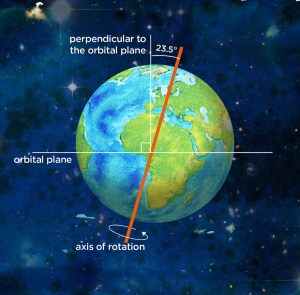
I had to inform my little step-granddaughter that she has to learn more about this before she brings it up; just give people a link to a good video and let them decided. At her young and tender age she should not bring this up in school, as the kids would laugh as well as the teacher. They will not take the time to study it and, quite frankly, people are too brainwashed. People, young and old, want to be part of a crowd and don’t want to be booted out because of their beliefs.

Some may say, “You should not have said anything to a 13 year old; maybe if she was older, OK.” I disagree with that. That is like saying, “You should not tell your child about Jesus Christ and the Old Testament stories as they would be laughed at. We all know that most people are not Christians at school and Christians seem to be keeping silent now. Yet, we Christians know that we should tell our children about the Bible. We know that they will get flack for their beliefs but we tell them anyway. Many children laugh at others about the Christian beliefs but that is just the chance they have to take. Naturally, we prepare them and say if they don’t want to listen, then don’t force it on them. The verbal attacks and snickers eventually stop and the kids play together again.

I hope that the above will give you some ideas of how to introduce the flat earth children. Children have a natural curiosity and they want to learn. So, we should introduce that to our teaching. When they learn the truth about this, they will – hopefully – learn other Bible truths. Thus, they are better prepared for life ahead. Truth helps people in life: they know what is right and wrong, who to trust, how to act, and how to live a good life.

Posted in Uncategorized | Tagged | Leave a comment

No Axial or Orbital Motion to the Earth

No Axial or Orbital Motion to the Earth

no earth axisIF a ball is allowed to drop from the mast-head of a ship at rest, it will strike the deck at the foot of the mast. If the same experiment is tried with a ship in motion, the same result will follow; because, in the latter case, the ball is acted upon simultaneously by two forces at right angles to each other–one, the momentum given to it by the moving ship in the direction of its own motion; and the other, the force of gravity, the direction of which is at right angles to that of the momentum. The ball being acted upon by the two forces together, will not go in the direction of either, but will take a diagonal course, as shown in the following diagram, fig. 46.
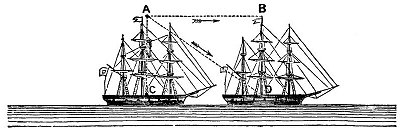
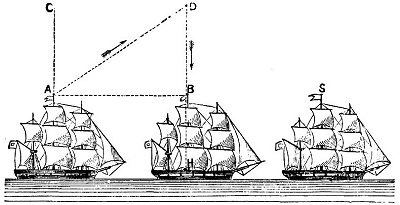
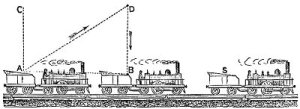
axial-fig46

FIG. 46.

The ball passing from A to C, by the force of gravity, and having, at the moment of its liberation, received a momentum . from the moving ship in the direction A, B, will, by the conjoint action of the two forces A, B, and A, C, take the direction A, D, falling at D, just as it would have fallen at C, had the vessel remained at rest.

It is argued by those who hold that the earth is a revolving globe, that if a ball is dropped from the mouth of a deep mine, it reaches the bottom in an apparently vertical direction, the same as it would if the earth were motionless. In the same way, and from the same cause, it is said that a ball allowed to drop from the top of a tower, will fall at the base. Admitting the fact that a ball dropped down a mine, or let fall from a high tower, reaches the bottom in a direction parallel to the side of either, it does not follow therefrom that the earth moves. It only follows that the earth might move, and yet allow of such a result. It is certain that such a result would occur on a stationary earth; and it is mathematically demonstrable that it would also occur on a revolving earth; but the question of motion or non-motion–of which is the fact it does not decide. It gives no proof that the ball falls in a vertical or in a diagonal direction. Hence, it is logically valueless. We must begin the enquiry with an experiment which does not involve a supposition or an ambiguity, but which will decide whether motion does actually or actually does not exist. It is certain, then, that the path of a ball, dropped from the mast-head of a stationary ship will be vertical. It is also certain that, dropped down a deep mine, or from the top of a high tower, upon a stationary earth, it would be vertical. It is equally certain that, dropped from the mast-head of a moving ship, it would be diagonal; so also upon a moving earth it would be diagonal. And as a matter of necessity, that which follows in one case would follow in every other case, if, in each, the conditions were the same. Now let the experiment shown in fig. 46 be modified in the following way:–

Let the ball be thrown upwards from the mast-head of a stationary ship, and it will fall back to the mast-head, and pass downwards to the foot of the mast. The same result would follow if the ball were thrown upwards from the mouth of a mine, or the top of a tower, on a stationary earth. Now put the ship in motion, and let the ball be thrown upwards. It will, as in the first instance, partake of the two motions–the upward or vertical, A, C, and the horizontal, A, B, as shown in fig. 47; but

axial-fig47

FIG. 47.

because the two motions act conjointly, the ball will take the diagonal direction, A, D. By the time the ball has arrived at D, the ship will have reached the position, 13; and now, as the two forces will have been expended, the ball will begin to fall, by the force of gravity alone, in the vertical direction, D, B, H; but during its fall towards H, the ship will have passed on to the position S, leaving the ball at H, a given distance behind it.

The same result will be observed on throwing a ball upwards from a railway carriage, when in rapid motion, as shown in the following diagram, fig. 48. While the carriage or tender passes

axial-fig48

FIG. 48.

from A to B, the ball thrown upwards, from A towards (2, will reach the position D; but during the time of its fall from D to B, the carriage will have advanced to S, leaving the ball behind at B, as in the case of the ship in the last experiment.

The same phenomenon would be observed in a circus, during the performance of a juggler on horseback, were it not that the balls employed are thrown more or less forward, according to the rapidity of the horse’s motion. The juggler standing in the ring, on the solid ground, throws his balls as vertically as he can, and they return to his hand; but when on the back of a rapidly-moving horse, he should throw the balls vertically, before they fell back to his hands, the horse would have taken him in advance, and the whole would drop to the ground behind him. It is the same in leaping from the back of a horse in motion. The performer must throw himself to a certain degree forward. If he jumps directly upwards, the horse will go from under him, and he would fall behind.

Thus it is demonstrable that, in all cases where a ball is thrown upwards from an object moving at right angles to its path, that ball will come down to a place behind the point from which it was thrown; and the distance at which it falls behind depends upon the time the ball has been in the air. As this is the result in every instance where the experiment is carefully and specially performed, the same would follow if a ball were discharged from any point upon a revolving earth. The causes or conditions operating being the same, the same effect would necessarily follow.

The experiment shown in fig. 49, demonstrates, however, that

axial-fig49

FIG. 49.

these causes, or conditions, or motion in the earth, do not exist.

A strong cast-iron cannon was placed with the muzzle upwards. The barrel was carefully tested with a plumb line, so that its true vertical direction was secured; and the breech of the gun was firmly embedded in sand up to the touch-hole, against which a piece of slow match was placed. The cannon had been loaded with powder and ball, previous to its position being secured. At a given moment the slow match at D was fired, and the operator retired to a shed. The explosion took place, and the ball was discharged in the direction A, B. In thirty seconds the ball fell back to the earth, from B to C; the point of contact, C, was only 8 inches from the gun, A. This experiment has been many times tried, and several times the ball fell back upon the mouth of the cannon; but the greatest deviation was less than 2 feet, and the average time of absence was 28 seconds; from which it is concluded that the earth on which the gun was placed did not move from its position during the 28 seconds the ball was in the atmosphere. Had there been motion in the direction from west to east, and at the rate of 600 miles per hour (the supposed velocity in the latitude of England), the result would have been as shown in fig. 49. The ball, thrown by the powder in the direction A, C, and acted on at the same moment by the earth’s motion in the direction A, B, would take the direction A, D; meanwhile the earth and the cannon would have reached the position B, opposite to D. On the ball beginning to descend, and during the time of its descent, the gun would have passed on to the position S, and the ball would have dropped at B, a consider-able distance behind the point S. As the average time of the ball’s absence in the atmosphere was 28 seconds–14 going upwards, and 14 in falling–we have only to multiply the time by the supposed velocity of the earth, and we find that instead of the ball coming down to within a few inches of the muzzle of the gun, it should have fallen behind it a distance of 8400 feet, or more than a mile and a half! Such a result is utterly destructive of the idea of the earth’s possible rotation.

The reader is advised not to deceive himself by imagining that the ball would take a parabolic course, like the balls and shells from cannon during a siege or battle. The parabolic curve could only be taken by a ball fired from a cannon inclined more or less from the vertical; when, of course, gravity acting in an angular direction against the force of the gunpowder, the ball would be forced to describe a parabola. But in the experiment just detailed, the gun was fixed in a perfectly vertical direction, so that the ball would be fired in a line the very contrary to the direction of gravity. The force of the powder would drive it directly upwards, and the force of gravity would pull it directly downwards. Hence it could only go up in a right line, and down or back to its starting point; it could not possibly take a path having the slightest degree of curvature. It is therefore demanded that, if the earth has a motion from west to east, a ball, instead of being dropped down a mine, or allowed to fall from the top of a tower, shall be shot upwards into the air, and from the moment of its beginning to descend, the surface of the earth shall turn from under its direction, and it would fall behind, or to the west of its line of descent. On making the most exact experiments, however, no such effect is observed; and, therefore, the conclusion is in every sense unavoidable, that THE EARTH HAS NO MOTION OF ROTATION.

EXPERIMENT 3

When sitting in a rapidly-moving railway carriage, let a spring-gun 1 be fired forward, or in the direction in which the train is moving. Again, let the same gun be fired, but in the opposite direction; and it will be found that the ball or other projectile will always go farther in the first case than in the latter.

If a person leaps backwards from a horse in full gallop, he cannot jump so great a distance as he can by jumping forward. Leaping from a moving sledge, coach, or other object, backwards or forwards, the same results are experienced.

Many other practical cases could be cited to show that any body projected from another body in motion, does not exhibit the same behaviour as it does when projected from a body at rest. Nor are the results the same when projected in the same direction as that in which the body moves, as when projected in the opposite direction; because, in the former case, the projected body receives its momentum from the projectile force, plus that given to it by the moving body; and in the latter case, this momentum, minus that of the moving body. Hence it would be found that if the earth is a globe, and moving rapidly from west to east, a cannon fired in a due easterly direction would send a ball to a greater distance than it would if fired in a due westerly direction. But the most experienced artillerymen–many of whom have had great practice, both at home and abroad, in almost every latitude–have declared that no difference whatever is observable. That in charging and pointing their guns, no, difference in the working is ever required, notwithstanding that the firing is at every point of the compass. Gunners in war ships have noticed a considerable difference in the results of their firing from guns at the bow, when sailing rapidly towards the object fired at, and when firing from guns placed at the stern while sailing away from the object: and in both cases the results are different to those observed when firing from a ship at perfect rest. These details of practical experience are utterly incompatible with the supposition of a revolving earth.

During the period of the Crimean War, the subject of gunnery, in connection with the earth’s rotation, was one which occupied the attention of many philosophers, as well as artillery officers and statesmen. About this time, Lord Palmerston, as Prime Minister, wrote the following letter to Lord Panmure, the Secretary for War:–

“December 20th, 1857.

“My dear Panmure.

“There is an investigation which it would be important and at the same time easy to make, and that is, whether the rotation of the earth on its axis has any effect on the curve of a cannon-ball in its flight. One should suppose that it has, and that while the cannon-ball is flying in the air, impelled by the gunpowder in a straight line from the cannon’s mouth, the ball would not follow the rotation of the earth in the same manner which it would do if lying at rest on the earth’s surface. If this be so, a ball fired in the meridional direction–that is to say, due south or due north–ought to deviate to the west of the object at which it was aimed, because during the time of flight, that object will have gone to the east somewhat faster than the cannon-ball will have done. In like manner, a ball fired due east, ought to fly less far upon the earth’s surface than a ball fired due west, the charges being equal, the elevation the same, and the atmosphere perfectly still. It must be remembered, however, that the ball, even after it has left the cannon’s mouth, will retain the motion from west to east which it had before received by the rotation of the earth on whose surface it was; and it is possible, therefore, that, except at very long ranges, the deviations above mentioned may in practice turn out to be very small, and not deserving the attention of an artilleryman. The trial might be easily made in any place in which a free circle of a mile or more radius could be obtained; and a cannon placed in the centre of that circle, and fired alternately north, south, east, and west, with equal charges, would afford the means of ascertaining whether each shot flew the same distance or not.

“Yours sincerely,

“PALMERSTON.”

The above letter was published, by Lord Dalhousie’s permission, in the “Proceedings of the Royal Artillery Institution for 1867.”

It will be observed that Lord Palmerston thought that firing eastwards, or in the direction of the earth’s supposed rotation, the ball would “fly less far upon the earth’s surface than a ball fired due west.” It is evident that his Lordship did not allow for the extra impulse given to the ball by the earth’s motion. But the answer given by the advocates of the theory of the earth’s motion is the following: Admitting that a ball fired from the earth at rest would go, say two miles, the same ball, fired from the earth in motion, would go, say three miles; but during the time the ball is passing through the air, the earth will advance one mile in the same direction. This one mile deducted from the three miles which the ball actually passes through the air, leaves the two miles which the ball has passed in advance of the cannon; so that practically the distance to which a ball is projected is precisely the same upon a moving earth as it is upon the earth at rest. The following diagram, fig. 50, will illustrate the path of a ball under the conditions above described.

axial-fig50

FIG. 50.

Let the curved line A, B, represent the distance a ball would fly from a cannon placed at A, upon the earth, at rest. Let A, C, represent the distance the same ball would fly from the conjoint action of the powder in the cannon, A, and the earth’s rotation in the direction A, C. During the time the ball would require to traverse the line A, C, the earth and the cannon would arrive at the point D; hence the distance D, C, would be the same as the distance A, B.

The above explanation is very ingenious, and would be perfectly satisfactory if other considerations were not involved in it. For instance, the above explanation does not prove the earth’s motion–it merely supposes it; but as in all other cases where the result of supposition is explained, it creates a dilemma. It demands that during the time the ball is in the air, the cannon is advancing in the direction of the supposed motion of the earth. But -this is granting the conditions required in the experiments represented by figs. 47, 48, and 49. If the cannon can advance in the one case, it must in the other; and as the result in the experiment represented at fig. 49, was that the ball, when fired vertically, essentially returned to the vertical cannon; that cannon could not have advanced, and therefore the earth could not have moved.

EXPERIMENT 4

Take a large grinding stone, and let the whole surface of the rim be well rubbed over with a saturated solution of phosphorus in olive oil; or cover the stone with several folds of coarse woollen cloth or flannel, which saturate with boiling water. If it be now turned rapidly round, by means of a multiplying wheel, the phosphoric vapour, or the steam from the flannel, which surrounds it and which may be called its atmosphere–analogous to the atmosphere of the earth–will be seen to follow the direction of the revolving surface. Now the surface of the earth is very irregular in its outline, mountains rising several miles above the sea, and ranging for hundreds of miles in every possible direction; rocks, capes, cliffs, gorges, defiles, caverns, immense forests, and every other form of ruggedness and irregularity calculated to adhere to and drag along whatever medium may exist upon it: and if it is a globe revolving on its axis, with the immense velocity at the equator of more than a thousand miles an hour, it is exceedingly difficult if not altogether impossible to conceive of such a mass moving at such a rate, and yet not taking the atmosphere along with it.

When it is considered, too, that the medium which it is said surrounds the earth and all the heavenly bodies, and filling all the vast spaces between them, is almost too ethereal and subtle to offer any sensible resistance, it is still more difficult to understand how the atmosphere can be prevented being carried forward with the earth’s rapidly revolving surface. Study the details of pneumatics or hydraulics as we may, we cannot suggest an experiment which will show the possibility of such a thing. Hence we are compelled to conclude that if the earth revolves, the atmosphere revolves also, and in the same direction. If the atmosphere rushes forward from west to east continually, we are again obliged to conclude that whatever floats or is suspended in it, at any altitude, must of necessity partake of its eastward motion. A piece of cork, or any other body floating in still water, will be motionless, but let the water be put in motion, in any direction whatever, and the floating bodies will move with it, in the same direction and with the same velocity. Let the experiment be tried in every possible way, and these results will invariable follow. Hence if the earth’s atmosphere is in constant motion from west to east, all the different strata which are known to exist in it, and all the various kinds of clouds and vapours which float in it must of mechanical necessity move rapidly eastwards. But what is the fact? If we fix upon any star as a standard or datum outside the visible atmosphere, we may sometimes observe a stratum of clouds going for hours together in a direction the very opposite to that in which the earth is supposed to be moving. See fig. 51, which represents a section of a

axial-fig51

Fig. 51

globe, surrounded with an atmosphere, moving at the rate of 1042 miles an hour at the equator, and in the direction of the arrows 1, 2, 3, while a stream of clouds are moving in the opposite direction, as indicated by the arrows, 4, 5, 6. Not only may a stratum of clouds be seen moving rapidly from east to west, but at the same moment other strata may often be seen moving from north to south, and from south to north. It is a fact well known to aeronauts, that several strata of atmospheric air are often moving in as many different directions at the same time. It is a knowledge of this fact which leads an experienced aeronaut, when desiring to rise in a balloon, and to go in a certain direction, not to regard the manner in which the wind is blowing on the immediate surface of the earth, because he knows that at a greater altitude, it may be going at right angles, or even in opposite and in various ways simultaneously. To ascertain whether and at what altitude a current is blowing in the desired direction, small, and so-called “pilot-balloons” are often sent up and carefully observed in their ascent. If during the passage of one of these through the variously moving strata, it is seen to enter a current which is going in the direction desired by the aëronaut, the large balloon is then ballasted in such a manner that it may ascend at once to the altitude of such current, and thus to proceed on its journey.

On almost any moonlight and cloudy night, different strata may be seen not only moving in different directions but, at the same time, moving with different velocities; some floating past the face of the moon rapidly and uniformly, and others passing gently along, sometimes becoming stationary, then starting fitfully into motion, and often standing still for minutes together. Some of those who have ascended in balloons for scientific purposes have recorded that as they have rapidly passed through the atmosphere, they have gone though strata differing in temperature, in density, and in hygrometric, magnetic, electric, and other conditions. These changes have been noticed both in ascending and descending, and in going for miles together at the same altitude.

“On the 27th November, 1839, the sky being very clear, the planet Venus was seen near the zenith, notwithstanding the brightness of the meridian sun. It enabled us to observe the higher stratum of clouds to be moving in an exactly opposite direction to that of the wind–a circumstance which is frequently recorded in our meteorological journal both in the north-east and south-east trades, and has also often been observed by former voyagers. Captain Basil Hall witnessed it from the summit of the Peak of Teneriffe; and Count Strzelechi, on ascending the volcanic mountain of Kiranea, in Owhyhee, reached at 4000 feet an elevation above that of the trade wind, and experienced the influence of an opposite current of air of a different hygrometric and thermometric condition. . . . Count Strzelechi further informed me of the following seemingly anomalous circumstance–that at the height of 6000 feet he found the current of air blowing at right angles to both the lower strata, also of a different hygrometric and thermometric condition, but warmer than the inter-stratum.” 1

Such a state of the atmosphere is compatible only with the fact which other evidence has demonstrated, that the earth is at rest. Were it otherwise-if a spherical mass of eight thousand miles in diameter, with an atmosphere of only fifty miles in depth, or relatively only as a sheet of note paper pasted upon a globe of one yard in diameter, and lying upon a rugged, adhesive, rapidly revolving surface, there is nothing to prevent such an atmosphere becoming a mingled homogeneous mass of vapour.

Notwithstanding that all practical experience, and all specially instituted experiments are against the possibility of a moving earth, and an independent moving and non-moving atmosphere, many mathematicians have endeavoured to “demonstrate” that with regard to this earth, such was actually the case. The celebrated philosophic divine, Bishop Wilkins, was reasoned by the theorists of his day into this belief; and, in consequence, very naturally suggested a new and easy way of travelling. He proposed that large balloons should be provided with apparatus to work against the varying currents of the air. On ascending to a proper altitude, the balloon was to be kept practically in a state of rest, while the earth revolved underneath it; and when the desired locality came into view, to stop the working of the fans, &c., to let out the gas, and drop down at once to the earth’s surface. In this simple way New York would be reached in a few hours, or rather New York would reach the balloon, at the rate, in the latitude of England, of more than 600 miles an hour.

The argument involved in the preceding remarks against the earth’s rotation has often been met by the following, at first sight, plausible statement. A ship with a number of passengers going rapidly in one continued direction, like the earth’s atmosphere, could nevertheless have upon its deck a number of distinctly and variously moving objects, like the clouds in the atmosphere. The clouds in the atmosphere are compared to the passengers on the deck of a ship; so far the cases are sufficiently parallel, but the passengers are sentient beings, having within themselves the power of distinct and independent motions: the clouds are the reverse; and here the parallelism fails. One case is not illustrative of the other, and the supposition of rotation in the earth remains without a single fact or argument in its favour. Birds in the air, or fish and reptiles in the water, would have offered a parallel and illustrative case, but these, like the passengers on the ship’s deck, are sentient and independent beings; clouds and vapours are dependent and non-sentient, and must therefore of necessity move with, and in the direction of, the medium in which they float.

Everything actually observable in Nature; every argument furnished by experiment; every legitimate process of reasoning; and, as it would seem, everything which it is possible for the human mind practically to conceive, combine in evidence against the doctrine of the earth’s motion upon axes.

ORBITAL MOTION.–The preceding experiments and remarks, logically and mathematically suffice as evidence against the assumed motion of the earth in an orbit round the sun. It is difficult, if not impossible, to understand how the behaviour of the ball thrown from a vertical gun should be other in relation to the earth’s forward motion in space, than it is in regard to its motion upon axes. Besides, it is demonstrable that it does not move upon axes, and therefore, the assumption that it moves in an orbit, is utterly useless for theoretical purposes. The explanation of phenomena, for which the theory of orbital and diurnal motion was framed, is no longer possible with a globular world rushing through space in a vast elliptical orbit, but without diurnal rotation. Hence the earth’s supposed orbital motion is logically void, and non-available, and there is really no necessity for either formally denying it, or in any way giving it further consideration. But that no point may be taken without direct and practical evidence, let the following experiment be tried.

Take two carefully-bored metallic tubes, not less than six feet in length, and place them one yard asunder, on the opposite sides of a wooden frame, or a solid block of wood or stone: so adjust them that their centres or axes of vision shall be perfectly parallel to each other. The following diagram will show the arrangement.

axial-fig52

Fig. 52

Now, direct them to the plane of some notable fixed star, a few seconds previous to its meridian time. Let an observer be stationed at each tube, as at A, B; and the moment the star appears in the tube A, T, let a loud knock or other signal be given, to be repeated by the observer at the tube B, T, when he first sees the same star. A distinct period of time will elapse between the signals given. The signals will follow each other in very rapid succession, but still, the time between is sufficient to show that the same star, S, is not visible at the same moment by two parallel lines of sight A, S, and B, C, when only one yard asunder. A slight inclination of the tube, B, C, towards the first tube A, S, would be required for the star, S, to be seen through both tubes at the same instant. Let the tubes remain in their position for six months; at the end of which time the same observation or experiment will produce the same results–the star, S, will be visible at the same meridian time, without the slightest alteration being required in the direction of the tubes: from which it is concluded that if the earth had moved one single yard in an orbit through space, there would at least be observed the slight inclination of the tube, B, C, which the difference in position of one yard had previously required.

But as no such difference in the direction of the tube B, C, is required, the conclusion is unavoidable, that in six months a given meridian upon the earth’s surface does not move a single yard, and therefore, that the earth has not the slightest degree of orbital motion.

Copernicus required, in his theory of terrestrial motions, that the earth moved in an extensive elliptical path round the sun, as represented in the following diagram, fig 53, where S is the

axial-fig53

Fig. 53

sun, A, the earth in its place in June, and B, its position in December; when desired to offer some proof of this orbital motion he suggested that a given star should be selected for observation on a given date; and in six months afterwards a second observation of the same star should be made. The first observation A, D, fig. 53, was recorded; and on observing again at the end of six months, when the earth was supposed to have passed to B, the other side of its orbit, to the astonishment of the assembled astronomers, the star was observed in exactly the same position, B, C, as it had been six months previously! It was expected that it would be seen in the direction B, D, and that this difference in the direction of observation would demonstrate the earth’s motion from A to B, and also furnish, with the distance A, S, B, the elements necessary for calculating the actual distance of the star D.

The above experiment has many times been tried, and always with the same general result. No difference whatever has been observed in the direction of the lines of sight A, D, and B, C, whereas every known principle of optics and geometry would require, that if the earth had really moved from A to B, the fixed star D, should be seen in the direction B, D. The advocates of this hypothesis of orbital motion, instead of being satisfied, from the failure to detect a difference in the angle of observation, that the earth could not possibly have changed its position in the six months, were so regardless of all logical consistency, that instead of admitting, and accepting the consequences, they, or some of them, most unworthily declared that they could not yield up the theory, on account of its apparent value in explaining certain phenomena, but demanded that the star D, was so vastly distant, that, notwithstanding that the earth must have moved from A to B, this great change of position would not give a readable difference in the angle of observation at B, or in other words the amount of parallax (” annual parallax,” it was called) was inappreciable!

Since the period of the above experiments, many have declared that a very small amount of “annual parallax” has been detected. But the proportion given by different observers has been so various, that nothing definite and satisfactory can yet be decided upon. Tycho Brahe, Kepler, and others, rejected the Copernican theory, principally

p. 83

eon account of the failure to detect displacement or parallax of the fixed stars. Dr. Bradley declared that what many had called “parallax,” was merely “aberration.” But “Dr. Brinkley, in 1810, from his observations with a very fine circle in the Royal Observatory of Dublin, thought he had detected a parallax of 1″ in the bright star Lyra (corresponding to an annual displacement of 2″). This, however, proved to be illusory; and it was not till the year 1839, that Mr. Henderson, having returned from filling the situation of astronomer royal to the Cape of Good Hope, and discussing as series of observations made there with a large “mural circle,” of the bright star, α Centauri, was enabled to announce as a positive fact the existence of a measurable parallax for that star, a result since fully confirmed with a very trifling correction by the observations of his successor, Sir T. Maclear. The parallax thus assigned α Centauri, is so very nearly a whole second in amount (0″.98), that we may speak of it as such. It corresponds to a distance from the sun of 18,918,000,000,000 British statute miles.

“Professor Bessel made the parallax of a star in the constellation Cygnus to be 0″.35. Later astronomers, going over the same ground, with more perfect instruments, and improved practice in this very delicate process ‘of observation, have found a somewhat larger result, stated by one at 0″.57, and by another at 0″.51, so that we may take it at 0″.54, corresponding to somewhat less than twice the distance of a Centauri;” 1 or to nearly 38 billions of miles.

It might seem to a non-scientific mind that the differences above referred to of only a few fractions of a second in the parallax of a star, constitute a very slight amount; but in reality such differences involve differences in the distance of such stars of millions of miles, as will be seen by the following quotation from the Edinburgh Review for June, 1850:–

“The rod used in measuring a base line is commonly ten feet long; and the astronomer may be said only to apply this very rod to measure the distance of the fixed stars! An error in, placing a fine dot, which fixes the length of the rod, amounting to one five-thousandth part of an inch, will amount to an excess, of 70 feet in the earth’s diameter; of 316 miles in the sun’s distance, and to 65,200,000 miles in that of the nearest fixed star!

“The second point to which we would advert is, that as the astronomer in his observatory has nothing to do with ascertaining length as distances, except by calculation, his whole skill and artifice are exhausted in the measurement of angles. For it is by these alone that spaces inaccessible can be compared. Happily a ray of light is straight. Were it not so (in celestial spaces at least) there were an end of our astronomy. It is as inflexible as adamant, which our instruments unfortunately are not. Now an angle of a second (3600 to a degree), is a subtle thing, it is an apparent breadth, utterly invisible to the unassisted eye, unless accompanied by so intense a splendour (as in the case of the fixed stars) as actually to raise by its effect on the nerve of sight a spurious image, having a sensible breadth. A silkworm’s fibre subtends an angle of one second at 3½ feet distance. A ball 2½ inches in diameter must be removed in order to subtend an angle of one second, to 43,000 feet, or about 8 miles; while it would be utterly invisible to the sharpest sight aided even by a telescope of some power. Yet it is on the measurement of one single second that the ascertainment of a sensible parallax in any fixed star depends; and an error of one-thousandth of that amount (a quantity still immeasurable by the most perfect of our instruments) would place a fixed star too far or too near by 200,000,000,000 of miles.”

Sir John Herschel says:–

“The observations require to be made with the very best instruments, with the minutest attention to everything which can affect their precision, and with the most rigorous application of an innumerable host of ‘corrections,’ some large, some small, but of which the smallest, neglected or erroneously applied, would be quite sufficient to overlay and conceal from view the minute quantity we are in search of. To give some idea of the delicacies which have to be attended to in this inquiry, it will suffice to mention that the stability not only of the instruments used and the masonry which supports them, but of the very rock itself on which it is founded, is found to be subject to annual fluctuations capable of seriously affecting the result.”

Dr. Lardner, in his “Museum of Science,” page 179, makes use of the following words

“Nothing in the whole range of astronomical research has more baffled the efforts of observers than this question of the parallax. * * * Now, since, in the determination of the exact uranographical position of a star, there are a multitude of disturbing effects to be taken into account and eliminated, such as precession, nutation, aberration, refraction, and others, besides the proper motion of the star; and since, besides the errors of observation, the quantities of these are subject to more or less uncertainty, it will astonish no one to be told that they may en-tail upon the final result of the calculation, an error of 1″; and if they do, it is vain to expect to discover such a residual phenomenon as parallax, the entire amount of which is less than one second.”

The complication, uncertainty, and unsatisfactory state of the question of annual parallax, and therefore of the earth’s motion in an orbit round the sun, as indicated by the several paragraphs above quoted, are at once and for ever annihilated by the simple fact, experimentally demonstrable, that upon a base line of only a single yard, there may be found a parallax, as certain and as great, if not greater, than that which astronomers pretend to find with the diameter of the earth’s supposed orbit of many millions of miles as a base line. To place the whole matter, complicated, uncertain, and unsatisfactory as it is, in a concentrated form, it is only necessary to state as an absolute truth the result of actual experiment, that, a given fixed star will, when observed from the two ends of a base line of not more than three feet, give a parallax equal to that which it is said is observed only from the two extremities of the earth’s orbit, a distance or base line, of one hundred and eighty millions of miles! So far, then, from the earth having passed in six months over the vast space of nearly two hundred millions of miles, the combined observations of all the astronomers of the whole civilized world have only resulted in the discovery of such elements, or such an amount of annual parallax, or sidereal displacement, as an actual change of position of a few feet will produce. It is useless to say, in explanation, that this very minute displacement, is owing to the almost infinite distance of the fixed stars; because the very same stars show an equal degree of parallax from a very minute base line; and, secondly, it will be proved from practical data, in a subsequent chapter, that all the luminaries in the firmament are only a few thousand miles from the surface of the earth.

Footnotes

69:1 The barrel containing a spiral spring, so that the projecting force will always be the same, which might not be so with gunpowder.

77:1 “South Sea Voyages,” p. 14, vol. i. By Sir James Clarke Ross, R.N.

83:1 Sir John F. W. Herschel, Bart., in “Good Words.”

Next: Chapter IV. The True Form and Magnitude of the Earth

Posted in Flat Earth Experiments, Reference Materials | Tagged | Leave a comment

Cause of Sunrise and Sunset

sun earth distance  ALTHOUGH the sun is at all times above the earth’s surface, it appears in the morning to ascend from the north-east to the noonday position, and thence to descend and disappear, or set, in the north-west. This phenomenon arises from the operation of a simple and everywhere visible law of perspective. A flock of birds, when passing over a flat or marshy country, always appears to descend is it recedes; and if the flock is extensive, the first bird appears lower or nearer to the horizon than the last, although they are at the same actual altitude above the earth immediately beneath them. When a balloon sails away from an observer, without increasing or decreasing its altitude, it appears to gradually approach the horizon. In a long row of lamps, the second–supposing the observer to stand at the beginning of the series—will appear lower than the first; the third lower than the .second; and so on to the end of the row; the farthest away always appearing the lowest, although each one has the same altitude; and if such a straight line of lamps could be continued far enough, the lights would at length descend, apparently, to the horizon, or to a level with the eye of the observer, as shown in the following diagram, fig. 63.

cause-of-sunrise-1

FIG. 63.

Let A, B, represent the altitude throughout of a long row of lamps, standing on the horizontal ground E, D; and C, H, the line of sight of an observer at C. The ordinary principles of perspective will cause an apparent rising of the ground E, D, to the eye-line C, H, meeting it at H; and an apparent descent of each subsequent lamp, from A, to H, towards the same eye-line, also meeting at H. The point H, is the horizon, or the true “vanishing point,” at which the last visible lamp, although it has really the altitude D, B, will disappear.

Bearing in mind the above phenomena it will easily be seen how the sun, although always above and parallel to the earth’s surface, must appear to ascend from the morning horizon to the noonday or meridian position; and thence to descend to the evening horizon.

In the diagram, fig. 64, let the line E, D, represent the

cause-of-sunrise-2

FIG. 64.

surface of the earth; H, H, the morning and evening horizon; and A, S, B, a portion of the true path of the sun. An observer at 0, looking to the east, will first see the sun in the morning, not at A, its true position, but in its apparent position, H, just emerging from the “vanishing point,” or the morning horizon. At nine o’clock, the sun will have the apparent position, 1, gradually appearing to ascend the line H, 1, S; the point S, being the meridian or noonday position. From S, the sun will be seen to gradually descend the line S, 2, H, until he reaches the horizon, H, and entering the “vanishing point,” disappears, to an observer in England, in the west, beyond the continent of North America, as in the morning he is seen to rise from the direction of Northern Asia. An excellent illustration of this “rising” and “setting” of the sun may be seen in a long tunnel, as shown in diagram, fig. 65. The top of the tunnel,

cause-of-sunrise-3

FIG. 65.

1, 2, and, the bottom, 3, 4, although really equi-distant throughout the whole length, would, to an observer in the centre, C, appear to approach each other, and converge at the points, H, H; and a lamp, or light of any kind, brought in, and carried along the top, close to the upper surface 1, 2, would, when really going along the line, 1, S, 2, appear to ascend the inclined plane H, S, to the centre, S, and after passing the centre, to descend the plane S, H; and if the tunnel were sufficiently long, the phenomena of sunrise and of sunset would be perfectly imitated.

A very striking illustration of the convergence of the top and bottom, as well as the sides, of a long tunnel, has been observed in that of Mont Cenis. M. de Porville, when in the centre of the tunnel, noticed that the entrance had apparently become so small that the daylight beyond it seemed like a bright star. “Before us, at an apparently prodigious distance, we beheld a small star at the entrance of the gallery. Its vivid light contrasted strangely with the red glare of the lamps. Its brightness increased as the horses dashed on the way. In a short time its proportions were more clearly defined, and its volume increased. The illusion was quickly dispelled as we got over some kilometres. This soft white light is the extremity of the gallery.” 1

We have seen that “sunrise” and “sunset” are phenomena dependent entirely upon the fact that horizontal lines, parallel to each other, appear to approach or converge in the distance. The surface of the earth being horizontal, and the line of sight of the observer and the sun’s path being over and parallel with it, the rising and setting of the moving sun over the immovable earth are simply phenomena arising necessarily from the laws of perspective.

Footnotes

127:1 “Morning Advertiser,” September 16th, 1871.

Posted in Sun Moon Stars | Tagged , | Leave a comment

Kent Hovind and the Flat Earth, part 2

kent hovind flat earth

To see the video, click here.

This video starts off with Edrique who said he called a travel agency to see if they have cruises from South America to New Zealand, which they said they did. He found out how long the cruise is and the average speed of the ship. With this, he commutated that it would be impossible for the earth to be round, as the distance would be too great (on a flat earth model the distance is much greater near the southern ridge). He said he had asked around for the answer from flat earthers and he got none. He said he would like to hear any answers from flat earth believer (this would be replying in the video Comments section).

My response

Firstly, I’m sure there are flat earth believers that did respond but he didn’t bother to answer. If that is the case, here is my response below. Secondly, there have been some very good comments under this video and I don’t see ANY response from Edrique or Kent Hovind! WHY? This is strange – for someone who claims to want to get to the truth of this matter.

My response to both of these gentlemen are: Did you actually go on the cruise? If so, did you add in the number of days at sea to see (approximately) how many miles traveled? NO, they didn’t. If he did, he would find out that they lied or that the trip does not take him to the places they said. How can I say that? Easy.

There was another man who tried to prove the same thing but with a flight from Santiago, Chile to Australia. He tried to book online and he found out that along the way, he came to a page where the clicked area was greyed out – he could not proceed any further! Tricky, huh?

He did some more checking and found out the other flights from Chile went via Huston, Texas, then a stop over in Los Angeles, THEN to Australia. He asked why instead of flying directly there. He was told “they had to pick up some passengers in Huston!” Could you believe such nonsense? Yet, this is what they tell people and people believe it.

For people who know the United States, if you were to take a bus from Tucson, Arizona to Huston, would the bus to go Denver to pick up passengers? Of course not. Would the people believe it? In this case, people would know that the travel agent was lying; and if they really did that, there was some other reason that they were keeping secret. Sure, there may be people in Denver who want to go to Huston, but they would get on their own bus! The same with a plane. Yes, if you were to take a flight like this, you would be picking up passengers in Huston and Los Angeles but a plane would not go out of its way to do so IF there was a direct flight from Chile to Australia AND if the flight was shorter. The fact is, the flight would be too long and they would run out of fuel with no place to stop. And this would be the case for a flat earth model.

Edrique might be nieve about Polars Cruise Lines telling them a lie. But if he knows the guy he is working for (Kent Hovind) he would know about the lies that professors, teachers, the media, and just about everyone else in power tell about evolution. Now, if you say that these evolutions are only repeating what they are told and really believe it. This may be so. However, we know the deliberate lies that are told the the U.S. Government that some Middle East terrorist blew up the World Trade Towers. What about the deliberate lie of a how a plane can completely disintegrate a steel structure building. We are told this from official sources, so why not a cruise lines tell a lie about a trip and engage in “bait and switch” tacit? Edrique could book a cruise, put up a deposit and, in a couple of weeks get a call from them to say, “that trip is cancelled, but there is another one available”! A cruse agency could be told by the government to “create” a trip like this but the real purpose in doing so would be to fool the public. The military knowing full well that a trip from South America to Austrail would not be possible so no trip could be made WITHOUT people finding out how that the distance is much greater than a ball earth that is 25,000 miles in circumference.

In short, talking to a travel agent does not prove the earth is a ball.

6:30 “I have yet to see any explanations of the tides. Others have said that there are channels in the earth that affects it.” This is what Edrique said. Did he listen to what he said?! First, he said there were no explanations of why the tides work, then, in the next breath, he gives an answer to what, apparently, a flat earther said. So, this doesn’t count? Apparently that’s how he handles answers that he doesn’t like – he says has not received any answers. Well, this is an answer that, apparently he doesn’t like. So, how do you get through these people?

There are channels in the earth that the oceans drain through that causes the tides and NOT gravity or the pull of the moon. This is why lakes, streams and small bodies of water are not effected. If, what we are told is true, that the moon affects the tides, then it should affect small bodies of water such as lakes, too. In fact, the high and low tide would be much greater as there is “less water to pull!” But it doesn’t and that is ether because it is an enclosed body of water or that the channels are not anywhere near them. For example, the Mediterranean is not affected by tides of any appreciable amount.

14:35 Here, Edrique quotes some Bible verses. I Samuel 2:8, Isaia 40:22, Matthew 24:30, Isaiah 11:12.

I Samuel 2:8

(1Sa 2:8) He raiseth up the poor out of the dust, and lifteth up the beggar from the dunghill, to set them among princes, and to make them inherit the throne of glory: for the pillars of the earth are the LORD’S, and he hath set the world upon them.

Pillars of the earth. He said that there are only 3-4 verses in the Bible that says that. Even if that is so, how many verses does he need? God could say something once and that should be enough. So, this is one of the reasons why this verse is discounted for support of the flat earth model. Visser is asking, “Is this a metaphorical way of explaining something?” This he believes and so does Hovind. IN fact all the verse that the flat earth believers show – that the earth is stationary and does not move – is explained by these two that these verses should not be interpreted literally.

This is just a cop-out on their part.

In the above verse, Edrique said that pillars symbolising strength; strength of the Lord. Yet, the verse plainly says, and it’s on the screen as he talks, “…for the pillars of the earth is the Lord’s…”. So the pillars are related to the earth not to God himself.

If you listen closely, you’ll hear that Edrique does not believe in the pillars of the earth, then Kent says that, “The earth does have pillars,” and Edrique shakes his head in a yes direction. So, why is this guy vacillating back and forth?

18:30 The talk is on Isaiah 40:22 where is stays:

It is he that sitteth upon the circle of the earth, and the inhabitants thereof are as grasshoppers; that stretcheth out the heavens as a curtain, and spreadeth them out as a tent to dwell in:

He goes on to say that, “a circle is a two dimensional object,” and Kent adds that it’s really a imaginary construct. Kent says, “It doesn’t have any depth at all or it would be cylinder.” He adds later, “that a circle does not exist.” (20:57).

Now, what they are both doing is splitting hairs, as it were. OK, so technically, this is the case in

2-D geometry, but do they really think that God meant it that way? No, a circle certainly indicates that something is flat whereas a ball – which is the word that Isaiah used in an earlier verse is something different. We use the word “circle” in a matter of speaking and we don’t have to explain it to anyone.

If they believe in a flat earth – just for a moment as a point of illustration – that God is above and that the flat round earth is below, you would use the word “circle.” They would use the word “circle,” too. It’s clearly understood by all, but they want to get into some mathematical technical meaning and say that it doesn’t mean a flat earth.

When God spoke that he stretched out the heavens as a curtain, again, Edrique said this is metaphorical; that the heavens are not a curtain. Well, of course, flat earth believers KNOW this, but the words God used is “liken to” is what it really means. This is so we can understand what he is talking about. We know that the heavens is not a curtain or a tent (another word that Isaiah uses) but it is understood that there is a covering of some kind over the earth. And this is the message we are to get – that there is some kind of physical object. That’s the point – A PHYSICAL OBJECT – not trillions of miles of endless empty space. This is the meaning that God conveyed and it was understood by early Christians and those that pre-date them in the Old Testament. It is when people like Kent comes along and makes the simple and the plain complex. They say that is only meant to be metaphorical.

22:55 Matthew 24:30

And then shall appear the sign of the Son of man in heaven: and then shall all the tribes of the earth mourn, and they shall see the Son of man coming in the clouds of heaven with power and great glory.

Flat earthers believe that all the tribes would be able to see God at once and that this would not be possible on a globe earth. Kent said, “That this prophecy can be answered by television and the internet.” I don’t know about that – that God would use man’s technology to make himself known world wide. I believe he will just show his glory and presence without man-made technology.

Kent mentioned something from the Bible with words to the effect, “Your sins shall be separated as far as the east is from the west.” Then, he pulls out his globe and shows that you can always go east on a globe, and he takes his finger and goes around it. “Hey, science teacher, you can go around a flat disk just the same!” Has he forgotten his geometry, which he said he taught for 15 years?!

As a side note to those who might be globe earth believers that are reading this, that when flat earth believers say the earth is flat, or that is like a round disk, we mean that it does have thickness to it but that it’s not a ball. But this is where the globe earth believers will pick at little straws in order to make their belief look right.

27:00 There is some talk about what flat earthers believe that the only people who can go to the Antarctica are those in the military, those doing scientific experiments and those who are on a trip but basically it is off limits under the Antarctica Treaty. Kent then said, “Because they believe it’s some kind of conspiracy.” In other words, he was making fun of flat earth believers. He, of all people should not make fun of conspiracy theorist, as he believes in many of them, himself. In fact, he knows of the evolutionist conspiracy, so why be surprised. He may doubt, he may laugh but let him try to go there himself. Let him tell the military that he will hire a plane to fly across it and he’ll find out the hard way. But of course, he won’t do this, as it would prove that what flat earthers say – that they will not let anyone into the interior.

31:30 Does God have feet? Kent said, “Come on it’s a metaphor.”

32:18 Edrique said, “I only found a verse that says, God has an arm and a hand, but not one that says that God has two feet.”

Can you image that? Do they really think that God has no feet? Is he making fun of God? Or, does he think that God is some form of energy mass like many of the New Age believers?

You’ve got to listen to this part of the video. So, they are turning God’s footstool into a metaphor, too. I notice that when you are talking to Christians who don’t believe in the flat earth, they conveniently use verses that refers to the earth as metaphors.

This is the end of video 2.

Posted in Bible and science, flat earth discussion | Tagged | Leave a comment

The True Distance From the Sun

The True Distance The Sun is From The Earth

sun earth distance

Zetetic Astronomy

by ‘Parallax’

(Samuel Birley Rowbotham)

1881

IT is now demonstrated that the earth is a plane, and therefore the distance of the sun may be readily and most accurately ascertained by the simplest possible process. The operation is one in plane trigonometry, which admits of no uncertainty and requires no modification or allowance for probable influences. The principle involved in the process may be illustrated by the following diagram, fig. 56.

sun earth distance

FIG 56

Let A be an object, the distance of which is desired, on the opposite side of a river. Place a rod vertically at the point C, and take a piece of strong cardboard, in the shape of a right-angled triangle, as B, C, D. It is evident that placing the triangle to the eye, and looking along the side D, B, the line of sight D, B, H, will pass far to the left of the object A. On removing the triangle more to the right, to the position E, the line E, F, will still pass to the left of A; but on removing it again to the right, until the line of sight from L touches or falls upon the object A, it will be seen that L, A, bears the same relation to A, C, L, as D, B, does to B, C, D: in other words, the two sides of the triangle B, C, and C, D, being equal in length, so the two lines C, A, and C, L, are equal. Hence, if the distance from L to C is measured, it will be in reality the same as the desired distance from C to A. It will be obvious that the same process applied vertically is equally certain in its results. On one occasion, in the year 1856, the author having previously delivered a course of lectures in Great Yarmouth, Norfolk, and this subject becoming very interesting to a number of his auditors, an invitation was given to meet him on the sea-shore; and among other observations and experiments, to measure, by the above process, the altitude of the Nelson’s Monument, which stands on the beach near the sea. A piece of thick cardboard was cut in the form of a right-angled triangle, the length of the two sides being about 8 inches. A fine silken thread, with a pebble attached, constituted a plumb line, fixed with a pin to one side of the triangle, as shown at P, . The purpose of this plumb line was to enable the observer to keep the triangle in a truly vertical position; just as the object of the rod C, in fig. 56 was to enable the base of the triangle to be kept in one and the same line by looking along from E and L towards C. On looking over the triangle held vertically, and one side parallel with the plumb line P, from the position A, the line of sight fell upon the point B; but on walking gradually backwards, the top of the helmet D, on the head of the figure of Britannia, which surmounts the column, was at length visible from the point C. On prolonging the line D, C, to H, by means of a rod, the distance from H to the centre of the Monument at O, was measured, and the altitude O, D, was affirmed to be

sun earth distance

FIG. 57

the same. But of this no proof existed further than that the principle involved in the triangulation compelled it to be so. Subsequently the altitude was obtained from a work published in Yarmouth, and was found to differ only one inch from the altitude ascertained by the simple operation above described. The foregoing remarks and illustrations are, of course, not necessary to the mathematician; but may be useful to the general reader, showing him that plane trigonometry, carried out on the earth’s plane or horizontal surface, permits of operations which are simple and perfect in principle, and in practice fully reliable and satisfactory.

The illustrations given above have reference to a fixed object; but the sun is not fixed; and therefore a modification of the process, but involving the same principle, must be adopted. Instead of the simple triangle and plumb line, represented in fig. 57, an instrument with a graduated arc must be employed, and two observers, one at each end of a north and south base line, must at the same moment observe the under edge of the sun as it passes the meridian; when, from the difference in the angle observed, and the known length of the base line, the actual distance of the sun may be calculated. The following case will fully illustrate this operation, as well as its results and importance:

The distance from London Bridge to the sea-coast at Brighton, in a straight line, is 50 statute miles. On a given day, at 12 o’clock, the altitude of the sun, from near the water at London Bridge, was found to be 61 degrees of an arc; and at the same moment of time the altitude from the sea-coast at Brighton was observed to be 64 degrees of an arc, as shown in fig. 58. The base-line from L to B, 50 measured statute miles; the angle at L, 61 degrees; and the angle at B, 64 degrees. In addition to the method by calculation, the distance of the under edge of the sun may be ascertained from these elements by the method called “construction.” The diagram, fig. 58, is the above case “constructed;” that is, the base-line from L to B represents 50 statute miles; and the line L, S, is drawn at an angle of 61 degrees, and the line B, S, at an angle of 64 degrees. Both lines are produced until they bisect or cross each other at the point S. Then, with a pair of compasses, measure the length of the base-line B, L, and see how many times the same length may be found in the line L, S, or B, S. It will be found to be

sun earth distance

FIG. 58

sixteen times, or sixteen times 50 miles, equal to 800 statute miles. Then measure in the same way the vertical line D, S, and it will be found to be 700 miles. Hence it is demonstrable that the distance of the sun over that part of the earth to which it is vertical is only 700 statute miles. By the same mode it may be ascertained that the distance from London of that part of the earth where the sun was vertical at the time (July 13th, 1870) the above observations were taken, was only 400 statute miles, as shown by dividing the base-line L, D, by the distance B, L. If any allowance is to be made for refraction–which, no doubt, exists where the sun’s rays have to pass through a medium, the atmosphere, which gradually increases in density as it approaches the earth’s surface–it will considerably diminish the above-named distance of the sun; so that it is perfectly safe to affirm that the under edge of the sun is considerably less than 700 statute miles above the earth.

The above method of measuring distances applies equally to the moon and stars; and it is easy to demonstrate, to place it beyond the possibility of error, so long as assumed premises are excluded, that the moon is nearer to the earth than the sun, and that all the visible luminaries in the firmament are contained within a vertical distance of 1000 statute miles. From which it unavoidably follows that the magnitude of the sun, moon, stars, and comets is comparatively small–much smaller than the earth from which they are measured, and to which, therefore, they must of necessity be secondary. and subservient. They cannot, indeed, be anything more than “centres of action,” throwing down light, and chemical products upon the earth.

Posted in Flat Earth Experiments, Sun Moon Stars | Tagged , | 2 Comments