
A Classic Flat Earth Interview
5 October, 2026
Dave Weiss, the man we have to thank for promoting the flat earth more than anyone else. Though, my hat goes off to anyone who shares the flat earth truth. But I would like to make a comment on what Dave had said on some interviews. He believes in the law of attraction; He said, “it really works.” I once believed in LofA but that was many years ago but now I don’t. The two videos below will help explain that.
This article is for those who believes in “the law of attraction,” which is no law at all – they just call it that! Now Dave had about 150,000 people on his flat earth map (my figure might be wrong but the number is up there). While that is many, and if what Dave said (about LofA) “It’s really true, try it,” then why hasn’t he attracted 10 million to his app? What about one million? Why not, as this is still a tiny fraction of the population of the world – even of the U.S.
What about the other flat earthers that believe Dave’s claim of the law of attraction, why haven’t they visualized millions more followers? Surely, someone’s thoughts should have brought that into existence?! The reason why this hasn’t happened is that this so-called “law of attraction,” is a law of BS!
How did we come to know about the flat earth? Basically, it’s because we had listened to what the other side said. For those who still believe in the law of attraction, of manifestation, listen to the other side. Don’t worry, it won’t bite you. We are told to do our research when it comes to the flat earth and other conspiracies, so do it with looking at the two videos below. You can also do you own research by simply typing in Google: “law of attraction fraud” or any other similar name. Since we know that Google hides a lot of truth, you might want to use Yandex.com as I find that gives better results. It does with the flat earth and I found it to do better on other topics, too.
Manifesting is a Scam
.
What the government doesn’t tell you about the earth.
Most of us move through the world with the comforting illusion of cognitive autonomy. We believe our opinions on public health, our adherence to new social norms, and our “logical” decisions are the products of our own reason. We are mistaken. As an investigative journalist and social psychologist, I have spent years peeling back the layers of how human behaviour is engineered. What I found was not a series of accidents, but a meticulously constructed blueprint of psychological management.
The “magicians at Oz” are no longer hiding; they are operating in plain sight, using our own biology against us. From the “Nudge Units” in global governments to the weaponized behavioural psychology of SAGE (Scientific Advisory Group for Emergencies) in the UK, the goal is the same: to manage the public mind. This is an exploration of how the green curtain was hung, who is pulling the levers, and why your rational brain may have been the first casualty of the magic show.
The Biological Kill-Switch: How Fear Shunts Your Logic
The cornerstone of any large-scale psychological operation is fear. It is not merely an emotional state; it is a physiological “kill-switch” for the human intellect. When fear is introduced—through infection numbers racing across a screen or the threat of social isolation—it triggers a transition of electrical activity and blood flow within the brain.
In a state of fear, the brain shunts resources away from the prefrontal cortex—the seat of rational thought, morality, ethics, and logic—and activates the limbic system at the top of the spine. This “primitive brain” is incapable of processing long-term consequences; it is designed for immediate survival, which makes it hyper-compliant to authority and intensely driven by groupthink.
As Jason Christoff notes:
“Fear lowers IQ… it removes the mind’s ability to consider the long-term consequences of its decisions or actions.”
This biological sabotage is a prerequisite for compliance. Data from statistical expert Denny Rancourt, analyzing Canadian government figures, showed that no emergency situation actually existed until the medical interventions were released. Yet, the RCMP (Royal Canadian Mounted Police) in Canada openly admitted that the situation provided a “unique opportunity” to test propaganda techniques on the population. By keeping the public in a “limbic” state, the architects of these operations ensured that the mind’s ability to argue was effectively turned off.
The Power of the Repeat: Why the Subconscious Loves the Herd
Once fear has neutralized the prefrontal cortex, the second pillar—Repetition—takes hold. Humans are fundamentally pack animals, hardwired to find safety in numbers. Our subconscious minds are constantly tabulating our environment to determine what the “herd” is doing.
The magicians understand that if they repeat a narrative often enough across every channel—social media, radio, TV, and movies—the subconscious will eventually adopt it as an objective truth. This is why the takeover of media channels is planned decades in advance. The very word “media” traces its roots to the Greek goddess Media, the goddess of illusion and sorcery, who was said to cast spells over the uninformed.
The more fear an individual experiences, the more desperately they look to the repetitive content of the media to form their beliefs. This is a “spell-casting” process where the subconscious documents the most frequent messaging and changes our behavior to match the “safe” path of the majority. When the fear is loud and the repetition is constant, the returns on this psychological investment are maximized.
Predictive Programming: How Entertainment Seeds the Future
The management of the mind does not stop at the news desk; it is embedded in our entertainment. This is known as “predictive programming” or “psychological priming”—the use of fiction to seed dormant programming that can be triggered by future events.
Consider the role of Netflix. The current CEO, Mark Bernays Randolph, is the great-nephew of Edward Bernays, the man known as the “Father of Public Relations” and weaponized mind control. During the 2020 operation, Netflix saw a massive surge in “virus-zombie-vaccine-saves-the-day” content, including the 2011 film Contagion, which functioned almost as a documentary for events that had yet to occur.
Using fiction is more effective than direct news because it bypasses our natural skepticism. We watch movies with our guard down, allowing the “future triggering” mechanisms to be planted in our minds. When the real-world event finally arrives, we have already been programmed on how to act, how to think, and who to trust.
The Strategy of Illogic: Using Confusion to Force Compliance
The final pillar is perhaps the most insidious: the purposeful use of “elogic” (illogic) to shatter the nervous system. When we see contradictory messages from the media and government, we often dismiss them as incompetence. They are not. They are a weapon of confusion.
“Elogic” is designed to paralyze the straight-thinking brain. Examples from recent years are staggering:
* The COVID test frequently marked perfectly healthy people as “infected.”
* Curfews implied a virus could tell time.
* Plexiglass barriers suggested an airborne threat could not float around a side opening.
* Most notably, the “Epidemic of the Unvaccinated” was created by a protocol where individuals injured or killed within 14 days of a medical procedure were classified as “unvaccinated.”
When the brain is hit with these nonsensical contradictions simultaneously, its logical analysis capability shuts down. In a state of confusion, the human nervous system instinctively looks to authority for direction.
As Dr. Joost Meerloo, a master of brainwashing psychology, famously stated:
“Logic can be met with logic while elogic cannot; it confuses those who think straight.”
Conclusion: Waking Up from the Magic Show
The effectiveness of these tactics relies on a single, fragile condition: the threat must be imaginary or exaggerated. If a threat is real and obvious, you do not need to “drown” the public in documented mind control tactics. You do not need SAGE weaponizing behavioral psychology or Nudge Units manipulating your subconscious. Real danger speaks for itself.
Once we understand the mechanics of the “magician’s” tricks—the biological bypass of fear, the tabulation of repetition, the priming of entertainment, and the paralysis of confusion—the magic show fails. We are no longer victims of the illusion; we are observers of the mechanism.
The first step toward cognitive freedom is the willingness to see the architecture of the influence. If you were being programmed to act against your own logic, would you even want to know?
With this day being the 25th anniversary of 9-11, here’s a documentary what the media will not tell you. This is another lie that they use to control us.

Yes, there is enriched radioactive material but it doesn’t not create a nuke. The radiation that takes thousands of years to disintegrate is actually the safest. Check out the fake videos taken in the 1950s and decide for yourself.
OK guys, try to keep your eyes off the boobs and listen to the video. 🙂
After watching this video, you can understand how people believe in NASA lies. NASA can produce the most ludicrous CGI videos and they will believe it. Here are people who are not taught basic geography in school. Teachers should be fired. Maybe they don’t know about geography themselves. You probably could fly these people to Mexico and tell them it’s Alaska and they’ll believe it.
The host also asks very basic math questions, which they all got wrong. So, would they understand 8 inches to the mile squared? Hell no! I think that many people are too far gone to reach them with the truth, and that is exactly how the real rulers of the world want it.
This guy should ask what kind of jobs they have. Keep this in mind the kind of people working in various jobs, then you’ll understand how you can’t get anything done. My wife is dealing with the most think-headed lawyers that it’s no wonder. Even their job, which has nothing to do with geography, their intelligence is so low they can’t even function in their job. And to think that they are paid large sums of money is beyond belief.
I’m not just picking on Americans, I bet much of Europe is the same way.
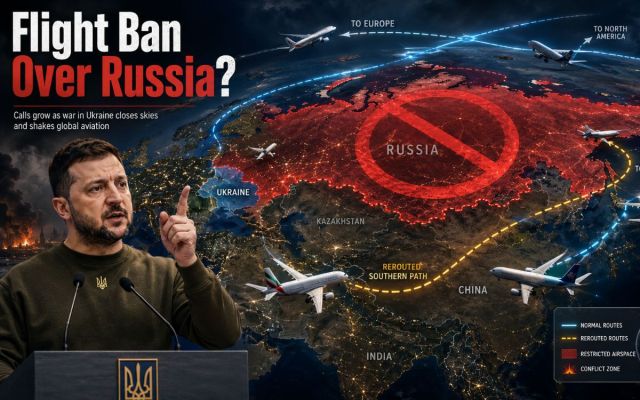
This is a revealing article, which you can read at the link below:
This is not simply about domestic flights within Russia. Zelensky is talking about international flights.
Think about it. Why would Zelensky be concerned about domestic flights operating entirely within Russia? He has no control over them. Yet a letter was sent to the secretary general of the International Civil Aviation Organization (ICAO), which strongly suggests that the real issue is foreign and international flights passing through Russian airspace.
The article states that Ukrainian newspaper Zerkalo Nedeli reported that Infrastructure Minister Nikolay Kalashnik sent a letter to Juan Carlos Salazar, secretary general of the ICAO, calling for action against flights through Russian airspace.
The head of the ICAO, or any other international organization, has no direct control over Russia. So why appeal to the ICAO? Why pressure European leaders to stop flights?
The obvious implication is that international flights are still passing through Russian airspace despite the war in Ukraine.
This raises a larger question.
Flight controllers, pilots, co-pilots, and navigators understand the routes aircraft actually fly. From my perspective, these routes do not make sense according to the conventional globe model. Instead, they appear to follow routes that make much more sense on a flat-earth model.
That would also suggest that, even during wartime, there are international understandings that allow certain civilian aircraft to continue using airspace that might otherwise be considered politically or militarily restricted.
Consider an example from the war in Ukraine. There was reportedly an emergency involving a flight travelling from Hong Kong toward California that resulted in the aircraft landing in eastern Russia. I do not recall all the details, but I previously discussed the incident elsewhere. A medical emergency forced the aircraft to land in a Russian city.
Most passengers probably had no reason to think about whether their flight would pass over Russia. However, once an emergency landing became necessary, the aircraft’s location could no longer be ignored.
In my view, passengers are generally not encouraged to think too deeply about these routes because doing so might raise questions about the conventional model of the earth.
On a globe, a passenger looking at a map may assume that a flight from Southeast Asia to California should simply travel directly across the Pacific. Yet many actual routes travel far to the north before turning south again toward their destinations.
Why?
From my perspective, the explanation is simple: aircraft are following the shortest practical route across the earth, travelling through or near Russia, Alaska, and then onward toward California.
The governments of the world, including Russia and China, continue to support the conventional idea of a spinning globe. Their space programmes are part of that public presentation.
To me, this suggests an extraordinary level of international agreement. Even nations that are political or military rivals continue supporting the same basic story.
Another example is Antarctica.
Russia and China have not withdrawn from the Antarctic Treaty system or openly challenged the restrictions governing activities there. If either country truly wanted to break with the international order, it could attempt much more extensive exploration of Antarctica’s interior.
Yet they do not.
This again suggests that there are certain international agreements that nations continue to honour even when they are hostile toward one another in other areas.
Russia could also prevent foreign aircraft from crossing its territory if it wanted to. It could restrict access to aircraft from friendly countries such as China, India, or Turkey while denying access to nations supporting Ukraine.
If Russia did that, the consequences for international aviation could be significant.
Flights between Europe and China, Southeast Asia, and other parts of Asia could become considerably longer. Some aircraft might require additional fuel stops. Airlines would face greater fuel expenses, longer flight times, crew scheduling difficulties, and increased operating costs.
Those additional costs would eventually be passed on to passengers.
People would naturally begin asking questions:
Why is my flight taking so much longer?
Why is there now an additional stop?
Why has the ticket price increased so dramatically?
Why has the route suddenly changed?
Once people begin studying airline routes for themselves, some may begin questioning whether the geographical explanations they have always been given make sense.
That, I believe, is something governments would rather avoid.
The situation becomes even more complicated because of the conflict involving Iran and the wider Middle East.
If commercial airlines must avoid large areas of Middle Eastern airspace because of drones, missiles, military aircraft, or other dangers, airlines could be forced to make even greater detours.
Depending upon the circumstances, commercial aircraft might need to avoid areas involving Israel, Lebanon, Jordan, and some of the Gulf states.
That creates another problem: where would the alternative routes go?
Could aircraft travel farther west toward Egypt before turning toward India and Asia? Would that route be practical?
Could some flights be forced much farther north or even across the Atlantic toward the United Kingdom and Canada before eventually continuing toward Asia?
Such routes could involve additional stops, far longer journeys, and dramatically higher operating costs.
Some journeys that are already long could become extremely difficult and expensive.
This is why Russia’s airspace is so important.
Closing Russian airspace entirely to airlines connected with countries supporting Ukraine would create a major problem for international aviation. It would also draw enormous public attention to the routes aircraft actually use.
I suspect that many presidents, prime ministers, and chancellors in Europe do not personally know the technical details of how international flight routes are planned. They rely upon aviation authorities, advisers, pilots, navigators, and organizations such as the ICAO.
If major changes to Russian airspace suddenly forced airlines to explain radically different routes to the public, those officials might themselves begin asking questions.
That is one reason I do not believe Zelensky’s demand will succeed.
If Vladimir Putin truly wanted to retaliate against the European Union in a way that would immediately affect international travel and commerce, he could severely restrict flights over Russian territory. He could allow aircraft from friendly nations such as Turkey, India, and China while denying access to others.
Would such a move hurt European airlines and passengers?
Absolutely.
Would it disrupt international business?
Certainly.
Would it force people to pay much closer attention to the geography of international air travel?
I believe it would.
But will Putin actually do it?
I doubt it.
Despite the hostile speeches, sanctions, threats, and military conflict, there are still international systems that continue operating behind the scenes. Aviation is one of the clearest examples.
Governments may fight wars, impose sanctions, and condemn one another publicly while still cooperating in areas necessary to keep international commerce functioning.
That is why I believe Zelensky’s demand for a broad international flight ban involving Russian airspace will ultimately go nowhere.
The International Civil Aviation Organization and the governments involved may listen to the request. There may be political statements and diplomatic pressure.
But a genuine worldwide shutdown of flights through Russian airspace would create enormous complications for airlines, passengers, businesses, and governments.
For that reason, I do not believe it will happen.
Zelensky can demand it.
The political leaders can discuss it.
The ICAO can receive the letters.
But when the economic and practical consequences are considered, I believe the answer will effectively be:
No.
Mark my words. This flight ban will not happen.


The Edge of the Earth
What the Bible, Antarctica, and the Four Corners May Reveal
Flat Earth: Edge or No Edge?
Among people who believe the earth is flat, there is an ongoing disagreement over one particular question: Does the earth have an edge?
Some flat earthers believe there is no edge at all. Others believe there is a definite boundary. Dave Weiss, perhaps one of the best-known people promoting the flat-earth position, has suggested that there may be no edge, or that the earth could extend for an enormous distance beyond what we presently know, perhaps containing many additional continents.
Dave is also known for asking an important question on his podcasts: “Do you believe, or do you know?”
The distinction is worth considering. To believe something means that you accept it as true, although you may not have personally confirmed it. To know something implies a greater degree of certainty.
But when it comes to the question of an edge, whichever position a flat earther takes is still, to some degree, a belief.
Personally, I believe the earth has a definite edge. I do not believe there are millions of miles of unknown territory beyond Antarctica containing an endless number of undiscovered continents.
However, I also recognize that none of us has personally travelled to the outermost limits of the earth and returned with unquestionable proof of what is there. Therefore, when discussing the edge, we should admit that there are things we simply do not know.
I have heard, for example, about an old Tibetan map that supposedly showed approximately ten large islands or continents beyond what we know as the South Pole. Whether that map accurately represents reality is another question.
This brings us back to the difference between belief and knowledge.
There is nothing wrong with belief. In fact, the Bible repeatedly calls upon us to believe. So I do not want to turn this into an argument over semantics. The important thing is to recognize where our certainty ends and speculation begins.
Does an Endless Earth Create the Same Problem as an Endless Universe?
One criticism flat earthers often make of the modern cosmological model is that mankind is portrayed as insignificant.
We are told that the universe is unimaginably large, constantly expanding, and filled with billions upon billions of stars, planets, and galaxies. In that picture, mankind becomes little more than a tiny speck floating through an incomprehensibly vast universe.
Many flat earthers rightly object to the philosophical implications of that worldview. It can make man appear insignificant in relation to God’s creation.
Yet I see a possible contradiction when some flat earthers then suggest that the earth itself might extend for millions of miles beyond Antarctica, containing an unknown number of continents and civilizations.
Would that not create a similar problem?
If there are millions of miles of unknown lands stretching far beyond anything we know, mankind once again becomes a tiny and insignificant part of an enormous creation.
For me, the Bible provides a much clearer picture.
The Four Corners of the Earth
Revelation 7:1 says:
“After this I saw four angels standing at the four corners of the earth, holding back the four winds of the earth to prevent any wind from blowing on the land or on the sea or on any tree.”
Many pastors, theologians, and seminary-trained teachers interpret the expression “four corners of the earth” as an ancient figure of speech referring to the four cardinal directions—north, south, east, and west—or simply to the entire earth.
I do not believe that explanation is necessarily required.
To me, the verse may be describing something more literal.
It also demonstrates something else that should not be overlooked: the incredible power of God’s angels.
There are numerous passages throughout Scripture describing angelic power. That subject deserves an article of its own, but it becomes important when we consider what might exist at the outer limits of the earth.
Everything in creation has limits.
A tree has a beginning and an end. A building has boundaries. A field has borders. A table has edges.
If something is flat and finite, what do we call its outer limit?
An edge.
Flat earthers generally believe there is also an upper boundary to the earth—the firmament. Likewise, there must be limits below.
So why should it be unreasonable to believe there is also an outer boundary?
Again, I admit there are things man does not know. An honest person should be willing to say, “I don’t know.”
Will mankind ever know exactly what lies at the outermost limits of the earth?
Perhaps not.
But that does not mean we cannot consider what Scripture tells us.
What Lies Beyond the Edge?
If there is an edge, what lies beyond it?
I do not claim to know.
Perhaps there is simply nothing beyond the created world.
We should remember that even what people call “space” would itself have to be created. If God created a finite earth for mankind, why assume He also created endless physical territory beyond it?
That leads to another important subject: Antarctica.
The Antarctic Treaty
The Antarctic Treaty raises questions that deserve serious consideration.
Nations that disagree on almost everything have nevertheless continued cooperating under an international system governing Antarctica.
Governments go to war. They violate treaties. They compete for territory. They fight over oil, minerals, trade routes, and natural resources.
Yet Antarctica remains subject to unusual international restrictions and agreements.
Why?
History shows that powerful nations are constantly searching for resources and strategic advantages. Governments have fought wars, supported revolutions, overthrown foreign governments, and used military power to secure economic interests.
So if enormous unexplored territories and natural resources existed beyond Antarctica, what would prevent major powers from attempting to claim them?
Why would countries such as the United States, Britain, Russia, China, and others simply agree to leave such territory alone?
I believe there may be a reason far greater than international diplomacy.
Could God’s Angels Guard the Boundaries?
I believe there may be a force capable of stopping any military power from going farther.
That force would not be another nation.
It would be the power of God.
The Bible gives us remarkable examples of what even one angel can do.
The same event is recorded in 2 Kings 19:35 and Isaiah 37:36, with another account in 2 Chronicles 32:21.
Second Kings 19:35 says:
“And it came to pass that night, that the angel of the LORD went out, and smote in the camp of the Assyrians an hundred fourscore and five thousand: and when they arose early in the morning, behold, they were all dead corpses.”
Think about that.
One angel destroyed 185,000 soldiers.
No modern army, no matter how technologically advanced or heavily armed, could stand against the power of God if He chose to stop it.
Men may boast about their aircraft, missiles, armies, weapons, and military technology, but none of it compares with the power described in Scripture.
And that was only one angel.
Revelation 7:1 speaks of four angels standing at the four corners of the earth.
Could such angels have some connection with the boundaries of the earth?
I cannot prove that. It is speculation.
But the possibility is worth considering.
If there really is something preventing nations from going beyond a certain point, it would have to be something powerful enough to stop even the strongest military forces on earth.
Why Would Governments Hide It?
Suppose a military expedition attempted to go farther and encountered something it could not overcome.
Would governments admit what happened?
If they admitted that supernatural power prevented them from advancing, they would also have to admit something far more important: that God is real.
Not simply some vague spiritual force, but the God who created heaven and earth—the God revealed in the Bible.
That admission would have enormous consequences.
If the Bible is true, then mankind is not the product of meaningless chance.
That is why this subject goes far beyond the physical shape of the earth.
It ultimately becomes a question of authority.
Who rules mankind?
God or man?
The Greater Issue
If people can be convinced that there is no Creator, then they are much more likely to accept man as the highest authority.
Government becomes supreme.
Human institutions determine morality.
Man decides right and wrong.
But if the God of the Bible created heaven and earth, then governments themselves are accountable to Him.
They are no longer the highest authority.
That is what makes the issue so important.
Deuteronomy 28, for example, describes blessings for obedience and curses for disobedience. Scripture repeatedly teaches that nations as well as individuals live under the authority of God.
This is why I believe the debate over the edge of the earth is about much more than geography.
Perhaps we will never physically stand at the outer boundary and look beyond it.
Perhaps there are details God has chosen not to reveal to us.
That is all right.
We should be willing to distinguish between what we know, what we believe, and what we merely speculate about.
But I believe there is a definite limit to the earth.
I believe Scripture gives us reason to consider the language of its “four corners” seriously.
And I believe no human military power would be capable of overcoming a boundary established and guarded by God.
Ultimately, the greatest question is not simply whether the earth has an edge.
The greater question is whether mankind will acknowledge the Creator who established its boundaries.
If Mystery Babylon can convince mankind that there is no God, then man is left with no higher authority than human government and human law.
But if God created heaven and earth, then His authority stands above every president, parliament, king, army, and government on earth.
That is what is really at stake.