History of Astronomy From the Roman Empire to the Present, Part 4
Before passing on to the more important part of this work, it is only just to record the fact that the first practical work in triangulation since the time of Hipparchus was performed by Jean Picard and J. and D. Cassini, between Paris and Dunkirk toward the end of the 17th century; when Newton was working out his theories.
At this time the Copernican theory of astronomy was well established, and was accepted by all the scientific world, though it is probable that the public in general found it difficult to reconcile the idea of an earth careering through space at prodigious speed with common sense and reason. Even the most ardent followers of Copernicus and Galileo recognised this difficulty, and some strove to find a satisfactory explanation.
Nearly a hundred years ago Kepler had suggested that some kind of unknown force must hold the earth and the heavenly bodies in their places, and now Sir Isaac Newton, the greatest mathematician of his age, took up the idea and built the Law of Gravitation.
The name is derived from the Latin word “ gravis,” which means “ heavy,” “having weight,” while the Law of Gravitation is defined as “That mutual action between masses of matter by virtue of which every such mass tends toward every other with a force varying directly as the product of the masses, and inversely as the square of their distances apart.”
Reduced to simplicity, gravitation is said to be “That which attracts every thing toward every other thing.” That does not tell us much; and yet the little it does tell us is not true ; for a thoughtful observer knows very well that every thing is not attracted towards every other thing. . . The definition implies that it is a force ; but it does not say so, for that phrase “ mutual action ” is ambiguous, and not at all convincing.
The Encyclopaedia Britannica tells us that “The Law of Gravitation is unique among the laws of nature, not only for its wide generality, taking the whole universe into its scope, but in the fact that, so far as is yet known, it is absolutely modified by any condition or cause whatever.”
Here again we observe that the nature of gravitation is not really defined at a 11; we’re are told that masses of matter tend toward each other, but no reason is given why they do so, or should do so; while to say that “it is absolutely unmodified by any condition or cause whatever” is one of the most unscientific statements it is possible to make. There is not any thing or force in the universe that is absolute! no thing that goes its own way and does what it will without regard to other forces or things.
The thing is impossible; and it is not true; wherefore it has fallen to me to show where the inconsistency in it lies.
The name given to this mutual action means “weight,” and weight is one of the attributes of all matter. Merely to say that anything is matter or material implies that it has weight, while to speak of weight implies matter. Matter and weight are inseparable, they are not laws, but elemental facts.
They exist.
But it has been suggested that gravitation is a force, indeed we often hear it referred to as the force of gravitation; but force is quite a different thing than weight, it is active energy expressed by certain conditions and combinations of matter. It acts. All experience and observation goes to prove that material things fall to earth because they possess the attribute of weight, and that an object remains suspended in air or space only so long as its weight is overcome by a force, which is contrary. And when we realize these simple facts we see that gravitation is in reality conditioned and modified by every other active force, both great and small.
Again, gravitation is spoken of as a pull, an agent of attraction that robs weight of its meaning, something that brings all terrestrial things down to earth while at the same time it keeps the heavenly bodies in their places and prevents them falling toward each other or apart. The thing is altogether too wonderful, it is not natural; and the theory is scientifically unsound…
Every man, however great his genius, must be limited by the conditions that surround him; and science in general was not sufficiently advanced two hundred years ago to be much help to Newton, so that— for lack of information which is ordinary knowledge to us having in the 20th century— he fell into the error of attributing the effects of “weight” and “force” to a common cause, which— for want of a better term— he called gravitation; but I have not the slightest doubt that if he were living now he would have arrived at the following more reasonable conclusions: That terrestrial things fall to earth by “gravis,” weight; because they are matter; while the heavenly bodies (which also are matter) do not fall because they are maintained in their courses by magnetic or electric force.
Another figure of great prominence in the early part of the eighteenth century was Dr. Hailey, who survived Sir Isaac Newton by some fifteen years, and it is to him that we owe nearly all the methods of measuring distance which are used in astronomy at the present day. So far no one had seriously considered the possibility of measuring the distance to the sun planets or stars since Hipparchus had failed— away back in the second century B.C.— but now, since the science had made great strides, it occurred to Dr. Hailey that it might be possible at least to find the distance from the earth to the sun, or to the nearest planet.
Remembering the time-honoured dogma that the stars are infinitely distant, inspired by the magnificence of the Copernican conception of the universe, and influenced— no doubt— by the colossal suggestions of Ole Roemer, he tried to invent some means of making a triangulation on a gigantic scale, with a base-line of hitherto unknown dimensions.
Long years ago Kepler had worked out a theory of the distances of the planets with relation to each other, the principle of which— when expressed in simple language and in round figures— is as follows : “ If we knew the distance to any one of the planets we could use that measurement as a basis from which to estimate the others. Thus Venus is apparently about twice as far from the sun as Mercury, while the earth is about three times and Mars four times as far from the sun as Mercury, so that should the distance of the smallest planet be— let us say— 50 million miles, then Venus would be 100, the Earth 150, and Mars 200 millions of miles.”
This seems to be the simplest kind of arithmetic, but the whole of the theory of relative distance goes to pieces because Kepler had not the slightest idea of the linear distance from the earth to anything in the firmament, and based all his calculations on time, and on the apparent movements of the planets in azimuth, that is— to right or left of the observer, and to the right or left of the sun.
Necessity compels me to state these facts in this plain and almost brutal fashion, but it is my sincere hope that no reader will suppose that I under-estimate the genius or the worth of such men as Newton and Kepler; for it is probable that I appreciate and honour them more than do most of those who blindly worship them with less understanding. I only regret that they were too ready to accept Copernican astronomy as though it were an axiom, and did not
put it to the proof; and that, as a consequence, their fine intelligence and industry should have been devoted to the glorification of a blunder.
Kepler’s work was of that high order which only one man in a million could do, but nevertheless, his calculations of the relative distances of the planets depends entirely upon the question whether they revolve round the sun or not ; and that we shall discover in due course.
However, Dr. Hailey had these theories in mind when he proposed to measure the distance to Mars at a time when the planet reached its nearest point to earth (in opposition to the sun), and then to multiply that distance by three (approximate), and in that manner estimate the distance of the sun.
He proceeded then to invent what is now known as the “ Diurnal Method of Measurement by Parallax,” which he described in detail in the form of a lecture to contemporary astronomers, introducing it by remarking that he would probably not be living when next Mars came into the required position, but others might at that time put the method into practice.
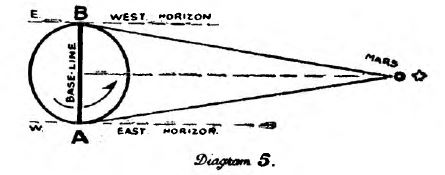
He began by saying that “If it were possible to place two observers at points diametrically opposite to each other on the surface of the earth (as A and B in dia^am 5), both observers— looking along their respective horizons— would see Mars at the same time, the planet being between them, to the east of one observer and to the westward of the other. In these circumstances the diameter of the earth might be used as a base-line, the observers at A and B might take simultaneous observations, and the two angles obtained, on being referred to the base-line, would give the distance of the planet.”
But this was in the reign of George II, long before the invention of steamships, cables or telegraphs, and Dr. Hailey knew that it was practically impossible to have B taking observations in the middle of the Pacific Ocean, so he proposed to overcome the difficulty by the following expedient: He suggested that both the observations could be taken by a single observer, using the same observatory, thus— “ Let an observer at A take the first observation in the evening, when Mars will be to his east: let him then wait twelve hours, during which time the rotation of the earth will have carried him round to B. He may then take his second observation. Mars being at this time to his west, and the two angles thus obtained— on being referred to the base-line— will give the distance of the planet.”
This proposition is so plausible that it has apparently deceived every astronomer from that day to this, and it might even now deceive the reader himself were it not that he knows I have some good reason for describing it here. It is marvellously specious; it does not seem to call for our examination; and yet it is all wrong! and Dr. Hailey has a world of facts against him. He is at fault in his premises, for if the planet was visible to one of the observers it must be above his horizon, and, therefore, could not be seen at the same time by the other; since it could not be above his horizon also. (See diagram 5.)
Again, his premises are in conflict with Euclid, because he supposes Mars to be midway between A and B, that is between their two horizons, which are parallel lines 8,000 miles apart throughout their entire length, and so it is obvious that if the planet— much smaller than the earth— was really in that position it could not be seen by either of the observers.
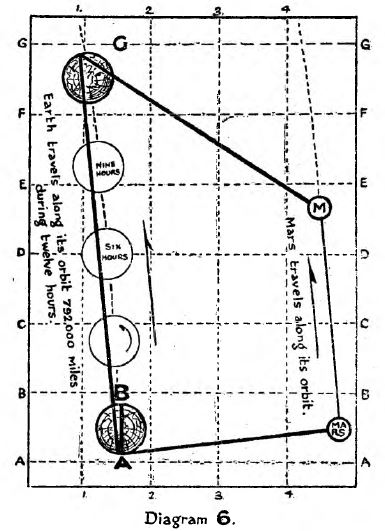
The alternative which Dr. Hailey proposes is as fallacious as his premises, for he overlooks the fact that— according to Copernican astronomy— during the twelve hours while the earth has been rotating on its axis it has also travelled an immense distance in its orbit round the sun. The results are:
That an observer starting from arrive at B, but must arrive in time at a point somewhere about three-quarters of a million miles beyond it, as shown in diagram 6.
The observer loses his original base-line, which was the diameter of the earth, and does not know the length of his new one, A, G, because the distance of the sun and the dimensions of the orbit had never previously been measured. 3. The angle of view from G is entirely different from the one intended from B.
Mars itself has moved along its orbit during the twelve hours, to a new position which is very uncertain.
The triangulation which was intended is utterly lost, and the combined movements of the earth and Mars, plus the two lines of sight, make up a quadrilateral figure, which of course contains angles of 360 degrees, and by means of which no measurement whatever is possible.
In conclusion. Dr. Hailey was mistaken when he supposed that two observations made from a single station with an interval of twelve hours between them, were equivalent to two observations taken simultaneously by A and B…
The actual attempt to measure the distance to Mars by the use of this Diurnal Method will be dealt with in the proper order of events, but for the present— what more need I say concerning such ingenious expedients?
A curious example of theorising to no useful purpose is the “ Theory of the Aberration of Light,” which is regarded by some as one of the pillars of astronomy. It aims to show that if the velocity of the earth were known the velocity of light could be found, while at the same time it implies the reverse that if the velocity of light were known we could find at what speed the earth is travelling round the sun. If Bradley intended to prove anything by this theory it was that the apparent movement of the stars proves that the earth is in motion ; which surely is egging the question.
The fact that the theory of the Aberration of Light has no scientific value whatever is very well shown by
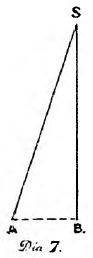
the following quotation from its author: “ If the observer be stationary at B (see dia. 7) the star will appear to be in the direction B, S; if, however, he traverses the line B A in the same time as light passes from the star to his eye the star will appear in the direction A. S.”
That is true, but it would be no less true if the star itself had moved to the right while the observer remained at B, but why did he say “if he moves from B to A in the same time as it takes light to pass from the star to his eye”? It is a needless qualification, for if the observer moves to A he will see the star at the same angle whether he walks there at three miles an hour or goes there by aeroplane at a mile a minute. It has nothing to do with the speed of light, and the velocity of light has nothing to do with the direction of the star, it is merely posing, using words to no purpose.
.


 Accordingly he took two observations at Ascension Island, one to his east and the other to the west, and, replying upon all the theories of his predecessors, failed to perceive that his second line of sight to the planet was on the wrong side of the perpendicular, and diverged from the first.
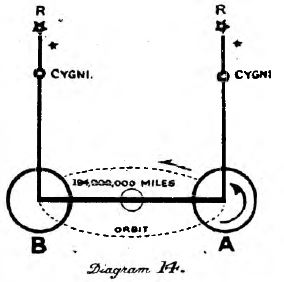
 It appeared to him that no base-line on earth (not even its diameter) would be of any use for such an immense triangulation as the stars required, but he thought it might be possible to obtain a base-line long enough if we knew the distance of the sun; and his reasoning ran as follows; As we have learned from Copernicus that the earth travels completely round the sun once in a year, it must be on opposite sides of the orbit every six months, therefore, if we make an observation to a star — let us say—tonight, and another observation to the same star when we are on the other side of the orbit in six months’ time, we can use the entire diameter of the orbit as a base-line.
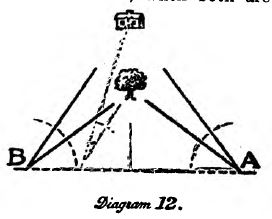 “The Theory of Parallax” as stated in astronomy, is “that the nearer the star the greater the parallax; hence the greater the apparent displacement the nearer the body or star must be.” In other words, it is supposed that because the tree in the diagram is nearer to the observer than the house, it will appear to move further from the house than the house will appear to move away from the tree, if the observer views them alternately from A and B. That is the principle which Bessel relied upon to find the parallax of “61 Cygni.” (I will leave the reader to make his own comments upon it.)
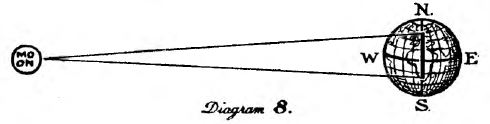
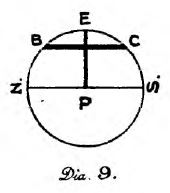 Really it is an imaginary triangulation, where the line E P in diagram 9 becomes a base-line. The line E P is vertical; therefore it follows that the theoretical triangulation by which Equatorial Parallax is found is in the vertical plane. . . We remember, however, that the moon was away in the west when seen by Lalande and Lacaille, while their base-line was the chord (a straight line running north and south) connecting Berlin with the Cape of Good Hope. These facts prove their triangulation to have been in azimuth; that is, in the horizontal — or nearly concerned with horizontal— plane; indicated by the base-line B C in diagram 9.