Kirk Cameron said God sent hurricanes to teach humility

Kirk Cameron said God sent hurricanes to teach humility

The heathens are raging!

Headline from the Daily Mail, UK:

Outrage after Kirk Cameron claims God sent Hurricanes Harvey and Irma to teach us ‘humility’ and to make sinners ‘repent’… as he prepares to fly OUT of Florida

Here is the video that is making all the fuss – with non-Christians, of course:

“Kirk Cameron has received a huge backlash on Twitter after uploading a Facebook video airing his thoughts on the current natural disasters occurring in the world right now, calling it divine punishment.

“His video, which has more than 250,000 views, attracted a lot of attention as the 46-year-old actor has said that God sent us the hurricanes to teach us ‘humility, awe and repentance.’

In the video the former Growing Pains star, who was at the airport leaving Florida, said: ‘We know that weather is sent to cause us to respond to God in humility, awe and repentance.’”

Read more:

This proves that God does punishes his people for disobedience. If he didn’t, there wouldn’t be any “outrage.”

First, I don’t know what the real percentage of people who does not agree with Kirk Cameron is, but it doesn’t matter. Notice how the newspapers never presents the other side. If Kirk’s Post or Tweet was viewed by fundamental Christians the response would be massively in favor, but you won’t hear this from the newspapers.

If majority of people don’t think that God is punishing us, that is expected from the accused – they simply LIE! Think of what the people said about Noah when he was building his Ark; they ridiculed him but the purpose of the flood was because of them! In short, I wonder how many heathens will die as a result of Hurricane Irma? Time will tell, as of this writing Hurricane Irma is beating down on Florida.

Posted in Important News, media lies, News analysis | Tagged | 3 Comments

History of Astronomy From The Roman Empire To The Present, part 16

History of Astronomy From The Roman Empire To The Present, part 16

Einstein’s Theories Examined

  Now we are free to deal with his Law of the Constancy of the Velocity of Light.

We are told that Light is a material thing, and that a beam of light is deflected from a straight line by the gravitation of any and every thing that lies near its course as it passes within their sphere of influence; and we are further assured that light always maintains a uniform speed of 186,414 miles a second. . . . We have, however, to remind Professor Einstein that the “Velocity of Light 186,414 miles a second ” was determined as the result of experiments by the physicists— Fizeau, Foucault, Cornu, Michelson and Newcomb, all of which experiments were conducted within the earth’s atmosphere, on terra-firma; the last between Fort Myer and the Washington Monument.

In all these experiments a ray of light was reflected between two mirrors several miles apart, so that it had to pass to and fro always through the atmosphere, and it is not to be supposed that light, or anything else, can travel at the same speed through the air as it would through the vacuum Einstein supposes space to be.

Let us reverse this in order to realize it better. It is not to be supposed that any material thing travels at no greater speed through a vacuum than it does through air, which has a certain amount of density, or opacity. If anything does not distinguish the difference between air and a vacuum, then it is not a material thing; it cannot be matter. On the other hand, anything that is matter must of necessity make such a distinction, and in that case its velocity can not be constant.

Again, if a ray of light can deviate from its course by the gravitational pull of the sun, or of any other celestial body it has to pass, it must accelerate its speed while approaching that body; and slacken it again in reverse ratio after it has passed; hence it follows that its velocity is not constant.

Once more, if a ray of light can bend by its own weight, or by the law of gravitation, it is subject to other conditions, and therefore is not absolute. . . The length of the course used by Newcomb in the final determination of the Velocity of Light was 7.44242 kilometres (return course). If the ray of light had deviated by a hair’s-breadth from an absolutely straight line, it never could have passed through the interstices between the very fine teeth of his revolving wheel, or return precisely to the appointed spot on his sending and receiving mirrors, which were 3.72121 kilometres, or more than two and a quarter miles apart in a bee-line. The fact that the ray of light did pass from mirror to mirror, and through the wheel, proves that it maintained a straight line; hence it is certain that it was not deflected from its course by the gravitation of the earth between the two mirrors; wherefore it is obvious that it was not affected by gravitation.

So we find that the very experiments by which the accepted 186,414 miles per second as the Velocity of Light was measured— experiments which were carried out with the utmost painstaking and minute attention to detail— prove that a ray of light is not influenced by the gravitation of the earth in the slightest degree.

Therefore, if those experiments were good enough to warrant all the world in accepting the “Velocity of Light” they may be equally well adduced as proof that a ray of light does not bend by its own weight; and that light is not affected by gradation…And if it is not influenced by gravitation a ray of light cannot be deflected from its course by anything it has to pass, so that its course remains true to the direction in which it was discharged; and that is a straight line in every direction from the source.

(Lord Kelvin tells us that “Light diverges from a luminous centre in all directions.” )

In brief— we find that Light is not a material thing, that it is not subject to gravitation, that it has no weight and does not bend, and that it does not describe any kind of curve ; but that it is “ an expression,” in the same sense as sound is an expression, and that— as such— its velocity varies according to the density of the medium through which it passes; and that therefore the Velocity of Light is not constant, and Einstein’s Second Law is entirely wrong! The question of the “ether versus empty space” remains unaffected by his theories, and the stars that glitter like veritable diamonds in the sky are exactly where they appear to be.

So much for Einstein’s Second Law. Now let us examine the other, the first law, or as he calls it—“The Principle of Relativity”: which states “That all inertial systems, that is, all systems which move with uniform and rectilinear velocity with respect to each other, are equivalent in expressing the laws of natural phenomena.”

That is what the law is stated to mean. It may not appear very inviting to the general reader, but he will find it quite interesting as we proceed, though it is, of course, of very great importance to every student of general science and mechanics. As a matter of fact it is not a law at all, it is a statement. At the same time it is not a plain statement; for it is equivocal, and means something which it does not say; it is a statement by implication. It is as though we were to say— “Hello, Jones, how long have you been out of coal?” That would make it necessary for Jones to prove that he had not been in coal, in order to dispose of the implication; and so it is with this statement of the Principles of Relativity; it is an implication.

Taken literally it is true; for it states what is already known; but it implies the reverse of what it states— “that all systems which do NOT move with uniform and rectilinear velocity with respect to each other are NOT equivalent in expressing the laws of natural phenomena!” and that is very much more important.

Now if we carry this innuendo to its logical conclusion, and put it into simple language, it means— “that no reliance can be placed upon any deductions which are obtained by means of observations to the heavenly bodies, because they are taken from the surface of the earth, and the observer is moving at a different speed than the object under observation.”

There would be a certain amount of truth in that if the earth was really moving; though, even if that were so, the effects of relative movement could be” easily overcome by taking two observations simultaneously from opposite sides of the meridian to which the object was vertical. The effects of time would be eliminated in that way ; and a mean would be formed by comparing the two opposite observations. And so we find that neither the statement (or law), or its implication, have any value. The statement might just as well have never been made.

With mental agility worthy of a better cause, Einstein leads from his Mechanical Principle of Relativity up to the Special Principle of Relativity, by means of one of the most extraordinary arguments it is possible to imagine ; but, strange as it is, and inconsequential as it may seem, this argument really affects everything that comes within the range covered by the word “Relativity”; and for that reason we will not allow it to pass unnoticed.

After admitting that Electro-magnetic laws do not alter according to the system in which they occur— that is to say— after admitting that Electro-magnetic laws act the same all the world over, he proceeds to argue precisely the contrary, by saying, quite definitely, that in reality they do alter, and offers to prove it by the following statement: “The motion of each locality on the earth is constantly changing from hour to hour, but no corresponding changes occur in electromagnetic action.”

Of course this has all the appearance of a man flatly contradicting himself, and it might even appear to be nonsense, but in reality it is a very pretty argument of the most elusive kind which it is a pleasure to meet. I will confess that I admire Einstein: he skims so close round the edge of the ice.


Posted in astronomy, Fake Science, gravity exposed | Tagged , | Leave a comment

Google and Artificial Intelligence

Google and Artificial Intelligence

Note: I’m taking a risk now, but I hope that with this information Google doesn’t make it harder to find this flat earth website. If it does, it just proves what I’m saying and what this video shows. Time will tell.

It seems like Google is out to control the world. while this is not new to many of us, they seem to be ramping up the pressure to do so. Google now will put a previously high ranking website and lower it to one of obscurity if they don’t like your content. So, it’s just a matter of time before they go after flat earth sites like the one you are on. I venture to say that there are many of you who found Christian Flat Earth Ministry by a Google search.

There are many websites that are in the cross-hairs of Google and not just flat earth websites. When people are searching for the truth it will be harder to find. One topic that Google wants to see put down the Orwellian Memory Hole are those who advocate holistic healing of one kind or another; website who expose the dangers of vaccines, orthodox cancer treatments and such. They simply don’t want people to know that there is a fast, natural and, for the most part, painless way to heal yourself.

As the above video says – he who controls Artificial Intelligence (aka, Al) will control the world. In light of this Vladimir Putin told a class of students and teachers from across Russia, this past September 1, on this very topic. He said, “Artificial intelligence is the future, not only for Russia, but for all humankind. It comes with colossal opportunities, but also threats that are difficult to predict. Whoever becomes the leader in this sphere will become the ruler of the world.” He continued, “If we become leaders in this area, we will share this know-how with entire world, the same way we share our nuclear technologies today,”

What Can We Do?

Unlike most people who write about the problems of the world and leave it like that, I like to end with some of the things we can do.

There are alternatives to Google, Facebook and Twitter.

Alternative to Google

goodgopher.com

Alternative to Facebook

seen.life

vk.com (this site is dominate in Eastern Europe and Russia)

Alternative to Twitter

gab.ai

Alternative to YouTube

Vimeo.com

Dailymotion.com

Now, you might know of others that you’d like to share with the rest of us. The long and the short of it is, anyone that is on the internet will already be in the data base of those who hate us but we should not let that stop us from reaching out to others with the truth.

Saving Videos

Videos that could be banned should be saved before Google either takes them off line or makes it real difficult to find. There are programs that you can get that will allow you to download YouTube videos. Another way to do it, which takes longer is, you can buy a program called Fast Stone at Faststone.org This cost $20 but is well worth it. This is a software that takes pictures and videos of your screen. So, when you see a video you can make a video of the video. This takes longer as you have to literally let the video play while you make a video of it.

Saving All Your Files

With all the text, audio and video files, you should have an external hard drive and or DVDs with your information on it. Do not store it in the same place as your computer but have it store at another premise. Think in terms of: What is some people raid my house? What if there was a fire? What if I’m barred from my own home? What if someone stole my computer? What would I do in this situation?

In short, you want to be able to preserve the truth so you can share with other people. Always be one step ahead of the enemy.

Posted in Conspiracies, Important News, mind control | Tagged , | Leave a comment

History of Astronomy From The Roman Empire To The Present, part 15

History of Astronomy From The Roman Empire To The Present, part 15

Einstein’s Theories Examined

As you know this whole model of the heliocentric universe is based on the “research” of certain people, such as Newton and Galileo – among others. In this group includes Albert Einstein. This video shows another side of Einstein that most people don’t know. There is a lot more that I have on Albert Einstein but I don’t want to diverge too much from the article below.

(It looks like the video was taken offline by YouTube, but as of yet, it has not; just click the “play icon” to view.)

Whatever it is that Relativity is supposed to establish is to be disproved backwards, beginning with the example which Einstein puts forward— where an observer standing at the centre of a rotating disk is watching some one else on the same disk measuring the circumference of a circle round the observer by repeated applications of a small measuring rod; and afterwards measuring the diameter of the circle in the same way.

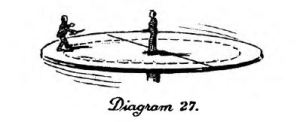
He says that because the disk is in motion, the small measuring rod will appear to the observer (at the centre) to be contracted, so that the person who is measuring (whom I will call “B” ) will have to apply the rod more often to go round that circle than he would if the disk was at rest. That is not true ! . . . If B actually lays the rod (or foot rule) down upon the disk correctly, the number of applications to go round the circle will be the same whether the disk is moving or not, and the observer at the centre will see that it is so, if he is not made too dizzy to count. On the other hand, if B does not lay the rod down and measure the circle as one would expect, but only walks around the disk with the rod in the air (as in diagram 27) then the rotation of the disk will disturb him, so that he has to make an effort to preserve his balance; with the result that he can not place the rod as accurately as he would if the disk were not in motion; and in that case it may take either more or less applications of the rule to go completely round than it would if the disk were still; and that difference would be seen by the observer at the centre— not as an optical illusion! (as Einstein implies) but in reality; a result that is entirely physical, and due to physical causes. When walking across the disk and measuring the diameter, B is not disturbed to anything like the same degree as in walking round the circumference, and so he measures the diameter more accurately. Most of us have at some time or other witnessed the antics of a clown trying to run or walk upon a spinning disk in a circus, and this enables us to understand how such a motion would affect our friends performing on Einstein’s revolving table.

His example is merely amusing, it serves no useful purpose, and proves nothing; unless, indeed, it proves by analogy that the inhabitants on a spinning earth would be rendered as incapable of acting and judging things correctly as his examples.

What we have always known as a “point” in the terms of Euclid, Einstein calls an “event!” but if words have any meaning a point and an event are two totally different things; for a point is a mark, a spot or place, and is only concerned in the consideration of material things; while an event is an occurrence, it is something that happens. . . . There is as much difference between them as there is between the sentence “This is a barrel of apples,” and “These apples came from New Zealand.”

While claiming “ time ” as a fourth dimension, Einstein explains that ” by dimension we must understand merely one of four independent quantities which locate an event in space.” . . . This is to imply that the other three dimensions which are in common use are independent quantities, which is not the case; for length, breadth and thickness are essentially found in combination; they co-exist in each and every physical thing, so that they are related— hence they are not independent quantities. On the contrary, time IS an independent quantity. It is independent of any one, or all, the three proportions of material things, it is not in any way related; and therefore cannot be used as a fourth dimension.

We know that an event is an occurrence; and we find that what Einstein really means by his fourth dimension is “merely the time by which we locate something that happened in space;” and that is just what time has always meant— the period between one event and another. . . Length, breadth and thickness, are proportions of each and every finite thing; while time is infinite. The dimensions are finite; while time is abstract.

Strangely enough, while Einstein claims that everything is in motion and nothing is stable, he allows one thing, and one thing only, to remain outside the realm of relativity, independent of everything else; and that is what he calls his Second Law, the Einstein “Law of the Constancy of the Velocity of Light.” He claims that the velocity of light is constant under all circumstances, and therefore is absolute.

This is a blunder of the first magnitude, but I do not imagine that he fell into it through any oversight; for it is quite evident that he was driven into this false position. He was compelled to say that the velocity of light is constant, because, if he did not his new geometry would be useless; for after all his geometry amounts to this:

He begins by assuming that light is a material thing, so that it is affected by the gravitational attraction of any celestial bodies it has to pass on its way to earth, which causes it to deviate from its appointed course so that it comes to us with more or less curve, according to its distance, and according to the bodies it encounters in its passage. But it always travels at the same velocity, and so, if we can estimate — for example— how much the light of Canopus is made to curve by the gravitation of other bodies between it and the earth (which would be done by Kepler’s and Newton’s laws), we can calculate how much longer its journey is made by those windings, twists, and turns. Then we can time its arrival, because— although it has to travel so much further than its distance would be in a straight line— it always travels at the same 671,090,400 miles an hour; or 186,414 miles every second. It is true that Einstein uses a number of signs and symbols which are supposed to simplify the process; though it is probable that they do no more than merely make it more mysterious, but the plain English of it is as I have shown; and so we perceive that Einstein uses time pretty much in the same way as we do, and not as a dimension at all.

Thus we have discovered that the things which he re-christened an Event, a Fourth Dimension, and a New Geometry, are false to the titles he has given them; the words as he uses them are misnomers, therefore we dismiss them ; for they are no longer of any use or interest to us.

Posted in astronomy | Tagged , , , , | Leave a comment

Getting People To See The Truth

Getting People To See The Truth

  Not long ago I came up with a way to get people to see the truth – at least to reconsider what they’ve been told concerning the medical profession. I did not read this or hear it from anyone else but had just thought of a way to tell others about alternative healing.

Now, we all know that the pharmaceutical researchers have lied to us when it comes to treatment. They say there is no cure for cancer, no cure for diabetes. They say that if you have cancer you must either have surgery, radiation or chemotherapy – depending on what your doctor recommends.

For many years now, I had found it hard to get through to people when it comes to holistic treatment to heal yourself. I’m sure you have had this problem, too. Then, again, there are Truth Seekers out there who know about government cover ups, the lies we have been told about history, the banking system, etc. but still believe in what they doctors and medical researchers tell us. I had found it hard to reach these people although they know of the other lies we have been told. Then, not too long ago, I came up with something so logical that if someone denies it, they would either have to be retarded (politically incorrect word, lol), are part of the problem, or they just came out of a cave.

Not long ago I was talking to one person that I know and we were discussing cancer. I said to Val, “We have had this “war on cancer” for about 40 years now. We have had other “wars” on poverty, drugs and crime. This is what various U.S. Presidents have announced starting back in the 1960s with Lyndon B. Johnson and his war on poverty. Well, tell me Val, has cancer decreased? Has poverty gone down? Are we winning this war on drugs?” And Val agreed with me.

Then I continued, “We allow businesses to take care of these problems. Right?”

“Yes.”

“Now, when a person goes into business, he wants to make money, right? When a person is in business, does he want to make more money or less money than the previous year?”

Val responded, “More money.”

I continued, “This we look at as normal and natural; it’s what we call capitalism. If a company that makes handcuffs for police departments wants to continuing making them, that means crime has to continue. If crime went down quite a bit, the need for police equipment, like handcuffs, would be less. Therefore, they don’t want to see crime go down.

“Take cancer. If the cancer rates dropped substantially, the pharmaceutical companies would not make much money. If the cure, for example, was to eat raw vegetables and have plenty of fresh juices, doctors would not want to see this. After all, how much money can be made selling carrots?”

To this, Val laughed.

I added, “If you had notice that over the years our problems get worse and worse, not better. That’s because businesses are allowed to go in and make money. But when it’s in an area that revolves around a problem of some kind, the problem gets worse, and that includes the medical profession. After all, people will not want to start a business if they were told that their aim is to do less and less business each year until they have to close down, does it?”

Val had to admit that this is the situation and that is why things are not getting better. Now, Val was not the only person that I had talked to like this – there were two other people that I know that I used this same approach – and all had to agree that our problems are getting worse.

I hope this is helpful to you when you are talking to others who can not seem why we are not told the truth.

Note: Check out the video post at the bottom of the page under the Mind Control tab you see at the top of this page. It’s about who the real Gate Keepers are that are controlling our information.

.

Posted in mind control | Tagged | Leave a comment

History of Astronomy From The Roman Empire To The Present, part 14

History of Astronomy From The Roman Empire To The Present, part 14

“RELATIVITY”

  The Theory of Relativity is so complicated, that when it first came to the public notice it was said that there were probably not more than twelve people in the world capable of understanding it. But public interest was aroused, partly by the novelty of Einstein’s hypothesis, and partly by the spectacular manner in which it had been received by the British Royal Astronomical Society on the night of November 6th, 1919, until Mr. Eugene Higgins, of U.S.A., offered a prize of 5,000 dollars for the best explanation of relativity, in the form of an essay, describing it so that the general public could understand what it was all about.

The prize was won by Mr. L. Bolton, London; and his essay can be found in the Scientific American (New York and London), June 1921, and also in the Westminster Gazette, London, June 14th, 1921. The editor of the Gazette found it necessary to remark, when publishing the essay, that “ Our readers will probably agree that even when stated in its simplest form it remains a tough proposition.”

That is just the trouble with it. It is about as far removed from ordinary “fact” and “plain English” as it is possible for anything to be; indeed it is so intangible that it may well be that Einstein can form a mental picture of it himself, while he is at the same time unable to convey his meaning to others through the medium of ordinary language.

The thing is elusive; abounding in inference, suggestion, half-truth and ambiguity; wherefore it follows that any discussion of it, such as we propose to enter upon, must of necessity be almost equally refined. It might seem tortuous to some readers, and yet be like a very entertaining game of chess to others; while it certainly will be useful to those who are willing to traverse the long and difficult labyrinth that leads to truth.

Relativity is clever; but it belongs to the same category as Newton’s Law of Gravitation and the Kant-Herschell-Laplace Nebular Hypothesis, in as far as it is a superfine effort of the imagination seeking to maintain an impossible theory of the universe in defiance of every fact against it. . . . Let us see what we can do with it.

First, we will let Professor Einstein himself tell us what he means by Relativity, in the words he used in the opening of his address at Princeton University, U.S.A.

“What we mean by relative motion in a general sense is perfectly plain to everyone. If we think of of a wagon moving along a street we know that it is possible to speak of the wagon at rest, and the street in motion, just as well as it is to speak of the wagon in motion and the street at rest. That, however, is a very special part of the ideas involved in the principle of Relativity.”

That would be amusing if we read it in a comic paper, or if Mutt and Jeff had said it; but when Professor Einstein says it in a lecture at the Princeton University, we are expected not to laugh; that is the only difference. It is silly, but I may not dismiss the matter with that remark, and so I will answer quite seriously that it is only possible for me to speak of the street moving while the wagon remains still— and to believe it— when I cast away all the experience of a lifetime and am no longer able to understand the evidence of my senses; which is insanity. . . . Such self-deception as this is not reasoning; it is the negation of reason; which is the faculty of forming correct conclusions from things observed, judged by the light of experience. It is unworthy of our intelligence and a waste of our greatest gift; but that introduction serves very well to illustrate the kind of illusion that lies at the root of Relativity.

Throughout the whole of his theories there is evidence that Einstein was thinking almost entirely of their application to astronomy, but it was inevitable that this should involve him with physics, so that he had then to engage upon a series of arguments intended to show how his principles would work out on the plane of general science. The first may be said to be the motive that inspired him; while the second consists of complications and difficulties which he could not avoid. . . . And when he suggested that the street might be moving while the wagon with its wheels revolving was standing still, he was asking us to imagine that in a similar manner the earth we stand upon might be moving while the stars that pass in the night stand still. It is a Case of Appeal, where Einstein appeals in the name of a convicted Copernican Astronomy against the judgment of Michelson – Morley, Nordmeyer, physics, fact, experience, observation and reason. We, on the other hand, are counsel for the prosecution, judge and jury.

Under the general heading of Relativity, Einstein includes an assortment of new ideas— each of which depends upon another,— and each of which contributes to support the whole. He says that there is no ether, and that light is a material thing which comes to us through empty space.

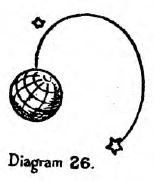
Consequently light has weight, and, therefore, is subject to the law of gravitation, so that the light coming from a star may bend under its own weight, or deviate from the straight line by the attraction of the sun, or of any other celestial body it has to pass in its journey to the observer on earth. . . . In that case it follows that no star is in reality where it appears to be, for it may be even as suggested in diagram 26. . . Consequently the heavenly bodies may be much further away than they have hitherto been supposed to be, and every method which is based upon the geometry of Euclid and the triangulation of Hipparchus will fail to discover the distance to a star; because its real position is no longer known. Wherefore Einstein has invented a new kind of geometry, in order to calculate the positions of the stars by what is nothing more or less than metaphysics.

We have always been accustomed to measure things by the three dimensions of Euclid— length, breadth and thickness, but Einstein (thinking of astronomy), says that “ Time ” is a Fourth Dimension ; and proposes that henceforth things should be measured on the understanding that they have four dimensions— length, breadth, time, and thickness.

The introduction of “time” as a fourth proportion of things makes it necessary for him to invent a number of new terms, and also to change the names of some of those that we already know and commonly use, thus, for example— “Space” is changed to “Continuimi,” while a “point” is called an “event,” time— as we have always understood it— no longer exists, and is said to be a fourth dimension ; while there are no such things as “infinity” or “eternity” in relativity.

That is the case for Einstein. It is the essence of his Relativity, clearly stated in plain English. The details of it represent an immense amount of labour of a refined character, the whole thing is very imaginative, and the work of an artist in fine-spun reflections; indeed, it is of that double-distilled intricacy which finds favour with those who like mental gymnastics and hair-splitting argument; and are fond of marvellous figures.

But I can conceive that in the course of time this Relative Phantasmagoria might come to be regarded as science, and be taught as such to the children of the near future; and that is to be prevented only by dealing with it now! which I will do, though I grieve to give so much space to a matter which only calls for it because it is pernicious.

Posted in astronomy | Tagged , , , | Leave a comment

History of Astronomy From The Roman Empire To The Present, part 13

History of Astronomy From The Roman Empire To The Present, part 13

The Earth Stands Still

It would seem that Copernican Astronomy had reached its highest development about the year 1882, and then began to decline, or rather, to fall to pieces. The first evidence of this devolution is to be found in the Michelson-Morley experiment of 1887, at Chicago; the result of which might have undeceived even the most devoted believer in the theory of a spinning earth.

Professor Michelson was one of the physicists foremost in determining the Velocity of Light, while he has recently been described in the New York Times as America’s greatest physicist; and it was he who— working in collaboration with Morley— in 1887 made the most painstaking experiments by means of rays of light for the purpose of testing, verifying, or proving by physical science, what really was the velocity of the earth. To express this more clearly. Astronomers have for a very long time stated that the earth travels round the sun with a speed of more than eighteen miles a second, or sixty-six thousand miles an hour.

Without in any way seeking to deny this statement, but really believing it to be thereabouts correct, Michelson and Morley undertook their experiments in order to put it to a practical test; just in the same way as we might say “The greengrocer has sent us a sack of potatoes which is said to contain 112 pounds weight; we will weigh it ourselves to see if that is correct.”

More technically, the experiment was to test what was the velocity with which the earth moved in its orbit round the sun relative to the aether.

A very well illustrated account of that experiment will be found in The Sphere, published in London, June 11th , 1921, and it is from that article I quote the following, verbatim : “But to the experimenters’ surprise no difference was discernible. The experiment was tried through numerous angles, but the motion through the aether was NIL!”

Observe that the means employed represented the best that modern physical science could do to prove the movement of the earth through ethereal space, and the result showed that the earth did not move at all! “The motion through the aether was NIL.”…But the world of astronomy has not accepted that result, for it continues to preach the old dogma; it appears that they are willing to accept the decisions of physicists when it suits their case, but reject them when otherwise. And so they still maintain the fabulous theory that the earth is rushing through space at eleven hundred miles a minute; which, as they would say in America, “Surely is some traveling.” It must be faster than a bullet from a Lewis gun.

What I have now to record, I do with regret, and only because my sense of duty in the pursuit of truth compels me. It is the circumstance that Sir George Airy, who retired from his position as Astronomer Royal in 1881, related— some nine years later— how he had for some time been harassed by a suspicion that certain errors had crept into some of the computations published in 1866, and that, though he had set himself seriously to the work of revision, his powers were no longer what they had been, and he was never able to examine sufficiently into the work. Then he spoke of a “ grievous error that had been committed in one of the first steps,” and pathetically added— “My spirit in the work was broken, and I have never heartily proceeded with it since.”

My sympathy goes out to Sir George in his tribulation of the spirit due to advancing age, while I am not unmindful of myself, for I realize that in him I have lost one who would have been a friend, who would have listened when I said that all was not as it should be with the science of astronomy; and stood by my side, encouraging and helping, when I, younger and stronger, strove to put it right. I do not know whether Sir George Airy was influenced or not by the result of the Michelson-Morley experiment, but it is at least a noteworthy coincidence that he made those comments only three years later ; but in any case science has need of him, and of such evident open mindedness and sincerity as his, now.

Not content to believe that the earth did not move, further experiments were carried out by Nordmeyer in the year 1903, to test the earth’s velocity in relation to the Intensities of Light from the heavenly bodies, but he also failed to discover any movement.

Even then astronomers were determined to hold on to their ancient theories, and deny the facts which had been twice demonstrated by the best means known to modern physical science. They preferred to believe the theory that the earth was gyrating round the sun with the velocity of a Big Bertha shell, and tried to account for the physicists’ failure to discover its movement by finding fault with the aether (or ether).

It is not only difficult to understand why they should prefer theory to fact in this manner, and so deceive themselves; but it is strange also that the world in general could tolerate such nonsense.

However, the results of several years’ speculations concerning ether and space were set forth in the year 1911, in a series of lectures by Professor Ormoff, Onspensky and Mingelsky, at Petrograd.

It was suggested that light was not permitted to come from the stars to earth in a straight line, because some quality in ethereal space caused it to follow the earth as it moved round the orb it; and that might account for the failure of the experiments of 1887 and 1903. In other words it was suggested that we cannot see straight, or that the image of the star as we see it twinkling there is coming to us in a curve— following the earth like a search-light, while it describes the five terrestrial motions ascribed to it by Newton.

When stated even more plainly it means that when we think we see a star overhead we are mistaken, for that is merely the end of a ray of light coming to us from a star which— in the material body— may be millions of miles to the right of us, or it might even be behind us; as in diagram 26.

  N.B.— A much greater curvature than we have illustrated in the diagram has since been suggested in all seriousness by leading astronomers from the platform of the R.A.S. at Burlington House, Nov. 6th, 1919, in these words “. . . . All and if they travelled far enough they would regain the starting point.”

Moreover, Ormoff, Onspensky and Mingelsky had come to the conclusion that nothing was fixed in the universe; so that while the moon goes round the earth and the earth and the planets go round the sun, the sun itself is moving with probably a downward tendency, carrying the whole Copernican solar system with it. Further, even the stars themselves have left their moorings, so that the entire visible universe is drifting; no one knows where.

In brief, these Petrograd lectures of 1911 introduced many new ideas such as those which have become familiar to the reader in Einstein’s Theory of Relativity, since the year following the great World-War.


Posted in astronomy | Tagged , , | Leave a comment

History of Astronomy From The Roman Empire To The Present, part 12

History of Astronomy From The Roman Empire To The Present, part 12

IT is for me, now, to show how the distance to the sun’ is really to be ascertained, and this may indicate the way to a new astronomy, and a saner conception of the universe.

The Copernican astronomy has been so hedged about with specious theories that it would seem to be impossible to obtain any kind of triangulation to the heavenly bodies that cannot be negatived by Perpendicularity, Geocentric Parallax or similar theories, nevertheless it can be done and that by two simultaneous observations taken from a base-line which is on solid earth; thus: Let two observers be placed on the same meridian; A in the northern hemisphere at about Mansfield, Nova Scotia, for example, 60 N, 74 W., and B in the southern hemisphere at Tierra del Fuego, Cape Horn, 55 S. 74 W., as shown in diagram 23.

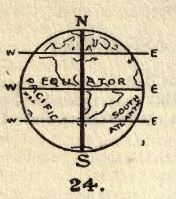
As the two observers are on the same meridian they use the same north and south, while all lines which cross that meridian at right angles indicate east and west, and are parallel to each other; so that A’s east is parallel to B’s, and to the equator, as in diagram 24.

.


  The chord that is a straight line connecting the two points of observation A, B, will give them a base-line 6,900 miles in length, which runs in a direction due north and south as in diagram 25. The two observers will find their easts by the compass, when it will be seen that they form two right angles to the base-line. The two easts, with the base-line, make a sort of frame, or three sides of a square; and it is within this frame between the two dotted lines running east, that the triangulation will be made to the sun.

Now let our observers take their places at about 8 o’clock local time (1 p.m. Greenwich Mean Time) on a morning within a week or so of Christmas. The sun will at that time be in the zenith, and almost exactly overhead, at the island of St. Helena, off the coast of South Africa.

The observer at A in Nova Scotia will see the sun, blood red, just rising above the horizon to his east-south-east, while the observer at Tierra del Fuego will see the sun at the same time, about eight degrees to the northward of his east (east by north); and so the two lines of sight from A and B converge so as to meet at the sun, which is between the two easts, a little to the southward of A and to the northward of B.

A true triangulation is thus obtained, and the two angles may be referred either to the parallel easts, or to the base-line which connects them. No ” allowances” of any kind whatever are to be made, and none of the fantastic theories of astronomy are in any way concerned. It is a plain, ordinary, common-sense triangulation, such as any surveyor would make if we were buying a piece of land ; and that is good enough for us. The angles at the base-line will equal about 148 degrees, while the angle at the sun, or apex of the triangle, will be 32 degrees (approximate). When these are multiplied into the base-line by ordinary trigonometry, the sun will prove to be about 13,000 miles in a bee-line from A and 10,000 miles from B.

The stars and the planets are to be measured in a in similar manner, when it will be found that no star is at any time further than twenty thousand miles away.

As it is my intention to deal more fully with such measurements in another book sequel to this devoted to the reconstruction, or rather, to the creation of a new Astronomy I have been content here to say only sufficient to establish my case, and to show that Hipparchus was mistaken when he thought the heavenly bodies were infinitely distant. And that, truly, is my case, for at last I have shown that the “infinitely distant” hypothesis which has been the guiding star of astronomers for two thousand years, was indeed, an error.


Posted in astronomy | Tagged , , | Leave a comment

History of Astronomy From The Roman Empire To The Present, part 11

History of Astronomy From The Roman Empire To The Present, part 11

The Transit of Venus and the Distance to the Sun

*****

There are some things which every man or woman of ordinary intelligence knows are nonsensical; but when such things have been permitted to pose for generations as scientific knowledge it is not sufficient merely to say that they are absurd; they must be treated as seriously as though they really were the scientific concepts they are supposed to be, and it must be shown just how, and why, and where, they are absurd.

*****

Not content with the work already done, all the world of astronomy set out to try to measure the distance to the sun again in the years 1874 and 1882, by observations of the Transit of Venus.

It was a most elaborate affair, ’tis said to be by far the greatest and most costly business ever undertaken for the purposes of astronomy. Men were trained specially for the work, equipped with all the most expensive things in the way of telescopes and instruments, and sent out by the British, French and German governments, all allied for the purpose, as expeditions of astronomers to all parts of the world in order to see Venus— like a small speck— pass across the face of the sun. We have it on the best authority that the 1874 transit was a failure; but, nothing daunted, the expeditions went out again in 1882, to the Indies, the Antipodes and the polar regions, but again the results are admitted to be unsatisfactory; though we may at least hope the astronomers found some entertainment by the way.

The Venus method has already been explained in an earlier chapter, and illustrated in diagram 10. It required that observations should be taken simultaneously by two observers placed as widely apart as possible in order to have the longest base-line obtainable; the ideal base-line being the entire diameter of the earth. From among a large number of observations taken in different parts of the world, two were selected as being better than the rest; they were the observations taken at Bermuda—those lovely little islands near the West Indies— and Sabrina Land, on the edge of the icy Antarctic regions; and from this pair the distance of the sun was computed, but the result obtained has never been considered good enough to take the place of the earlier figures of Gill. We will give it the coup-de-grace in short order ;— Bermuda is situated in 32° 15′ north latitude, and 64° 50′ west longitude; while Sabrina Land is 67° south, and 120° east of Greenwich. We must also mention the fact that both the sun and Venus were somewhere between these places, in the eastern hemisphere.

These common-place facts alone prove that the two observations were not taken at the same time, and consequently were useless for the purpose. I will explain how that is. In their endeavour to secure the longest possible base-line our astronomers separated themselves by 99 degrees in the north and south direction, and by 184° 50′ east and west, so it is perfectly plain that the sun had already set to the observer at Sabrina Land, before the observer at Bermuda could see it rise above his horizon at dawn.
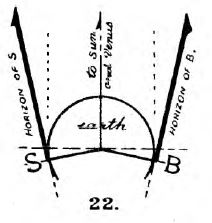
   N.B.— The sun rises and sets at a distance of 90 degrees from the observer, so that the Transit astronomers should not have been more than 180 degrees apart even if they had wished to see the sun on the horizon; but our observers had exceeded the limit by nearly five degrees. (See dia. 22.)

The two horizons diverge from each other, and for some part of the time the sun is between them, and not visible to either observer, while as it must be above each of these observer’s horizons in turn in order to be seen at all, it is ridiculous to imagine that any observations taken by B and S in a direction toward the top of this page and above their horizons could ever meet anywhere in the universe. The whole business was a fiasco.

Of all the various methods of estimating the distance of the sun, that by means of the measurement to Mars is by far the most important, while the second in order of merit is the one we have just dealt with; the computation by the transit of Venus, which, it will be remembered, was first used by Encke in 1824. But there are, no doubt, many adherents of astronomy who will still hope to save the time-honoured dogma which hangs upon the question of the distance to the sun; too egotistical to admit that they could have been mistaken, or too old-fashioned to accept new truths; and so— while they cannot any longer defend the Mars and Venus illusions— they will say that they know the sun is 93,000,000 miles away because it has been estimated and verified by quite a number of other methods, with always the same result, or thereabouts.

In these circumstances it becomes necessary for us to touch upon these also. The brief examination we shall give to them will be illuminating, and Astronomers will probably be surprised in one way while the layman will be surprised in another…There are some things which every man or woman of ordinary intelligence knows are nonsensical; but when such things have been permitted to pose for generations as scientific knowledge it is not sufficient merely to say that they are absurd; they must— for the moment-— be treated as seriously as though they really were the scientific concepts they are supposed to be, and it must be shown just how, and why, and where, they are absurd. Then, when that is done, they can masquerade no more, and will no longer obstruct the road to knowledge.

Any one of these means of estimating the sun’s distance might be made the subject of a lengthy argument, for they are like ” half-truths ” which, as we all know, are harder to deal with than down-right falsehood; but I do not wish to worry the reader with any more words than I am compelled to use, and so will deal with them as briefly as possible.

Every one of these things which are believed to be methods of computing the distance to the sun, or means of verifying the 93,000,000 mile estimate, presumes the distance of the sun to be already known; and in every case the method is the result of deductions from the figure “93,000,000 miles.”

I am not particularly concerned as to how or why this was done, nor is it my affair whether it seems incredible or not: but I do know that it is as I have stated, and that I am very well able to prove it. I am only interested in knowing the truth, and in proving it by reason and fact.

The verification of the sun’s distance by the measurements to the minor planets Victoria, Iris and Sappho, in 1888 and 1889, was done in the same manner as the measurement to Mars, and fails in precisely the same way, by the fallacy of Dr. Hailey’s Diurnal Method of Measurement by Parallax.

There is the calculation of the sun’s distance by the “Nodes of the Moon,” which it is not necessary for me to dilate upon, because it has already been discredited, and is not considered of any value by the authorities on astronomy themselves.

The computation of the distance to the sun by the “Aberration of Light” is based upon the theory that the earth travels along its orbit at the velocity of 18.64 miles per second. This velocity of the earth is the speed at which it is supposed to be travelling along an orbit round the sun, 18.64 miles a second, 66,000 miles an hour, 1,584,000 miles a day, or five hundred and eighty-four million miles in a year.

The last of these figures is the circumference of the orbit, half of whose diameter— the radius— is of course the distance of the sun itself, and it is from this (pardon the necessary repetition) distance of the sun, first calculated by Encke in 1824, and later by Gill in 1877, that the whole of the figures— including the alleged “ velocity of the earth 18.64 miles a second ”— were deduced. The 18.64 miles is wrong, because the 93,000,000 is wrong, because neither Encke nor Gill obtained any measurement of the sun’s distance whatever; and the whole affair is nothing more than a playful piece of arithmetic, where the distance of the sun is first presumed to be known; from that the Velocity of the earth per second is worked out by simple division, and then the result is worked up again by multiplication to the original figure, “93,000,000,” and the astronomer then says that is the distance to the sun. That is why it is absurd.

The estimation of the distance of the sun by the “Masses of the Planets” depends upon the size, weight, volume or masses of the planets, which depend upon their distance; and the distances of the planets were calculated by Kepler’s, Newton’s and Bode’s Laws from Sir David Gill’s attempt to measure the distance of Mars; wherefore, as we have discovered that he did not find the distance to Mars, all the calculations which are founded upon his entirely erroneous conception of the distance, size, and mass of that planet, go by the board.

It will not do for anyone to say to us that the distance to Mars is 35,000,000 miles (when in opposition) and therefore it must be 4,200 miles in diameter, therefore the distance of the sun must be 93,000,000 miles, therefore its diameter must be 875,000 miles and its mass 1,300,000 times greater than the mass of the earth, or three million times greater than Mars, &c., &c., &c., and therefore it must be 93,000,000 miles away. It is neither good logic, good mathematics, nor good sense. If anyone seeks to show that the distance from the earth to the sun can be measured by weighing the sun and the planets let him do his weighing first, and not assume anything; and he would do well to remember that “The sun’s distance is the indispensable link which connects terrestrial measures with all celestial ones.”

Finally the sun’s distance as 93,000,000 miles is said to be justified by the “Velocity of Light.” The Velocity of Light was measured by an arrangement of wheels and revolving mirrors in the year 1882 at the Washington Monument, U.S.A., and calculated to be 186,414 miles a second.

N.B.— Experiments had been made on several previous occasions, with somewhat similar results, but Professor Newcomb’s result obtained in 1882, is the accepted figure.

Taking up this figure, astronomers recalled that in the 17th century Ole Roemer had conceived the hypothesis that light took nearly 8 ¼ minutes to travel from the sun to the earth, and so they multiplied his 8 ¼ minutes by Newcomb’s 186,414, and said, in effect — “there you are again— the distance of the sun is 93,000,000 miles.” It is so simple; but we are not so simple as to believe it, for we have shown in diagram 4 how Ole Roemer deduced that 8 ¼ minute hypothesis from a mistaken idea of the cause of the difference in the times of the Eclipses of Jupiter’s Satellites; and we know that there is no evidence in the world to show that light takes 8 ¼  minutes to come from the sun to the earth, so the altogether erroneous and misconceived hypothesis of Ole Roemer can not be admitted as any kind of evidence and used in conjunction with the calculation of the Velocity of Light as an argument in favour of the ridiculous idea that the sun is ninety-three— or any other number of millions of miles from this world of ours.

All the extraordinary means used by astronomers have failed to discover the real distance of the sun, and the many attempts that have been made have achieved no more result than if they had never been done; that is to say— that it is not to be supposed that they may perhaps be somewhere near the mark; but it is to be understood, in the most literal sense of the word, that the astronomers of to-day have no more knowledge of the sun’s real distance than Adam. Indeed we have to forget all the romantic things that have been said since the time of Copernicus, and look at the universe, as frankly, and as fearlessly as he did : then we might acknowledge the debt we owe to such as he, for even though he was so greatly in error his originality stimulated the world of thought tremendously; and in that way furthered the world’s progress.

And then, tutored and encouraged by the shades of Hipparchus, Ptolemy, and Copernicus; Kepler, Newton and all their kind, we might, with the added experience and advantage of our times, rebuild the science of astronomy as they would do it now ; true to the facts of nature.

.

Posted in astronomy | Tagged , | Leave a comment

History of Astronomy From Roman Empire to the Present, part 10

History of Astronomy From Roman Empire to the Present, part 10

The fundamental principle of parallactic angles is unsound, while it is at the same time in conflict with quite a host of other astronomical theories, because the theories of Atmospheric Refraction, Perpendicularity, Geocentric Parallax, and the Aberration of Light, combined with the use of Sidereal Time, all go to prove that every observation taken from the surface of the earth to a star is exactly parallel with a line from the centre of the earth to the same star, and that B’s line to x is parallel to that of A.

Consequently if Mars were on the line O X (in diagram 15), as Dr. Hailey presumed when he invented this method, it would be perpendicular to both A and B, therefore neither one observer or the other would see it at any angle at a 11; as shown in diagram 17.

It is not possible for any observer on earth to see Mars to the right or left of a star that is perpendicular unless the planet is in reality to the right or left of that perpendicular. No apparent displacement could occur, but the displacement must be physical; and so the theory of parallactic angles is exploded.

Of course there will be some ready to contend that Sir David Gill really did measure an angle. That is true; but it will prove to be an actual (physical) deviation of the planet from the perpendicular, which is a very different thing than an angle of parallax.

But it was believed to be a parallactic angle, that is to say— it was supposed to be only an optical or apparent displacement due to the change in the position of the observer from A to B, hence a world of romance is built upon that little angle in this fashion: Angle of Mars 23″ = 35,000,000 miles, 35,000,000×2.6571 =93,000,000= solar parallax 8.80’ = distance of the sun; the sun’s diameter is 875,000 miles; weight X Y Z lbs., age 17,000,000 years, and will probably be burnt out in another 17 million years. 93,000,000 x 2 = 186,000,000 miles diameter of earth’s orbit, the distance to the stars must be billions of miles or even more, they must be a terrific size, and the earth is only like a speck of dust in the Brobdinagian Universe, &c., &c., &c.

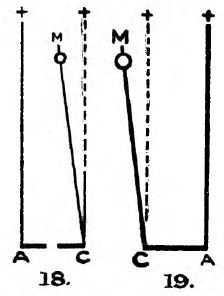
But we have not yet done with that angle. Regarded as an angle of parallax, and considered to be equivalent to just such an angle as a surveyor would use in measuring a plot of land, it was of course presumed that the two lines of sight converged so as to meet at a point thirty-five million miles away. (See diagram 18.) This, however, is a mistake, for the two lines of observation, when placed in their proper relations to each other, and in the order as they were taken, should be as in diagram 19, which shows that they diverge.

We will prove this in diagram 20. A study of our earlier diagram 6— which gives a suggestion of a
small section mapped out with dotted lines to indicate latitude and longitude in universal space— reveals the fact that twelve hours’ rotation of the earth does not transfer the observer from A to the point B in space, because— according to Copernican astronomy— the earth is not only rotating on its axis during those twelve hours, but also rushing through space in a gigantic orbit round the sun at the rate of sixty-six thousand miles an hour, or thereabouts, and so when the observer takes his second observation he is something like three-quarters of a million miles away from where he started. He is at latitude G in diagram 6.

Now let us study diagram 20, which has been made as simple as possible in order to illustrate the principle involved the more clearly. The letter C is used in this diagram to take the place of G in the earlier diagram 6, because it is simpler to describe the movements of the observer by A, B, C than it is by A, B, G ; easier to convey my meaning.


All the principles and theories of modern astronomy have been carefully observed, and the parallelism of the lines is strictly in accordance with the theories of Greenwich. As I anticipate that in the course of time a battle-royal will wage around this question of the measurement to Mars, I wish to make it quite clear that diagram 20 is designed only to illustrate the principles; it is to clarify the whole proceeding so that the layman can follow the argument. If the Royal Astronomical Society have any objection to make, I will be happy to discuss these questions with them in a manner worthy of the subject. The discussion may then, perhaps, be more refined, indeed.
I foresee a very pretty debate, wherefore I advise them that I know that Sir David did not really take his observations with a twelve hours’ interval as proposed by Dr. Hailey— because it was impossible—but that he actually waited only seven and a half hours (hence my use of C in place of G in diagram 20), but that only elevates the discussion to a higher plane, while the principle and the net results remain the same. In the appointed time and place I will discuss the actual practice if desired, but here I am dealing with the principle; and talking to the layman and the judge.

Now let us get on with this diagram 20. The first observation is taken at A and the second at C. It was evening when the observer was at A, but it is morning when he arrives at C, so that his east and west are reversed, the sun remaining fixed far below the bottom of this page. (The sun is at the observer’s west in the evening, and to his east in the morning, while Mars is in the opposite direction to the sun.)

In this example I have placed the planet exactly on the perpendicular from A to the star of reference, thus “A MARS X.” That is the starting point, or first observation; taken in the evening to the observer’s eastward. Twelve hours later the observer is at C, and sees the same star and the planet both to his west; but Mars is at this time not exactly on the perpendicular, but a little, a very little, to the left of the star.

The planet is not quite as much west as the star, that is to say— being to the left— it is to the eastward in universal geography ; and to the eastward of the perpendicular line C X.

Now if we were not particularly careful, and had not this diagram to guide us, it would be quite natural to think that the first observation (to the east) should be on the left hand, and the other (west) on the right, so as to face each other, so that any angle that might appear, such as an angle of parallax, would be between the two perpendiculars to the star. In that case they would seem to be as shown in diagram 18; but that is wrong!

Referring again to diagram 20, where the observations are illustrated in the proper order as they were actually taken, and all in accordance with the theories of Copernican astronomy, we find that the angle of Mars is to the EASTWARD! outside of the two perpendiculars. This is more simply shown in diagram 19. A being the first observation, on the right, and C, the second observation, on the left; that is correct.

Starting, as we did, with Mars on the perpendicular at A, we know that whenever we shall see it again it must be to the eastward of the star which marks that perpendicular, because, while the star remains fixed in space the planet is moving every hour along its orbit to the eastward round the sun, and so, when we see it from C the next morning, it is as we have shown in diagrams 19 and 20. It has moved from the line A X to a position a little further east in universal space than the line C X.

Whatever displacement there is, is outside the two perpendiculars; so that the second line of sight to Mars diverges from the firs t; consequently no triangulation occurs, and nothing of any material value is accomplished.

  The so-called angle of parallax was a displacement due to a real movement of the planet during the night.

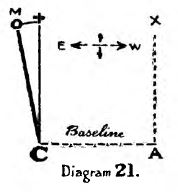
In conclusion, as A X and C X are one and the same perpendicular, and no angle, either real or apparent, occurs between them, the first observation A X and the base-line are entirely without value, and may be discarded as useless. (Diagram 21.) This leaves us with only the perpendicular C X and the second observation, which proves to be a narrow inverted triangle “ C X Mars,” where the displacement of the Diagram 21. planet X M— (hitherto known as the parallax of Mars) — indicates how much the planet has moved to the left of the star during the night; while the observer at C is at the apex. Just that, and no more.


Posted in astronomy | Tagged , , | Leave a comment