History of Astronomy From The Roman Empire To The Present, part 19

Pons-Winnecke Comet and Other Such Non-sense

Nothing now remains of that astronomy which was once said to be the most perfect of the sciences; and imagination— stretched even to its uttermost— has failed to support it in the face of reason, and yet these last two years since Relativity became the vogue have produced the most remarkable figures astronomy has ever known.

“Betelgeuse”

betelgeuse star  In December 1920, Professor Michelson related how he had perfected an instrument known as an Interference- Refractometer, and how he had used it to measure the angular diameter of the star Betelgeuse, in the Belt of Orion; and found it to be 0.046 seconds of arc. That is to say that he found the measurement of this star as it appears to the eye (which is only like a glittering pin-point) to be 0.046″ from one side to the other, and that is one-twentieth part of a second of arc, or 1 72,000th part of a degree; very fine measurement indeed.

Professor Michelson, however, is a physicist, specially interested with theories of light, and so, having invented the instrument and measured the apparent diameter of the star, his work was done.

Astronomers then took up the matter, and on referring to their records, found the distance of Betelgeuse to be 180 light-years; that is 180 times 6,000,000,000,000 miles, or one thousand and eighty billions of miles from the earth ; and so they calculated that if a thing so far away appeared to be 1 72,000th part of a degree in diameter, its real diameter must be two hundred and sixty million miles!

Then the world of astronomy pointed with pride to the mighty star that was 260 million miles from one side to the other, and told how the sun was a million times bigger than the earth, while Betelgeuse was 27 million times bigger than the sun.

The actual size of Betelgeuse, however, depends upon its distance, and as we have shown in the chapter on “61 Cygni” that the astronomers’ method of measuring stellar distance is absolutely useless, we know that they are entirely wrong in supposing Betelgeuse to be 1,080 billions— or any other number of billions— of miles from the earth. Therefore it follows that as they do not know its distance, they may not use its apparent diameter and divide that into unknown billions of miles.

Being in reality quite ignorant of the distance of Betelgeuse, they have no legitimate means of forming any conception of its dimensions at all. Those dimensions are to be ascertained by first finding the star’s real distance, which is something less than twenty thousand miles.

Then that may be divided by Professor Michelson’s 0.046″, which will show the actual size of that twinkling little point of light known as “Betelgeuse” to be not much more than twenty-five feet!

It has since transpired that the distance to Betelgeuse had been measured on three different occasions, each time with a different result. One of these showed it to be 654 billions, another made it 900 billions, while the other gave it as 180 light-years, or 1,080 billions of miles away; and it is surprising that astronomers did not realise the fact which was clearly demonstrated by these differences— that their methods of measuring stellar distance are not to be relied upon.

In the meantime we can see no reason why they preferred to use the greatest of the three various estimates of the star’s distance— in conjunction with Michelson’s angular diameter— rather than the least, for that only seems to have had the effect of magnifying the dimensions of Betelgeuse to the uttermost.

“Pons-Winnecke”
pons-winnecke comet  While the excitement over Betelgeuse was at its height the universe loomed even larger than before, for Canopus and Rigel were then said to be “460 light-years away and they may be 1,000 or more.”

Meanwhile Dr. Crommelin gave us a scare with the story of how a comet called Pons-Winnecke was rushing toward the earth at a hundred thousand miles an hour, while Dr. Slipher discovered a nebulous mass that was gyrating round the firmament at eleven hundred miles a second!!! This, so far, has never been surpassed, and “SPIRAL NEBULA NUMBER 584” still holds the record of being the fastest thing in creation; its velocity being so great that it could go from Liverpool to New York in two ticks of the clock.

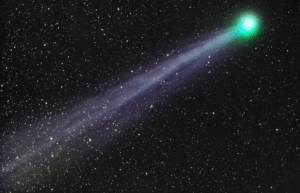
Pons-Winnecke had been seen somewhere in Africa in January 1921, and it was predicted that this comet would be visible at London in June; and this gave rise to much speculation. It was said that Pons-Winnecke might strike the earth with a fearful bump about the 26th of June, but Mr. E. W. Maunder said that though there might be a bump it is only a fog of gas after all; while Dr. Crommelin thought the comet might miss the earth this time, and so there appeared to be no danger. Then Sir Richard Gregory said that if the head of Pons-Winnecke did hit the earth it might set the world on fire, but we were reassured again when he told us that there is about as much chance of the comet hitting the earth as of a random shot hitting a bird in full flight; yet it seemed strange that he should imagine a comet to be like a random shot in this well-ordered universe; unless, perchance,
he had forgotten about the Law of Gravitation. And how are we to understand how the earth could be set on fire when he tells us that we may pass through the tail of a comet without harm because it is really a far higher vacuum than anything that can be produced in our laboratories? Then what are we to think of it all when Professor Fowler tells us that we don’t know how a comet is formed, we don’t know where it comes from, and don’t seem really to know what it is? He thought they may come from gases thrown off from the sun which are gradually cooled ; but that made it even more difficult to understand how it could set the earth on fire, or what all the bother was about.

Nevertheless the discussion continued, until at last the leading authorities advanced the “Fascinating Theory that Pons-Winnecke may have come from a distance in space so great that it is impossible to think or speak of that distance in terms of miles.” That took our breath away, for it appeared that the comet might come out of illimitable space, to wander amid the stars at its own sweet will, regardless of the Laws of Dynamics and Gravitation.

Even yet the romance is not complete— for after waiting in great expectation for several months the Secretary of the Royal Astronomical Society told us that “Pons” had been seen again! this time with only a stump of his original tail, though even this stump was five hundred million miles long, and seemed to be comprised mostly of gas and meteors. It is not recorded how he knew the length of its tail, and nothing was said as to what had become of the remainder ; but to cut a long tale short— the summer came and passed— but Pons-Winnecke never arrived!

He was lost; and even now he may be wandering on and on, somewhere in fathomless space, no one knows whither; and nobody cares.

Note: Doesn’t all this sound like today, in the year 2017? Only the names have changed, that is all!

Posted in astronomy | Tagged , , | Leave a comment

History of Astronomy From The Roman Empire To The Present, part 18

History of Astronomy From The Roman Empire To The Present, part 18

Einstein’s Evidence

But it will be remembered that he offered three crucial tests as evidence in support of his theories, and these we have still to examine. They are:

1. That certain irregularities in the movements
of the planet Mercury would be accounted
for by Einstein’s geometry.

2. That because light has weight it would bend
by gravitation as it passed near another
body on its way to the earth, and that this
could be verified by observations taken at
the time of a solar eclipse.

3. That certain lines in the spectrum would be
found to shift.

We have done with mental athletics, and here we have something a little more tangible to deal with.

Of the Third it is said by the Authorities of Astronomy that the observations necessary to prove or disprove such a shifting of the lines in the spectrum would be so extremely difficult that it is practically impossible ever to do it, and therefore it is set aside.

The First is very well handled in an article by T. F. Gaynor in the London Daily Express of Time 6th, 1921.

Mr. Gaynor meets Einstein on his own ground as a good astronomer should, and uses figures which take my breath away ; but, nevertheless, I will leave him to deal with crucial test number 1.

He says that the discovery of Neptune, 75 years ago, by means of Newton’s Law, utterly extinguishes the Einstein theory so far as Mercury is concerned.

Irregularities similar to those of Mercury had been observed in the movements of Uranus, and in 1841 it was thought that these unaccountable movements must be due to the gravitation of some other planet at that time still undiscovered. But I will quote Mr. Gaynor verbatim; “Uranus is 1,800,000,000,000 miles from the sun. Adams and Leverrier, applying Newton’s Law, which, according to Einstein is an exploded theory, located the probable position of the undiscovered planet a thousand million miles still further on in space— and there Dr. Galle, the Berlin astronomer, found it, on September 23rd, 1846.

Thus, 75 years ago, the Newtonian law found a previously unknown planet (Neptune) at a distance of 2,800 millions of miles from the sun, yet Einstein would have us believe that the same law does not hold good with regard to Mercury; which is only 36,000,000 miles from the sun! The “proof” he adduces from the aberration of the orbit of Mercury can be disposed of in a sentence. He has made the elementary blunder of regarding Mercury as globular instead of spheroidal.”

Light and Gravity

There remains now but one last defence of the Theory of Relativity, and that is the statement that light is really matter, and that it is subject to gravitation. (Test No. 2.)

In order to put this to the test, expeditions old British Astronomers were sent to Sobral in North Brazil, and to the island of Principe on the west coast of Africa, to observe the total eclipse of the sun on May 29th, 1919, and the results they obtained seemed to justify Einstein’s main test, so that as a consequence the Royal Astronomical Society held a remarkable meeting at Burlington House on November 6th, 1919 ; and on the next day all the world of astronomy did homage to Einstein.

The results of the eclipse appeared to satisfy the gathering at Burlington House. Sir Frank Dyson, the Astronomer Royal, described the work of the expeditions, and convinced the meeting that the results were definite and conclusive. Dr. Crommelin explained that the purpose of the expeditions was to test whether the light of the stars that are nearly in a line with the sun is bent by its attraction, and if so, whether the amount of bending is that indicated by the Newtonian law of gravitation, viz. : seven-eighths of a second at the sun’s limb, or the amount indicated by the new Einstein Theory; which postulates a bending just twice as great. The results of the observations were 2.08 and 1.94 seconds respectively. The combined result was 1.98 seconds, with a probable error of about 6 per cent. This was a strong confirmation of Einstein’s Theory, which gave a shift of 1.75 seconds.

The fourth dimension was discussed, and it appeared that Euclidian straight lines could not exist in Einstein’s space. All lines were curved, and if they travelled far enough they would regain the starting point. Mr. de Sitter had attempted to find the radius of space. He gave reasons for putting it at about a billion times the distance from the earth to the sun, or about sixteen million light-years! This was eighty times the distance assigned by Dr. Shapley to the most distant stellar cluster known. The Fourth Dimension had been the subject of vague speculation for a long time, but they seemed at last to have been brought face to face with it.

Even the President of the Royal Society, in stating that they had just listened to “one of the most momentous, if not the most momentous, pronouncements of human thought,” confessed that no one had yet succeeded in stating in clear language what the theory of Einstein really was. But he was confident that “the Einstein Theory must now be reckoned with, and that our conceptions of the fabric of the universe must be fundamentally altered.”

Subsequent speakers joined in congratulating the observers, and agreed in accepting their results. More than one, however, Professor Newell of Cambridge, hesitated as to the full extent of the inferences that had been drawn, and suggested that the phenomena might be due to an unknown solar atmosphere further in its extent than had been supposed, and with unknown properties.

With such a reception as this it is not surprising that the followers of Copernicus everywhere should be almost willing to believe in Relativity whether they understood it or not; but the Royal Astronomical Society might have been a great deal more careful than they were, as we shall see:

That the Einstein Theories were automatically coming to be regarded as accepted science, is evidenced by the fact that the Astronomer Royal himself introduced them into a public lecture on eclipses which he gave at the Old Vic. in the February of 1921.

Coming to the description of the eclipse of May 29th, a slide was thrown upon the screen to illustrate the result of the observations t h a t were said to verify Einstein’s Theory.

  The lecturer described how certain stars which were in the same direction as the sun could, of course, not be seen in the ordinary way in the day time, but when the sun was obscured, as at the time of a total eclipse, they could be seen through a smoked glass or telescope. The exact position of these stars was known to astronomy, but if Einstein’s Theory was correct the light coming from them to the observer would be bent as it passed near the sun, so that they would not appear to be in their true positions. Then he showed how the Einstein Theory was verified; for the stars were observed to be a little further from the sun than their theoretical or true positions. But the Law of Gravitation is “That mutual action between masses of matter by virtue of which every such mass tends toward every other, etc., etc.”

Observe that it tends toward; it attracts; it pulls; therefore— if light was matter, and was affected by the gravitation of the sun, the stars would be seen nearer to the sun ; and not as stated by the lecturer and illustrated on the slide.

In diagram 29 the crosses XX suggest the normal, true, or theoretical positions of the stars with respect to the sun. If Einstein’s theories had been right the stars would be seen nearer to the sun than the crosses, but the Astronomer Royal demonstrated the fact that they were actually further away!

Such was the real result of the solar eclipse of May 29th, 1919. The circumstances had been laid before the Royal Astronomical Society in Burlington House on November 6th, and yet, for some unaccountable reason they failed to perceive that the result was contrary to the Law of Gravitation; and clearly demonstrated the fact that Einstein’s Theory is false.

N.B.— The real cause of the displacement of these stars from their true positions is known to the author, and will be explained in a book sequel to this work; but he does not consider that explanation necessary to the present discussion. Einstein’s Theory is disproved; alternative or no alternative.

.

Posted in astronomy | Tagged , | Leave a comment

The Recent Hurricanes and the Spinning Earth

The Recent Hurricanes and the Spinning Earth

Hi Folks!

Just want to let you know that I’m still waiting on my computer as they had delivered the wrong one, as you know. I’m at the library now to make this Post.

Here is a thought that came to me when I watched the hurricanes that have been pounding the Caribbean and the U.S. which made me think of something you can point out to your round earth friends. Remind them how the 150 mph winds destroyed the homes of people in path of the hurricanes. Now, ask them what would 1,000 mph winds do. Of course, they would say that it would be total destruction. Then, ask them how we can stand on the earth with no destruction at all with the spinning earth. If they don’t know you are flat earth believer, then just start off by asking a series of questions. When they answer they don’t know, it’s good, as it leaves a doubt in their collective minds. And, with a doubt, there is the start of independent investigation (hopefully) of what they have been told.

Anyhow, I hope to be on track with more Posts later this week.


Posted in Flat Earth Questions | Tagged | Leave a comment

The World Is Starting To Wake Up

The World Is Starting To Wake Up

FE on Dutch TV

https://www.youtube.com/watch?v=zQRvfH7pwSc

You Can’t Stop This Movement

https://www.youtube.com/watch?v=66LvdZup8OE

.


Posted in flat earth discussion | Tagged | Leave a comment

Just a Quick Note

Just a Quick Note

Thanks for all those who joined on our mailing list! I’m at the library now using the computer as my computer crashed. I’m ordering an inexpensive computer and waiting on that. What they shipped out yesterday was the wrong one! I’ll make a comment on what I observed and how this simple mistake made me realise what the Internet Giants are doing and even how it affects us flat earth people and all truth seekers.

So, when I get online again at home, I’ll be adding more posts and start with the first of the newsletter.

By the way our Stats are up!

God Bless

Posted in Important News | Tagged | Leave a comment

Video: Flat Earth and the Bible

Video: Flat Earth and the Bible

Flat Earth Creation summed up in a couple of minutes.

.


Posted in Bible and Flat Earth, Bible and science | Tagged , | Leave a comment

History of Astronomy From The Roman Empire To The Present, part 17

History of Astronomy From The Roman Empire To The Present, part 17

Einstein’s Theories Examined

What Einstein suggests is this:

The observer is located on the surface of an earth which is rotating on its axis, and at the same time travelling through space at many thousands of miles an hour, consequently his place, or locality, is continually changing with respect to an imaginary point fixed in space. Notwithstanding this change of place, electro-magnetic laws appear to act precisely as they would if this place was not changing its position with respect to that point. Therefore Einstein argues that electro-magnetic currents must, in reality, vary their speed, and so adapt themselves to the changing conditions in such a manner as to “seem the same to the observer as if he had not changed his position.” Unfortunately he is unable to show any reason why electro-magnetic action should do this remarkable thing; for he treats it as a thing that had intelligence, as if it wilfully acted in a manner calculated to deceive the observer.

When reduced to its essence, this argument proves to be no more logical than the idea that the street might be moving while the wagon was at rest. Einstein has been betrayed into supposing a thing that is altogether impossible, i.e. that a physical law can act in an unnatural manner, and yet produce an effect which appears to be normal; because he began by assuming that the locality of the observer was changing, and that assumption was untrue! Now if he can realize the fact that the earth is actually at rest, he will find that his difficulties all disappear; and that Electro-magnetic laws do not alter, neither does the locality of the observer change.

But as Einstein persisted in shutting his eyes to the fact that the earth is stationary he did not see the incongruity of his assumptions concerning electromagnetic action, so that— in order to support his contention— he was led still further into error, and compelled to repudiate two of the Laws of Dynamics, viz.: 1. “Lengths of rigid bodies are unaffected by motion of the frame of reference;” and 2, “Measured times are likewise unaffected.”

He says that these two laws of dynamics are untrue, and thought to prove they were wrong by the foregoing argument, so it becomes necessary for us to prove the fallacy of that argument in such a manner as to leave no doubt whatever as to what is true, and what is false; the two “Laws of Dynamics” 1 and 2, being the stake at issue.

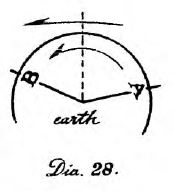
Einstein believes that the earth is rotating on its axis in the direction of the arrow in diagram 28, at the rate of 1,000 miles an hour; and that at the same time it is travelling, en mass, in the same general direction along its orbit at 66,000 miles an hour; therefore he thinks that an electro-magnetic current must travel from B to A in less time than it will take in travelling from A to B, because B is all the while running away from A, while A is always going towards B. Therefore it appears that the measured length of a current passing from B to A (and also the time it takes) will be shorter than the measured length and time of a current passing in the opposite direction from A to B; (hence his contention that lengths of bodies and measured times must both be affected by the motion of the observer.)

Of course we know that his premises were wrong, and that A and B are both located on an earth which is at rest; but, for the purpose of the argument, we will waive that, and assume the Copernican astronomy to be true. Then his argument is not so unreasonable as it seemed; indeed it almost has the appearance of being true; but Einstein has forgotten that the observers at A and B are both on the same earth— that they both use the same Greenwich Mean Time— and that the Electro-magnetic wave passes from one place to the other by convention— so that the earth’s atmosphere offers the same facility to its passage from A to B, as it does from B to A.

And that is the trifle that turns the scale against him. The fact that the whole operation takes place within the terrestrial atmosphere gives equal conditions to an electro-magnetic current passing in any direction within that atmosphere; the same being unaffected by anything that may, or may not, take place in ethereal space, which the earth and its atmosphere in its entirety is unconscious of. Thus, an electro-magnetic wave passes from A to B in the same time as it passes from B to A, just as a train travelling at a uniform speed of 60 miles an hour goes from Bristol to London in the same time as it will go from London to Bristol; while the length of the railway track measures the same from Bristol to London as it does from London to Bristol.

And so the Laws of Dynamics 1 and 2 remain true; while Einstein’s contention has been proven false.

The whole hypothesis of Relativity has failed, both in the mass and in detail, under our examination, so that, unable to support itself, it can no longer aspire to support any theory of the universe. Therefore our judgment remains unaltered. Copernican Astronomy stands condemned, and has lost its last, and perhaps its ablest, living advocate.

Posted in astronomy, Hidden history | Tagged , , | Leave a comment

Anti Communist Song

Anti-Communist Song

Here is a song that I never heard before. It sounds like it was written many years ago but it is still relevant for today. This is something that Christian Patriots should be singing the next time they have a march. Enjoy…

.

Posted in Uncategorized | Tagged | Leave a comment

“Charities” Like The American Red Cross Are Selling Donations Claims Some People

“Charities” Like The American Red Cross Are Selling Donations Claims Some People

Charity Rip Offs

.


Posted in Important News, media lies | Tagged | Leave a comment