
5G Prediction That Came True
I don’t want the word about what is going today but you’ll find out what it is in this video. It’s about a prediction that has come true in 2020. Watch it while you can. This guy connects all the dots.
I don’t want the word about what is going today but you’ll find out what it is in this video. It’s about a prediction that has come true in 2020. Watch it while you can. This guy connects all the dots.
 Globe earthers will often quip that ‘if the earth were flat, then we could see all over it!’ but this is, of course, ignorant and inaccurate. If you stand on the beach, a plain or prairie, you will find the horizon extends about three to six miles around you – depending on the weather and your eyesight. The range of the human eye, our field of vision is from 110 to 1 degree, and the smallest angle under which an object can still be seen is 1/60 of 1 degree, so that when an object is 3000 times its own diameter away from an observer, it will cease to be visible. So, for example, the farthest distance at which one can see a 1 inch diameter penny, is 3000 inches, or 250 feet. Therefore, if a ship’s hull is 10 feet above the water, it will disappear from the unaided eye at 3,000 times 10 feet, or 6 miles. This has nothing to do with the supposed ‘convexity’ or ‘curvature’ of the earth and everything to do with the common Law of Perspective.
The horizon of an observer is distant or near according to the greatness or otherwise of his elevation above the surface of the supposed globe. If he stands 24 feet above sea level, he is said to be in the centre of a circle, which bounds his vision, the radius of which in any direction, on a clear day, is six miles. A local gentleman tells me that he has watched a boat-race in New Zealand, seeing the boats all the way out and home, the distance being 9 miles from where he was standing on the beach. I have seen the hull of a steamer with the naked eye at an elevation of not more than 24 feet, as a distance of 12 miles, and in taking observations along the South African coast, have sometimes had an horizon of at least 20 miles at an elevation of 20 feet only.
The distance of the horizon, or vanishing point, where the sky appears to touch the earth and sea, is determined, largely by the weather, and when that is clear, by the power of our vision. This is proved by the fact that the telescope will increase the distance of the horizon very greatly, and bring objects into view which are entirely beyond the range of vision of the unaided eye. But, as no telescope can pierce a segment of water, the legitimate conclusion we are forced to arrive at, is that the surface of water is level, and that, therefore, the shape of the world cannot be globular, and on such a flat or level surface, the greater the elevation of the observer, the longer will his range of vision be, and thus the father he can see. Thomas Winship, “Zetetic Cosmogeny
On the shore near Waterloo, a few miles to the north of Liverpool, a good telescope was fixed, at an elevation of 6 feet above the water. It was directed to a large steamer, just leaving the River Mersey, and sailing out to Dublin.
Gradually the mast-head of the receding vessel came nearer to the horizon, until, at length, after more than four hours had elapsed, it disappeared. The ordinary rate of sailing of the Dublin steamers was fully eight miles an hour; so that the vessel would be, at least, thirty-two miles distant when the mast-head came to the horizon. This 6 feet of elevation of the telescope would require three miles to be deducted for convexity, which would leave 29 miles, the square of which, multiplied by 8 inches, gives 560 feet; deducting 80 feet for the height of the main-mast, and we find that, according to the doctrine of rotundity, the mast-head of the outward bound steamer should have been 480 feet below the horizon.
Many other experiments of this kind have been made upon sea-going steamers, and always with results entirely incompatible with the theory that the earth is a globe. Dr. Samuel Rowbotham, ‘Zetetic Astronomy, Earht Not a Globe!’
Here is a video for your consideration. Since the earth is flat, there has to be more land in the extreme south of earth (Antarctica). Here is a video for your consideration. Notice that this land is free of ice and snow except in the higher elevations. So, where would it be this warm when all around is snow 12 months of the year?
We know that there is more ocean in the southern hemisphere but you can’t photograph that and say, “Here is new ocean!” It doesn’t make sense but with land you can do this. What you can do with the ocean – to prove that there is more – is to sail in a ship. For example, we are given the distance between the southern continents, so, if you have a sea-worthy yacht, see if the journey takes longer than what it should. If you find out that it does, it tells us that the earth is much larger than what it is. If you are rich and have your own jet, fly the distance from New Zealand to South America – directly. But before you do, you better have plans to be sure you can land on some island on the way. The reason for this is, that if you gage the fuel with what you are told the distance is, you’ll come up, perhaps, thousands of miles short.
This man knows what he’s talking about. He must have taken the same natural hygiene course I took many years ago. WELL WORTH LISTENING TO.
A flat earther explains how a globe earth believer is wrong!
RULES OF LOGIC
Discussing the flat earth with anyone it would help to know what rules of logic the critic has broken. When you know this and say what they are doing, it helps in your discussion. For example, you might say that they are using the straw man argument and give an explanation of it.
Below you’ll see the rules of logic, its definition and an example.
I hope that you find this of interest and find it useful in not only discussing the flat earth but also anything else that the public is usually wrong about.
Your support for this ministry is kindly appreciated. God Bless you and yours.
strawman
You misrepresented someone’s argument to make it easier to attack.
By exaggerating, misrepresenting, or just completely fabricating someone’s argument, it’s much easier to present your own position as being reasonable, but this kind of dishonesty serves to undermine honest rational debate.
Example: After Will said that we should put more money into health and education, Warren responded by saying that he was surprised that Will hates our country so much that he wants to leave it defenceless by cutting military spending.
false cause
You presumed that a real or perceived relationship between things means that one is the cause of the other.
Many people confuse correlation (things happening together or in sequence) for causation (that one thing actually causes the other to happen). Sometimes correlation is coincidental, or it may be attributable to a common cause.
Example: Pointing to a fancy chart, Roger shows how temperatures have been rising over the past few centuries, whilst at the same time the numbers of pirates have been decreasing; thus pirates cool the world and global warming is a hoax.
Note: This is a bad example (by the person who wrote this article) as we know that global warming is a hoax.
appeal to emotion
You attempted to manipulate an emotional response in place of a valid or compelling argument.
Appeals to emotion include appeals to fear, envy, hatred, pity, pride, and more. It’s important to note that sometimes a logically coherent argument may inspire emotion or have an emotional aspect, but the problem and fallacy occurs when emotion is used instead of a logical argument, or to obscure the fact that no compelling rational reason exists for one’s position. Everyone, bar sociopaths, is affected by emotion, and so appeals to emotion are a very common and effective argument tactic, but they’re ultimately flawed, dishonest, and tend to make one’s opponents justifiably emotional.
Example: Luke didn’t want to eat his sheep’s brains with chopped liver and brussel sprouts, but his father told him to think about the poor, starving children in a third world country who weren’t fortunate enough to have any food at all.
the fallacy fallacy
You presumed that because a claim has been poorly argued, or a fallacy has been made, that the claim itself must be wrong.
It is entirely possible to make a claim that is false yet argue with logical coherency for that claim, just as it is possible to make a claim that is true and justify it with various fallacies and poor arguments.
Example: Recognising that Amanda had committed a fallacy in arguing that we should eat healthy food because a nutritionist said it was popular, Alyse said we should therefore eat bacon double cheeseburgers every day.
slippery slope
You said that if we allow A to happen, then Z will eventually happen too, therefore A should not happen.
The problem with this reasoning is that it avoids engaging with the issue at hand, and instead shifts attention to extreme hypotheticals. Because no proof is presented to show that such extreme hypotheticals will in fact occur, this fallacy has the form of an appeal to emotion fallacy by leveraging fear. In effect the argument at hand is unfairly tainted by unsubstantiated conjecture.
Example: Colin Closet asserts that if we allow same-sex couples to marry, then the next thing we know we’ll be allowing people to marry their parents, their cars and even monkeys.
ad hominem
You attacked your opponent’s character or personal traits in an attempt to undermine their argument.
Ad hominem attacks can take the form of overtly attacking somebody, or more subtly casting doubt on their character or personal attributes as a way to discredit their argument. The result of an ad hom attack can be to undermine someone’s case without actually having to engage with it.
Example: After Sally presents an eloquent and compelling case for a more equitable taxation system, Sam asks the audience whether we should believe anything from a woman who isn’t married, was once arrested, and smells a bit weird.
tu quoque
You avoided having to engage with criticism by turning it back on the accuser – you answered criticism with criticism.
Pronounced too-kwo-kwee. Literally translating as ‘you too’ this fallacy is also known as the appeal to hypocrisy. It is commonly employed as an effective red herring because it takes the heat off someone having to defend their argument, and instead shifts the focus back on to the person making the criticism.
Example: Nicole identified that Hannah had committed a logical fallacy, but instead of addressing the substance of her claim, Hannah accused Nicole of committing a fallacy earlier on in the conversation.
personal incredulity
Because you found something difficult to understand, or are unaware of how it works, you made out like it’s probably not true.
Complex subjects like biological evolution through natural selection require some amount of understanding before one is able to make an informed judgement about the subject at hand; this fallacy is usually used in place of that understanding.
Example: Kirk drew a picture of a fish and a human and with effusive disdain asked Richard if he really thought we were stupid enough to believe that a fish somehow turned into a human through just, like, random things happening over time.
Note: This is a bad example, as we know that there is no such thing as evolution of the species.
special pleading
You moved the goalposts or made up an exception when your claim was shown to be false.
Humans are funny creatures and have a foolish aversion to being wrong. Rather than appreciate the benefits of being able to change one’s mind through better understanding, many will invent ways to cling to old beliefs. One of the most common ways that people do this is to post-rationalize a reason why what they thought to be true must remain to be true. It’s usually very easy to find a reason to believe something that suits us, and it requires integrity and genuine honesty with oneself to examine one’s own beliefs and motivations without falling into the trap of justifying our existing ways of seeing ourselves and the world around us.
Example: Edward Johns claimed to be psychic, but when his ‘abilities’ were tested under proper scientific conditions, they magically disappeared. Edward explained this saying that one had to have faith in his abilities for them to work.
loaded question
You asked a question that had a presumption built into it so that it couldn’t be answered without appearing guilty.
Loaded question fallacies are particularly effective at derailing rational debates because of their inflammatory nature – the recipient of the loaded question is compelled to defend themselves and may appear flustered or on the back foot.
Example: Grace and Helen were both romantically interested in Brad. One day, with Brad sitting within earshot, Grace asked in an inquisitive tone whether Helen was still having problems with her drug habit.
burden of proof
You said that the burden of proof lies not with the person making the claim, but with someone else to disprove.
The burden of proof lies with someone who is making a claim, and is not upon anyone else to disprove. The inability, or disinclination, to disprove a claim does not render that claim valid, nor give it any credence whatsoever. However it is important to note that we can never be certain of anything, and so we must assign value to any claim based on the available evidence, and to dismiss something on the basis that it hasn’t been proven beyond all doubt is also fallacious reasoning.
Example: Bertrand declares that a teapot is, at this very moment, in orbit around the Sun between the Earth and Mars, and that because no one can prove him wrong, his claim is therefore a valid one.
ambiguity
You used a double meaning or ambiguity of language to mislead or misrepresent the truth.
Politicians are often guilty of using ambiguity to mislead and will later point to how they were technically not outright lying if they come under scrutiny. The reason that it qualifies as a fallacy is that it is intrinsically misleading.
Example: When the judge asked the defendant why he hadn’t paid his parking fines, he said that he shouldn’t have to pay them because the sign said ‘Fine for parking here’ and so he naturally presumed that it would be fine to park there.
the gambler’s fallacy
You said that ‘runs’ occur to statistically independent phenomena such as roulette wheel spins.
This commonly believed fallacy can be said to have helped create an entire city in the desert of Nevada USA. Though the overall odds of a ‘big run’ happening may be low, each spin of the wheel is itself entirely independent from the last. So whilst there may be a very small chance that heads will come up 20 times in a row if you flip a coin, the chances of heads coming up on each individual flip remain 50/50, and aren’t influenced by what happened before.
Example: Red had come up six times in a row on the roulette wheel, so Greg knew that it was close to certain that black would be next up. Suffering an economic form of natural selection with this thinking, he soon lost all of his savings.
bandwagon
You appealed to popularity or the fact that many people do something as an attempted form of validation.
The flaw in this argument is that the popularity of an idea has absolutely no bearing on its validity.
If it did, then the Earth would have made itself a globe for most of history to accommodate this popular belief.
Example: Shamus pointed a drunken finger at Sean and asked him to explain how so many people could believe in leprechauns if they’re only a silly old superstition. Sean, however, had had a few too many Guinness himself and fell off his chair.
appeal to authority
You said that because an authority thinks something, it must therefore be true.
It’s important to note that this fallacy should not be used to dismiss the claims of experts, or scientific consensus. Appeals to authority are not valid arguments, but nor is it reasonable to disregard the claims of experts who have a demonstrated depth of knowledge unless one has a similar level of understanding and/or access to empirical evidence. However, it is entirely possible that the opinion of a person or institution of authority is wrong; therefore the authority that such a person or institution holds does not have any intrinsic bearing upon whether their claims are true or not.
Example: Not able to defend his position that geocentrism ‘isn’t true’ Bob says that he knows a scientist who also questions evolution (and presumably isn’t a primate).
composition/division
You assumed that one part of something has to be applied to all, or other, parts of it; or that the whole must apply to its parts.
Often when something is true for the part it does also apply to the whole, or vice versa, but the crucial difference is whether there exists good evidence to show that this is the case. Because we observe consistencies in things, our thinking can become biased so that we presume consistency to exist where it does not.
Example: Daniel was a precocious child and had a liking for logic. He reasoned that atoms are invisible, and that he was made of atoms and therefore invisible too. Unfortunately, despite his thinky skills, he lost the game of hide and go seek.
no true scotsman
You made what could be called an appeal to purity as a way to dismiss relevant criticisms or flaws of your argument.
In this form of faulty reasoning one’s belief is rendered unfalsifiable because no matter how compelling the evidence is, one simply shifts the goalposts so that it wouldn’t apply to a supposedly ‘true’ example. This kind of post-rationalization is a way of avoiding valid criticisms of one’s argument.
Example: Angus declares that Scotsmen do not put sugar on their porridge, to which Lachlan points out that he is a Scotsman and puts sugar on his porridge. Furious, like a true Scot, Angus yells that no true Scotsman sugars his porridge.
genetic
You judged something as either good or bad on the basis of where it comes from, or from whom it came.
This fallacy avoids the argument by shifting focus onto something’s or someone’s origins. It’s similar to an ad hominem fallacy in that it leverages existing negative perceptions to make someone’s argument look bad, without actually presenting a case for why the argument itself lacks merit.
Example: Accused on the 6 o’clock news of corruption and taking bribes, the senator said that we should all be very wary of the things we hear in the media, because we all know how very unreliable the media can be.
black-or-white
You presented two alternative states as the only possibilities, when in fact more possibilities exist.
Also known as the false dilemma, this insidious tactic has the appearance of forming a logical argument, but under closer scrutiny it becomes evident that there are more possibilities than the either/or choice that is presented. Binary, black-or-white thinking doesn’t allow for the many different variables, conditions, and contexts in which there would exist more than just the two possibilities put forth. It frames the argument misleadingly and obscures rational, honest debate.
Example: Whilst rallying support for his plan to fundamentally undermine citizens’ rights, the Supreme Leader told the people they were either on his side, or they were on the side of the enemy.
begging the question
You presented a circular argument in which the conclusion was included in the premise.
This logically incoherent argument often arises in situations where people have an assumption that is very ingrained, and therefore taken in their minds as a given. Circular reasoning is bad mostly because it’s not very good.
Example: The word of Zorbo the Great is flawless and perfect. We know this because it says so in The Great and Infallible Book of Zorbo’s Best and Most Truest Things that are Definitely True and Should Not Ever Be Questioned.
appeal to nature
You argued that because something is ‘natural’ it is therefore valid, justified, inevitable, good or ideal.
Many ‘natural’ things are also considered ‘good’, and this can bias our thinking; but naturalness itself doesn’t make something good or bad. For instance murder could be seen as very natural, but that doesn’t mean it’s good or justifiable.
Example: The medicine man rolled into town on his bandwagon offering various natural remedies, such as very special plain water. He said that it was only natural that people should be wary of ‘artificial’ medicines such as antibiotics.
Note: This is a bad example, as all medicines has contraindicative effects.
anecdotal
You used a personal experience or an isolated example instead of a sound argument or compelling evidence.
It’s often much easier for people to believe someone’s testimony as opposed to understanding complex data and variation across a continuum. Quantitative scientific measures are almost always more accurate than personal perceptions and experiences, but our inclination is to believe that which is tangible to us, and/or the word of someone we trust over a more ‘abstract’ statistical reality.
Example: Jason said that that was all cool and everything, but his grandfather smoked, like, 30 cigarettes a day and lived until 97 – so don’t believe everything you read about meta analyses of methodologically sound studies showing proven causal relationships.
the texas sharpshooter
You cherry-picked a data cluster to suit your argument, or found a pattern to fit a presumption.
This ‘false cause’ fallacy is coined after a marksman shooting randomly at barns and then painting bullseye targets around the spot where the most bullet holes appear, making it appear as if he’s a really good shot. Clusters naturally appear by chance, but don’t necessarily indicate that there is a causal relationship.
Example: The makers of Sugarette Candy Drinks point to research showing that of the five countries where Sugarette drinks sell the most units, three of them are in the top ten healthiest countries on Earth, therefore Sugarette drinks are healthy.
middle ground
You claimed that a compromise, or middle point, between two extremes must be the truth.
Much of the time the truth does indeed lie between two extreme points, but this can bias our thinking: sometimes a thing is simply untrue and a compromise of it is also untrue. Half way between truth and a lie, is still a lie.
Example: Holly said that vaccinations caused autism in children (which it does, ed.), but her scientifically well-read friend Caleb said that this claim had been debunked and proven false (because a person repeats what he is told, he says it out of fear, or he is in the pay of a pharmaceutical company, ed.). Their friend Alice offered a compromise that vaccinations must cause some autism, just not all autism.
Note: This is a bad another example by the person who wrote the article.
Does the ‘bottomless pit’ as talked about in the Bible fit with a globe earth or a flat earth?
If a good theodolite is placed on the summit of Shooter’s Hill, in Kent, and levelled, the line of sight, on being directed to Hampstead Hill, will cut the cross on St. Paul’s Cathedral, and fall upon a part of Hampstead Hill, the altitude of which is the same as that of Shooter’s Hill. The altitude of each of these points is 412 feet above the Trinity high water mark, at London Bridge. The distance from Shooter’s Hill to St. Paul’s Cathedral is 7 statute miles, and from St. Paul’s to Hampstead Hill, 5 miles. If the earth is a globe, the line of sight from the “levelled” theodolite would be a tangent, below which St. Paul’s cross would be 32 feet, and Hampstead Hill 96 feet. The highest point of Hampstead Hill is 430 feet, which we find, on making the proper calculation, would be 78 feet below the summit of Shooter’s Hill; whereas, according to the Ordnance Survey, and as may be proved by experiment, the three points are in the same direct line; again demonstrating that the earth is a plane.
The diagrams, figs. 42 and 43, will show the difference
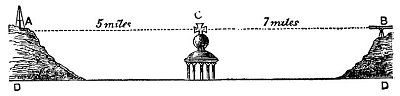
FIG. 42.
between the theory of rotundity and the results of actual survey. A, represents Hampstead Hill; C, St. Paul’s cross; B, Shooter’s Hill; and D, D, the datum line–the Trinity high water mark. In fig. 43, A, B, C, and D, D, represent the same points respectively as in fig. 42.
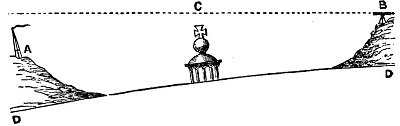
FIG. 43.
In the account of the trigonometrical operations in France, by M. M. Biot and Arago, it is stated that the light of a powerful lamp, with good reflectors, was placed on a rocky summit, in Spain, called Desierto las Palmas, and was distinctly seen from Camprey, on the Island of Iviza. The elevation of the two points was nearly the same, and the distance between them nearly 100 miles. If the earth is a globe, the light on the rock in Spain would have been more than 6600 feet, or nearly one mile and a quarter, below the line of sight.
“The length of some of the sides of the great triangles (in the English survey) is upwards of 100 miles; and many means were employed to render the stations visible from each other at such great distances. The oxy-hydrogen, or Drummond’s Light, was employed in some instances; but a heliostat, for reflecting the sun’s rays in the direction of the distant observer, was more generally and successfully employed. Lieutenant-Colonel Portlock, R.E., who observed the station on Precelly, a mountain in South Wales, from the station on Kippure, a mountain about 10 miles south-west of Dublin–the distance between the stations being 108 miles–says: ‘For five weeks I watched in vain; when, to my joy, the heliostat blazed out in the early beams of the rising sun, and continued visible as a bright star the whole day.’” 1
Many other very long “sights” have been taken by surveyors of different countries, which upon a globe of 25,000 miles in circumference, would have been quite impossible; but with the demonstrated fact that the earth is a plane, are practical and consistent.
Footnotes
59:1 Handbook to the Official Catalogue of the Great Exhibition of 1851.
This is what I had been saying since the fires started but what I pointed out was more than what this article says, meaning, that trees are still standing when brick walls are not. The brick walls did not just collapse but looked like most of them disintegrate. Also, the glass in calls are gone – not smashed but melted! This is not caused by a forest fires as forest fires don’t reach that high of temperature.
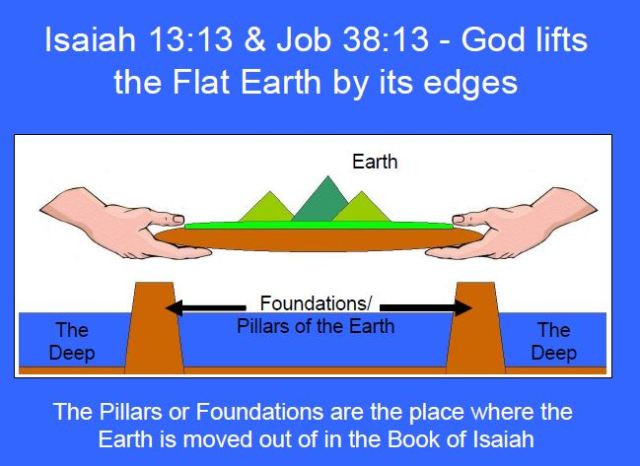
I just came across a sermon by a Christian Identity pastor by the name of Jeromy John Visser who attacks flat earth believers. His attack is pretty poor and much like those who are not Christian. The flat earth topic is mixed in with several other topics that are not even related, which I don”t understand.
Below is the link to the video if you want to hear it. However, I would like to make some comments on this malicious attack of Christians who also believe in the flat earth.
Visser paraphrases the Bible and says that: ‘that God sits on the sphere or circle of the earth.’ His first mistake is that the Bible does not use the word ‘sphere’, unless he is using one of those modern-day Bibles created by non-Christians in order to prove their interpretation, and not the KJV.
He also paraphrases the Bible and says that the world hangs on nothing. Now, this is true but he can’t get in his mind that you can have a flat earth and it hangs on nothing. This is what Yahweh, God said and I believe it; all flat earthers believe it. Otherwise you’d have to believe that it sits on some other land. But if that is the case, where does that sit on? – the back of a huge turtle? Lol.
The next claim is that some Rabbi Sodie invented the flat earth. Now, the flat earth might be mentioned in the Talmud but does that make it false? It might be mentioned in other health religions but because it has, does this alone make it false? The fact is, that these other people got the flat earth from Christians and if they put it in their writings is simply that they are copying what they heard. In regardless to the flat earth, they at least got that right.
Visser says ‘the truth movement is being inundated by idiots and deceivers’ – implying flat earthers. There is a lot of implications to flat earthers here and he gets quite mean. If he read other articles on this website – if he had been here – he would not use those words.
He also said ‘we must use sound doctrine’ and he quotes a verse – again implying that flat earthers doesn’t use sound doctrine. He should look to himself!
Another quote, ‘Anything that the Bible says trumps what man said and if the Bible says the earth is round it would trump what others say that is contrary.’ This is a typical critic’s argument – they imply what they say is the truth, so anything that is contrary is wrong. Sure, this is what the Bible says BUT when it’s used to support something that is not true, he hopes that the listener follows along.

All of the above is the first four minutes of the video. Now, it gets ludicrous – it’s funny. Jeromy Visser said, ‘I’ve been on planes flying to the Vatican and you can look out the window and see the earth is round.’ If this isn’t absurd, I don’t know what is! Lol. It’s also revealing and I’ll talk about that in a minute.
When you look out a window when you are flying, do you see a round earth? Do you see any curvature? I don’t. I see a flat horizon that goes up the the level of my eyes – which is one proof (of many) that the earth is flat. If we are on a globe that would not happen. Or, are they making windows with fish-eye lens! We know that they aren’t, at least at the writing.
I thought about what he said, and I’m glad that he said it as it reveals a previously unknown condition that the world is being subject to. I never read or heard anyone talking on this subject before, so I’ll do so.
If pastor Vissor is honest in what he said, and I’ve heard others say the same thing by critics of the flat earth, it reveals something very interesting. I had to create a new phrase for this and that is digital overlay If you fly once a year, for example, but during that year you see 1,000 images or CGI of a globe earth. Then when you fly, you look out the window. Then later, when you recall your trip and asked how it looked out the window, you would say the earth has a curve to it. Now, this is just a theory but it explains how some people can honestly think they saw something that they really didn’t. Because, back in their recollection is also the 1,000 images they had seen something that was created digitally and is overlaid on the real memory they had. Because, what they had seen on the evening news, for example, is much more often than their flight that happened a year ago. So, I call this, for a lack of any other word, digital overlay; I’ll trade mark that, too: digital overlay TM
I dare say that this digital overlay TM can and does happen with anything else that we are constantly shown on the computer or TV and changes our real memory experience, but I’ll leave that for now.
The other interesting thing I want to point out that Visser said, and I think he slipped up, was that when he fly to the Vatican many times. So, what is a person who knows the falsehoods about the Catholic Church and knows about the dark deeds theJesuits do, visiting the Vatican? He knows about the Pope and how he deceives the people. So, when Visser said that deceivers have came into the church, who is he talking about?
About half way through this video Visser said the year was 2015. Now, this is when the flat earth information really took off and it was when I first learned about it and started to write about it. I’m wondering if he had seen some of my posts. If so, he didn’t mention it.
Finally, at the 37 minute mark that he said if you look out your window you can see that the Moon is round. Well, I could hold up a dinner plate and it’s round, too, but that does not make it a globe, nor does it tell me (by looking at the Moon) that it’s 242,000 miles away (or whatever the distance is now).
About this other sermon that he said he would make just on the globe earth, I haven’t seen it. If you have seen it, kindly let me know and send me the link. I would be interested in listening to it. Maybe Visser found our more about what we actually say but was too embarrassed to say he was wrong, I don’t know.
I highly recommend that he, and other critics, actually read what is on this website before making a conclusion; before looking foolish and shooting off your mouth.
Side note: Visser talks about we are not to use four letter words and said that the Bible uses the word ‘profanity.’ yet, at the very end of the video, he talked about meeting someone (which includes flat earthers, though it’s implied) that, and I quote, ‘I would hit him ____ in the mouth!’ You actually heard a bleep but you know he would have said the ‘F word.’ So, he just did what he condemned!
Summery
To sum up this, Jeromy Visser has not taken the time to read and watch what us flat earthers really believe and talk on that – to either prove we are wrong or to agree. He does not mention another 50 verses where God talks about the earth, Sun and Moon. He does not talk about the other word of God, and that is nature, specifically the laws of physics. God created that, too, but Visser never once commented on that.
The attack on flat earthers seem to follow the same pattern – whether they come from other Christians or from non-Christians. Hopefully, you are aware of what to expect and how to answer them.
Just like a jury that listens to a criminal case, they have to listen to both sides before they make a decision; the same goes for a judge. King Solomon said, he who judges a matter before he hears it is a fool.

