The Hidden Importance of Russia to International Flight Routes
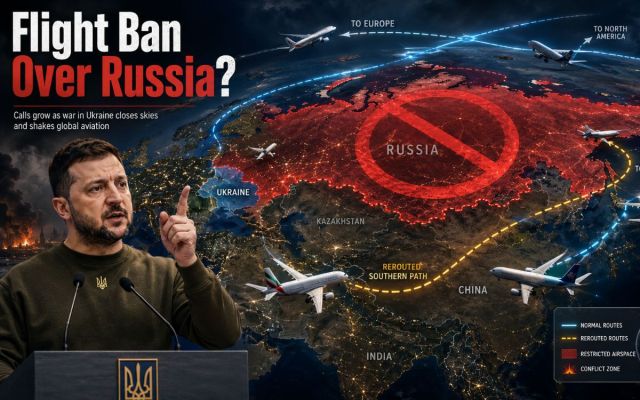
This is a revealing article, which you can read at the link below:
Click Here
This is not simply about domestic flights within Russia. Zelensky is talking about international flights.
Think about it. Why would Zelensky be concerned about domestic flights operating entirely within Russia? He has no control over them. Yet a letter was sent to the secretary general of the International Civil Aviation Organization (ICAO), which strongly suggests that the real issue is foreign and international flights passing through Russian airspace.
The article states that Ukrainian newspaper Zerkalo Nedeli reported that Infrastructure Minister Nikolay Kalashnik sent a letter to Juan Carlos Salazar, secretary general of the ICAO, calling for action against flights through Russian airspace.
The head of the ICAO, or any other international organization, has no direct control over Russia. So why appeal to the ICAO? Why pressure European leaders to stop flights?
The obvious implication is that international flights are still passing through Russian airspace despite the war in Ukraine.
This raises a larger question.
Flight controllers, pilots, co-pilots, and navigators understand the routes aircraft actually fly. From my perspective, these routes do not make sense according to the conventional globe model. Instead, they appear to follow routes that make much more sense on a flat-earth model.
That would also suggest that, even during wartime, there are international understandings that allow certain civilian aircraft to continue using airspace that might otherwise be considered politically or militarily restricted.
Consider an example from the war in Ukraine. There was reportedly an emergency involving a flight travelling from Hong Kong toward California that resulted in the aircraft landing in eastern Russia. I do not recall all the details, but I previously discussed the incident elsewhere. A medical emergency forced the aircraft to land in a Russian city.
Most passengers probably had no reason to think about whether their flight would pass over Russia. However, once an emergency landing became necessary, the aircraft’s location could no longer be ignored.
In my view, passengers are generally not encouraged to think too deeply about these routes because doing so might raise questions about the conventional model of the earth.
On a globe, a passenger looking at a map may assume that a flight from Southeast Asia to California should simply travel directly across the Pacific. Yet many actual routes travel far to the north before turning south again toward their destinations.
Why?
From my perspective, the explanation is simple: aircraft are following the shortest practical route across the earth, travelling through or near Russia, Alaska, and then onward toward California.
The governments of the world, including Russia and China, continue to support the conventional idea of a spinning globe. Their space programmes are part of that public presentation.
To me, this suggests an extraordinary level of international agreement. Even nations that are political or military rivals continue supporting the same basic story.
Another example is Antarctica.
Russia and China have not withdrawn from the Antarctic Treaty system or openly challenged the restrictions governing activities there. If either country truly wanted to break with the international order, it could attempt much more extensive exploration of Antarctica’s interior.
Yet they do not.
This again suggests that there are certain international agreements that nations continue to honour even when they are hostile toward one another in other areas.
Russia could also prevent foreign aircraft from crossing its territory if it wanted to. It could restrict access to aircraft from friendly countries such as China, India, or Turkey while denying access to nations supporting Ukraine.
If Russia did that, the consequences for international aviation could be significant.
Flights between Europe and China, Southeast Asia, and other parts of Asia could become considerably longer. Some aircraft might require additional fuel stops. Airlines would face greater fuel expenses, longer flight times, crew scheduling difficulties, and increased operating costs.
Those additional costs would eventually be passed on to passengers.
People would naturally begin asking questions:
Why is my flight taking so much longer?
Why is there now an additional stop?
Why has the ticket price increased so dramatically?
Why has the route suddenly changed?
Once people begin studying airline routes for themselves, some may begin questioning whether the geographical explanations they have always been given make sense.
That, I believe, is something governments would rather avoid.
The situation becomes even more complicated because of the conflict involving Iran and the wider Middle East.
If commercial airlines must avoid large areas of Middle Eastern airspace because of drones, missiles, military aircraft, or other dangers, airlines could be forced to make even greater detours.
Depending upon the circumstances, commercial aircraft might need to avoid areas involving Israel, Lebanon, Jordan, and some of the Gulf states.
That creates another problem: where would the alternative routes go?
Could aircraft travel farther west toward Egypt before turning toward India and Asia? Would that route be practical?
Could some flights be forced much farther north or even across the Atlantic toward the United Kingdom and Canada before eventually continuing toward Asia?
Such routes could involve additional stops, far longer journeys, and dramatically higher operating costs.
Some journeys that are already long could become extremely difficult and expensive.
This is why Russia’s airspace is so important.
Closing Russian airspace entirely to airlines connected with countries supporting Ukraine would create a major problem for international aviation. It would also draw enormous public attention to the routes aircraft actually use.
I suspect that many presidents, prime ministers, and chancellors in Europe do not personally know the technical details of how international flight routes are planned. They rely upon aviation authorities, advisers, pilots, navigators, and organizations such as the ICAO.
If major changes to Russian airspace suddenly forced airlines to explain radically different routes to the public, those officials might themselves begin asking questions.
That is one reason I do not believe Zelensky’s demand will succeed.
If Vladimir Putin truly wanted to retaliate against the European Union in a way that would immediately affect international travel and commerce, he could severely restrict flights over Russian territory. He could allow aircraft from friendly nations such as Turkey, India, and China while denying access to others.
Would such a move hurt European airlines and passengers?
Absolutely.
Would it disrupt international business?
Certainly.
Would it force people to pay much closer attention to the geography of international air travel?
I believe it would.
But will Putin actually do it?
I doubt it.
Despite the hostile speeches, sanctions, threats, and military conflict, there are still international systems that continue operating behind the scenes. Aviation is one of the clearest examples.
Governments may fight wars, impose sanctions, and condemn one another publicly while still cooperating in areas necessary to keep international commerce functioning.
That is why I believe Zelensky’s demand for a broad international flight ban involving Russian airspace will ultimately go nowhere.
The International Civil Aviation Organization and the governments involved may listen to the request. There may be political statements and diplomatic pressure.
But a genuine worldwide shutdown of flights through Russian airspace would create enormous complications for airlines, passengers, businesses, and governments.
For that reason, I do not believe it will happen.
Zelensky can demand it.
The political leaders can discuss it.
The ICAO can receive the letters.
But when the economic and practical consequences are considered, I believe the answer will effectively be:
No.
Mark my words. This flight ban will not happen.


Why a Global Flight Ban Over Russia Will Never Happen
The Hidden Importance of Russia to International Flight Routes
This is a revealing article, which you can read at the link below:
Click Here
This is not simply about domestic flights within Russia. Zelensky is talking about international flights.
Think about it. Why would Zelensky be concerned about domestic flights operating entirely within Russia? He has no control over them. Yet a letter was sent to the secretary general of the International Civil Aviation Organization (ICAO), which strongly suggests that the real issue is foreign and international flights passing through Russian airspace.
The article states that Ukrainian newspaper Zerkalo Nedeli reported that Infrastructure Minister Nikolay Kalashnik sent a letter to Juan Carlos Salazar, secretary general of the ICAO, calling for action against flights through Russian airspace.
The head of the ICAO, or any other international organization, has no direct control over Russia. So why appeal to the ICAO? Why pressure European leaders to stop flights?
The obvious implication is that international flights are still passing through Russian airspace despite the war in Ukraine.
This raises a larger question.
Flight controllers, pilots, co-pilots, and navigators understand the routes aircraft actually fly. From my perspective, these routes do not make sense according to the conventional globe model. Instead, they appear to follow routes that make much more sense on a flat-earth model.
That would also suggest that, even during wartime, there are international understandings that allow certain civilian aircraft to continue using airspace that might otherwise be considered politically or militarily restricted.
Consider an example from the war in Ukraine. There was reportedly an emergency involving a flight travelling from Hong Kong toward California that resulted in the aircraft landing in eastern Russia. I do not recall all the details, but I previously discussed the incident elsewhere. A medical emergency forced the aircraft to land in a Russian city.
Most passengers probably had no reason to think about whether their flight would pass over Russia. However, once an emergency landing became necessary, the aircraft’s location could no longer be ignored.
In my view, passengers are generally not encouraged to think too deeply about these routes because doing so might raise questions about the conventional model of the earth.
On a globe, a passenger looking at a map may assume that a flight from Southeast Asia to California should simply travel directly across the Pacific. Yet many actual routes travel far to the north before turning south again toward their destinations.
Why?
From my perspective, the explanation is simple: aircraft are following the shortest practical route across the earth, travelling through or near Russia, Alaska, and then onward toward California.
The governments of the world, including Russia and China, continue to support the conventional idea of a spinning globe. Their space programmes are part of that public presentation.
To me, this suggests an extraordinary level of international agreement. Even nations that are political or military rivals continue supporting the same basic story.
Another example is Antarctica.
Russia and China have not withdrawn from the Antarctic Treaty system or openly challenged the restrictions governing activities there. If either country truly wanted to break with the international order, it could attempt much more extensive exploration of Antarctica’s interior.
Yet they do not.
This again suggests that there are certain international agreements that nations continue to honour even when they are hostile toward one another in other areas.
Russia could also prevent foreign aircraft from crossing its territory if it wanted to. It could restrict access to aircraft from friendly countries such as China, India, or Turkey while denying access to nations supporting Ukraine.
If Russia did that, the consequences for international aviation could be significant.
Flights between Europe and China, Southeast Asia, and other parts of Asia could become considerably longer. Some aircraft might require additional fuel stops. Airlines would face greater fuel expenses, longer flight times, crew scheduling difficulties, and increased operating costs.
Those additional costs would eventually be passed on to passengers.
People would naturally begin asking questions:
Why is my flight taking so much longer?
Why is there now an additional stop?
Why has the ticket price increased so dramatically?
Why has the route suddenly changed?
Once people begin studying airline routes for themselves, some may begin questioning whether the geographical explanations they have always been given make sense.
That, I believe, is something governments would rather avoid.
The situation becomes even more complicated because of the conflict involving Iran and the wider Middle East.
If commercial airlines must avoid large areas of Middle Eastern airspace because of drones, missiles, military aircraft, or other dangers, airlines could be forced to make even greater detours.
Depending upon the circumstances, commercial aircraft might need to avoid areas involving Israel, Lebanon, Jordan, and some of the Gulf states.
That creates another problem: where would the alternative routes go?
Could aircraft travel farther west toward Egypt before turning toward India and Asia? Would that route be practical?
Could some flights be forced much farther north or even across the Atlantic toward the United Kingdom and Canada before eventually continuing toward Asia?
Such routes could involve additional stops, far longer journeys, and dramatically higher operating costs.
Some journeys that are already long could become extremely difficult and expensive.
This is why Russia’s airspace is so important.
Closing Russian airspace entirely to airlines connected with countries supporting Ukraine would create a major problem for international aviation. It would also draw enormous public attention to the routes aircraft actually use.
I suspect that many presidents, prime ministers, and chancellors in Europe do not personally know the technical details of how international flight routes are planned. They rely upon aviation authorities, advisers, pilots, navigators, and organizations such as the ICAO.
If major changes to Russian airspace suddenly forced airlines to explain radically different routes to the public, those officials might themselves begin asking questions.
That is one reason I do not believe Zelensky’s demand will succeed.
If Vladimir Putin truly wanted to retaliate against the European Union in a way that would immediately affect international travel and commerce, he could severely restrict flights over Russian territory. He could allow aircraft from friendly nations such as Turkey, India, and China while denying access to others.
Would such a move hurt European airlines and passengers?
Absolutely.
Would it disrupt international business?
Certainly.
Would it force people to pay much closer attention to the geography of international air travel?
I believe it would.
But will Putin actually do it?
I doubt it.
Despite the hostile speeches, sanctions, threats, and military conflict, there are still international systems that continue operating behind the scenes. Aviation is one of the clearest examples.
Governments may fight wars, impose sanctions, and condemn one another publicly while still cooperating in areas necessary to keep international commerce functioning.
That is why I believe Zelensky’s demand for a broad international flight ban involving Russian airspace will ultimately go nowhere.
The International Civil Aviation Organization and the governments involved may listen to the request. There may be political statements and diplomatic pressure.
But a genuine worldwide shutdown of flights through Russian airspace would create enormous complications for airlines, passengers, businesses, and governments.
For that reason, I do not believe it will happen.
Zelensky can demand it.
The political leaders can discuss it.
The ICAO can receive the letters.
But when the economic and practical consequences are considered, I believe the answer will effectively be:
No.
Mark my words. This flight ban will not happen.
Share this:
Related
About revealed4you
First and foremost I'm a Christian and believe that the Bible is the inspired word of Yahweh God. Introducing people to the Bible through the flat earth facts.